
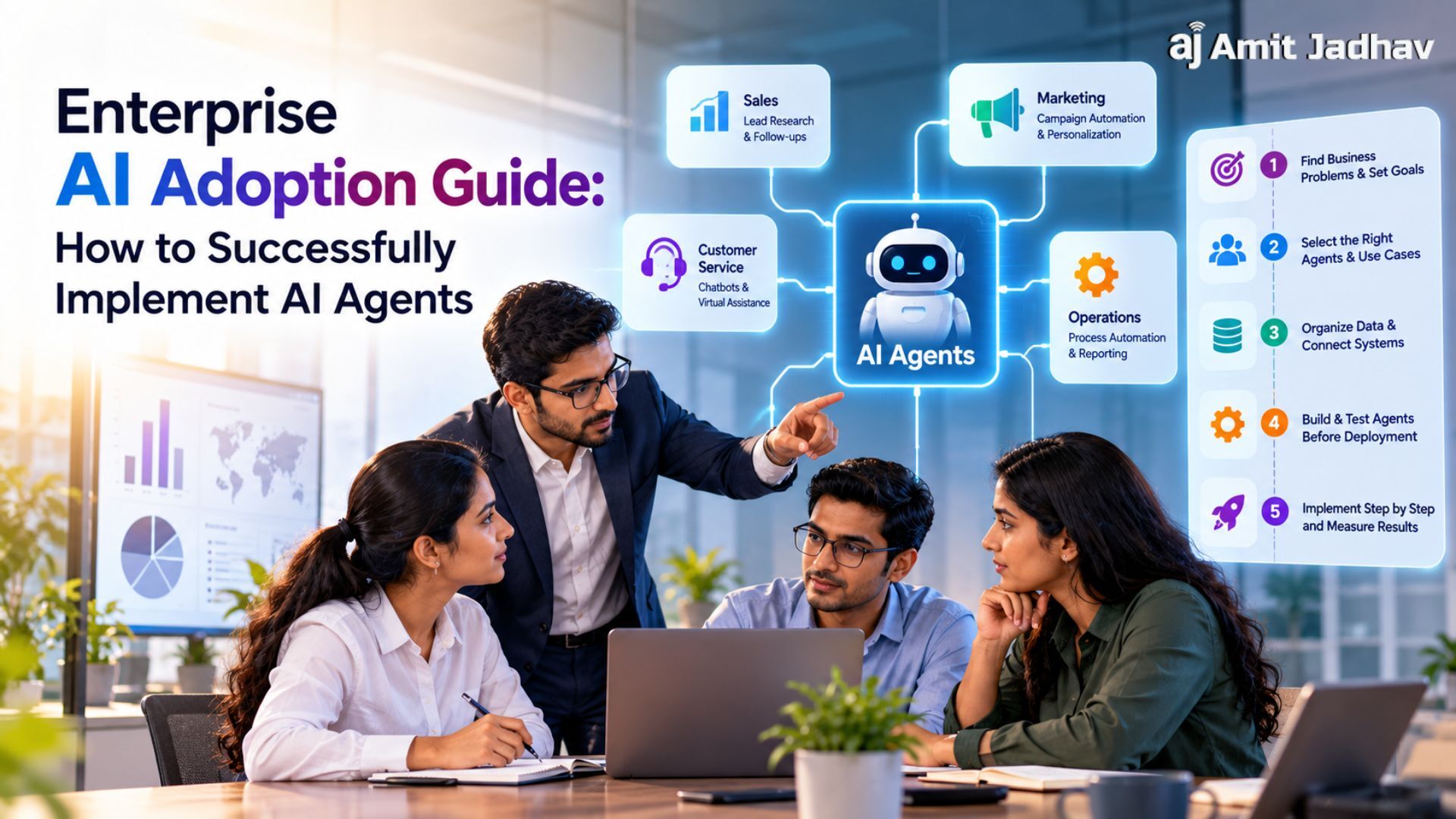
Enterprise AI Adoption Guide: How to Successfully Implement AI Agents
Introduction to Agentic AI
Businesses are using AI for more than creating content or answering questions. Agentic AI gives companies new ways to handle tasks automatically, manage workflows, and reach business goals with less manual work. However, using AI successfully involves more than selecting a tool. Businesses need a clear approach to introduce AI Agents, fit them into existing work processes, and track the results.
This guide explains how enterprises can put AI agents into practice and use them to increase productivity, improve customer engagement, and achieve better business results.
What is Agentic AI in Enterprises?
Agentic AI refers to AI systems that can work toward specific goals, plan the steps involved, use available tools, and perform tasks within set limits. Unlike basic chatbots that mainly answer questions, AI Agents can carry out several steps to complete a task.
For example, an AI agent can collect customer details, review related records, draft a follow-up message, and send it for approval before it reaches the customer.
These features make Enterprise AI useful for businesses looking to go beyond simple automation. However, AI agents still require clear instructions, access to the right information, regular monitoring, and human supervision.
How to Successfully Implement AI Agents in an Enterprise
1. Find Business Problems and Set Clear Goals
The first step is to identify areas where AI can make a real difference. Rather than adopting AI just because it is becoming popular, businesses should focus on tasks that take too much time, require repeated decisions, or cause delays.
For example, a sales team may spend several hours researching potential customers and updating records. Similarly, a marketing team may find it difficult to create suitable campaigns for different customer groups.
Begin by listing these challenges and deciding what the business wants to achieve. Goals may include faster responses, better lead follow-ups, less manual work, or higher customer satisfaction.
Having clear goals makes it easier to choose the right AI Agent Solutions and check whether they are delivering the expected results.
2. Select the Right AI Agents and Use Cases
Not every business task needs an autonomous agent. Traditional automation may be enough for simple, rule-based activities, while other tasks may benefit from AI that can understand information and adjust its actions when situations change.
Before selecting a solution, businesses should consider the complexity of the task, its expected value, possible risks, and the effort needed to set it up.
Here are some common ways businesses can use AI agents:
- Sales: Researching leads, setting follow-up reminders, forecasting sales, and predicting which leads are more likely to convert.
- Marketing: Managing marketing automation, reviewing campaign results, creating content, and delivering hyper-personalization.
- Customer service: Using chatbots, providing virtual assistance, and responding to customer queries.
- Operations: Processing documents, preparing reports, and supporting Business Process Automation.
Starting with one clearly defined use case allows businesses to test AI Automation, review its performance, and make improvements before using it in other departments.
3. Organize Business Data and Connect Existing Systems
AI Agents need accurate and useful information to complete their tasks properly. When business data is outdated, missing, or stored in separate systems, agents may not deliver reliable results.
Before introducing AI, check the available data, remove repeated entries where necessary, and set suitable permissions to control who can access the information.
Businesses should also plan how their AI agents will connect with existing tools, such as Customer Relationship Management (CRM) systems, marketing software, databases, and other internal applications.
For example, a sales agent linked to a CRM system can review a customer's past interactions and suggest more relevant follow-up messages.
Good data management and smooth system connections provide a strong base for Intelligent Automation and AI Powered Workflows.
4. Build and Test Agents Before Deployment
AI Agent Development includes deciding what an agent should do, giving it clear instructions, selecting the tools it can use, setting limits on its actions, and defining the results it should deliver.
Businesses can choose ready-made tools for common tasks or consider Custom AI Solutions when they need features designed for their specific work processes.
Before putting an agent into use, teams should test it in situations similar to those it may face at work. They should check whether it follows instructions, deals with missing information, avoids actions without permission, and sends unusual cases to the right person.
Natural language processing helps agents understand human language. Multimodal AI can also help them work with different types of information, such as text and images, if the chosen system supports these features.
Businesses must also decide when human approval is necessary. Activities such as financial transactions, sensitive customer messages, and other important actions may require additional checks.
5. Introduce AI Agents Step by Step
Introducing AI across the entire company at once can be difficult to manage. A gradual rollout gives businesses more time to test the system and make changes where needed.
Start with a small pilot project involving one team or a specific work process. Gather employee feedback, identify any issues, and improve the system before using it on a larger scale.
For example, a company can first use an agent to draft sales follow-up messages instead of allowing it to contact customers directly. If the process works well, the company can gradually allow the agent to take on more tasks.
For complex business needs, Multi-Agent Systems allow different agents to manage separate tasks. One agent might review customer information, while another prepares a report or suggests the next step.
However, businesses need clear rules for how these agents work together, what each agent can access, and how their actions are monitored. This helps reduce the risk of errors or conflicting actions.
For more detailed information, check out the blog, “AI Adoption in Enterprises: Step-by-Step Strategy That Actually Works!”
6. Track Results and Measure ROI
Businesses should measure the actual results of AI implementation instead of assuming that automation will automatically improve productivity.
Several useful measures can help them evaluate performance:
- Time saved: Check how much less time employees spend on repeated tasks.
- Fewer manual errors: Measure whether mistakes have decreased.
- Sales performance: Track lead response times and conversion rates.
- Customer service: Monitor customer satisfaction and the time taken to resolve issues.
- Marketing results: Review campaign CTR (click-through rate) and customer engagement.
- Return on investment (ROI): Compare the benefits with the total cost of using AI.
For sales teams, AI-driven Sales enablement can help prioritize leads, improve sales processes, and support timely communication with potential customers. Marketing teams can check whether automated campaigns improve CTR and conversion rate optimization.
Compare the results with the performance levels recorded before implementation. When calculating ROI, include setup expenses, maintenance costs, employee training, and ongoing monitoring. This gives businesses a clearer picture of whether their AI investment is delivering real value.
7. Train Employees and Set Clear Rules for AI Use
Adopting AI involves more than introducing new technology. Employees must know how AI agents operate, how to use their suggestions, and when human involvement is needed.
Offer practical training to help employees understand how AI will affect their daily tasks and responsibilities. Encourage them to report incorrect results, share feedback, and suggest ways to improve the system.
Businesses also need clear guidelines for data privacy, security, responsibility, and user access. Decide who can approve changes, check agent activities, and take action when something goes wrong.
AI Consulting can help companies understand their current needs, choose suitable technologies, and create a step-by-step plan for implementation. Following a clear process helps reduce risks and makes it easier to use AI successfully over time.
Common Challenges in Enterprise AI Adoption
Companies may encounter several difficulties when introducing AI, including inaccurate data, problems connecting existing systems, employee concerns, unexpected results, and confusion about who is responsible for an agent's actions.
Businesses can manage these challenges through proper planning, small pilot projects, regular testing, and human supervision.
They should also avoid automating work processes that are already inefficient. Reviewing existing steps and removing unnecessary work before introducing AI can help make AI Process Automation more useful.
As AI technology advances, enterprises may consider additional applications involving Generative AI, predictive analytics, and even augmented reality for specific business needs. However, companies should select technologies based on their actual requirements rather than adopting them simply because they are popular.
Explore our blog post, “Why Most Enterprises Fail at AI Adoption (And How to Fix It)” and face your Enterprise AI adoption challenges!
Conclusion
Agentic AI can help enterprises save time, simplify workflows, and improve customer experiences when it is introduced with clear business goals.
To get the best results, businesses should begin by identifying specific problems, organizing their data, choosing suitable AI Agents, and testing their performance. They should also provide employee training, protect business information, and review agent activities regularly.
With the right plan and proper supervision, AI can become an important part of Enterprise Automation and broader Digital Transformation with AI, helping businesses manage their work more efficiently and respond better to changing needs.
- Amit Jadhav
www.amitjadhav.com