
AI Adoption in Enterprises: Step-by-Step Strategy That Actually Works
Let’s Start
Creating an effective Enterprise AI Adoption Strategy is now a critical business requirement rather than merely a futuristic goal. Leaders are finding that installing smart technologies is the easy part as businesses hurry to use AI. Making those instruments work together to promote long-term, quantifiable improvement is the true difficulty.
You need a tried-and-true method if your company wants to grow beyond basic experimentation. Technical innovation must give way to strategic business alignment in order to achieve success when implementing digital transformation at scale.
Let's dissect the useful, methodical approach for moving your business from AI curiosity to operational proficiency.
The Foundation of an Effective Enterprise AI Adoption Strategy
Many businesses don't evaluate their current infrastructure before implementing the newest generative AI models. This leads to costly technical debt and fragmented workflows. A very effective business AI strategy focuses on creating a long-term competitive advantage rather than following trends.
You must view technology as an extension of your human staff in order to comprehend how to implement AI in enterprise business.
The Step-by-Step Enterprise AI Roadmap
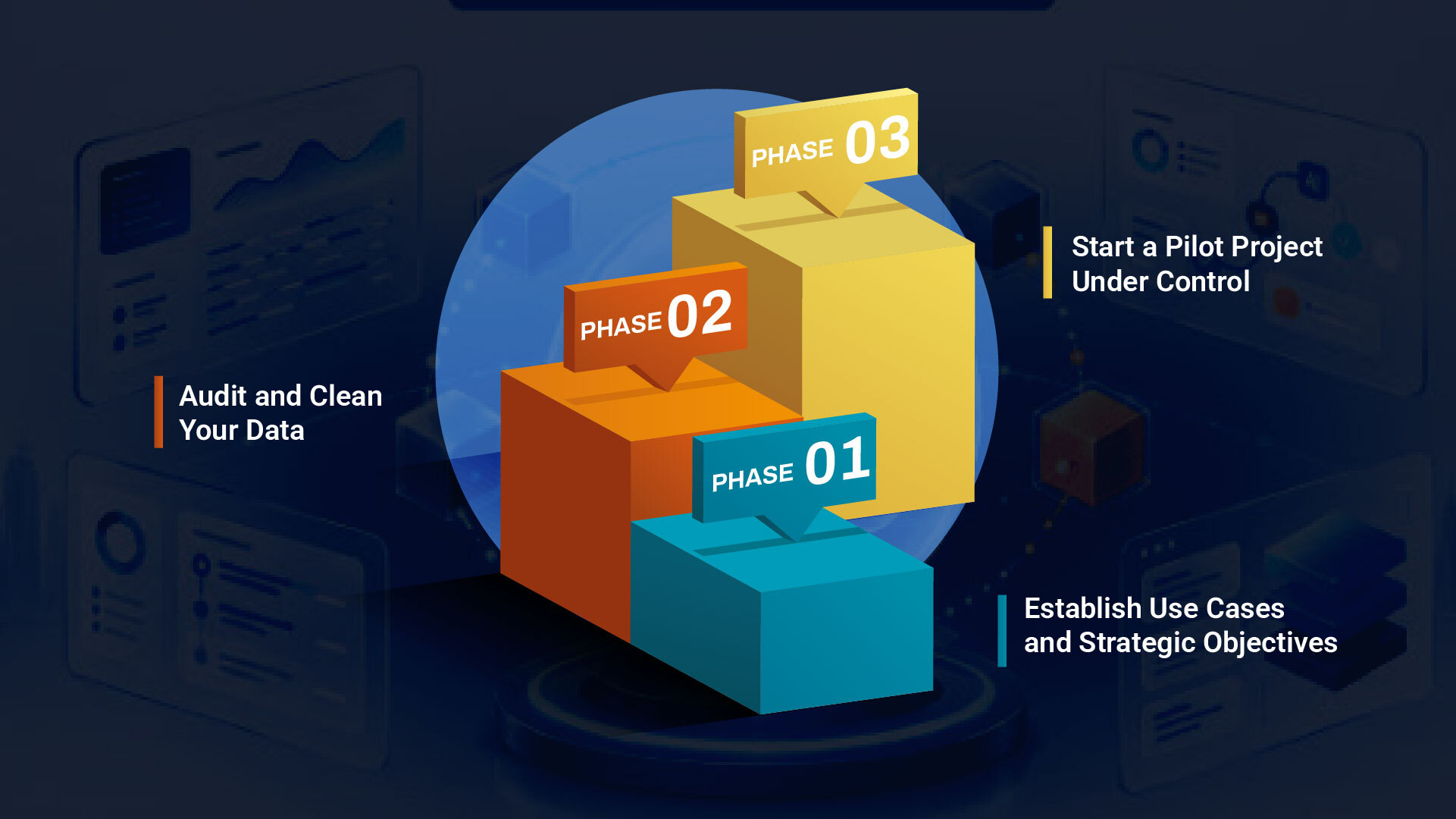
Nearly 70% of digital transformation projects fail to meet their objectives due to a lack of organized scaling strategy, according to a new study. Use this staged enterprise AI transformation roadmap to steer clear of this pitfall:
Phase 1: Establish Use Cases and Strategic Objectives
Finding high-friction business procedures is the first step in any successful AI adoption strategy for enterprises. To assess current workflows, assemble executives from all areas of your company.
Where do delays in decision-making stem from manual data analysis?
Do your teams lack creative strategy because they are mired in regular administration?
Identify certain areas where automation and predictive analytics might address pressing business issues.
Phase 2: Audit and Clean Your Data
Artificial intelligence is entirely dependent on the caliber of the data it receives. Natural language processing models and sophisticated multimodal AI cannot be applied to disjointed, compartmentalized spreadsheets. Early in your enterprise AI implementation strategy, give data cleansing, consolidation, and security procedures top priority.
Phase 3: Start a Pilot Project Under Control
Create a very targeted proof-of-concept rather than attempting a broad company-wide deployment. Your sales and marketing ecosystem is a terrific place to start. This environment generates highly visible results and provides quick, data-rich feedback loops.
Using AI in Sales and Marketing to Boost Your Revenue Engine
Using AI in departments that interact with clients is one of the fastest ways to show value and win team support. By turning passive interest into active clients, it has a direct effect on your bottom line.
1. Optimization of High-Impact Sales
It is often difficult for modern B2B sales teams to determine which prospects are truly worth pursuing. In this case, clever sales enablement tools can be helpful:
- Predictive Lead Scoring: AI models automatically rate prospects based on past interactions, company profiles, and online activity.
- Sales Forecasting: By eliminating uncertainty, predictive algorithms enable executives to make very accurate quarterly sales projections.
Thanks to these tools, salespeople can focus all of their efforts on increasing sales and building human connections.
2. Hyper-Personalization and Marketing Automation
Modern consumers demand customized experiences rather than generic advertisements. You may provide hyper-personalization on a never-before-seen scale by combining content creation engines with marketing automation.
AI-powered systems can dynamically change the copy, graphics, and offers that are shown to various website users by evaluating real-time user activities. Putting this degree of customisation into practice has a direct influence on important performance metrics, like increasing your email's click-through rate (CTR) and lowering cart abandonment rates.
Additionally, using intelligent chatbots and virtual assistance tools guarantees that your company offers 24/7 customer support, increasing conversion rate optimization and client happiness.
Overcoming Obstacles in an Enterprise AI Adoption Strategy
You will run against institutional and cultural barriers even if you have the ideal plan. The capacity to get past these challenges is what sets successful rollouts apart from failed endeavors:
- Overcoming Anxiety in Employees: Present AI as an "assistant," not a substitute. Present technology as a collaborative partner that handles time-consuming administrative duties, allowing human workers to execute incredibly innovative and smart ideas.
- Addressing the Talent Gap: The majority of conventional businesses lack internal AI architects and machine learning experts. Many forward-thinking businesses hire AI consultants for enterprise teams or collaborate with a specialized AI consulting company to upskill their current staff in order to close this gap.
- Considering the Future: Watch what happens in the future. The digital era is being shaped by innovations such as Augmented Reality and ASI & AJI (Artificial Super Intelligence and Artificial Joint Intelligence), which are redefining how businesses move beyond simple task-specific solutions.
Your infrastructure will be able to change in the future if you design a flexible base now.
Monitoring Your ROI and Success
You must link each implementation to specific, quantifiable business results in order to support the resource allocation of your AI transformation strategy:
| Department | AI Use Case | Primary Performance Metrics | Target Business Outcome |
|---|---|---|---|
| Sales | Predictive Lead Scoring | Pipeline Velocity, Win Rate | Faster sales cycles and higher deal value |
| Marketing | Hyper-Personalized Campaigns | CTR (Click-Through Rate), CAC | Lower customer acquisition costs |
| Support | AI Chatbots / Virtual Assistants | First Response Time, CSAT | Better customer satisfaction, 24/7 coverage |
The Reasons Businesses Are Using Enterprise AI Strategy Consulting
Successful commercial AI scaling calls for extremely specific knowledge. Trying to handle complicated vendor selection, data pipeline development, and security compliance all by yourself frequently results in lost time and money.
For this reason, forward-thinking companies spend money on expert enterprise AI strategy consulting. To keep projects on track and within budget, seasoned partners offer firms end-to-end AI implementation services for businesses and focused AI consultancy.
Specialized advice from an AI strategy consultant for business can translate difficult technical concepts into actual market share if you're searching for specially designed AI strategy consulting services to map out your digital growth. You can make sure that your infrastructure is built to scale safely by collaborating with a professional in AI consulting services for business growth.
Have a look at our blog post, “How to Build a Winning Enterprise AI Strategy for Scalable Growth”,! and it will guide you through the process of creating an effective Enterprise AI adoption strategy.
Your Upcoming Strategic Action
Businesses that integrate technology with human capabilities will be more successful in the upcoming decade than those that use the most cutting-edge technology. To gain a distinct competitive advantage, start by analyzing your data, educating your staff, and concentrating on quantifiable business results.
- Amit Jadhav
www.amitjadhav.com