
Why Most Enterprises Fail at AI Adoption (And How to Fix It)
What is the Enterprise AI Adoption Strategy?
Enterprise AI Adoption Strategy is turning into a commercial must rather than a luxury. Strong enterprise AI adoption strategies put businesses in a better position to increase output, make wiser choices, and maintain an advantage over rivals.
However, many businesses are unable to attain the anticipated outcomes in spite of growing investments in AI. Seldom is the technology itself the issue. Businesses frequently lack a well-defined strategy, capable leadership, and a workable implementation strategy.
The good news? With the correct approach, professional advice, and a well-organized plan, these obstacles can be surmounted.
Why Many Businesses Fail to Adopt AI
Business operations have been completely changed by artificial intelligence. Organizations today have access to potent technology that may enhance nearly every business function, from automation and predictive analytics to generative AI.
Industry reports state that inadequate planning, a lack of governance, or ambiguous business goals make it difficult for roughly 70% of AI projects to produce long-term commercial value.
Before determining the business issues they wish to address, many companies invest in AI technologies. As a result, rather than being a business transformation drive, AI turns into just another technology project.
This is the point at which a successful AI adoption strategy for enterprises becomes crucial.
Typical Obstacles to Enterprise AI Adoption
Building effective AI projects starts with an understanding of the challenges in enterprise AI adoption.
1. Lack of Specific Business Goals
Many businesses start utilizing AI because the technology is popular or because their rivals are using it.
AI projects frequently lose focus in the absence of quantifiable business objectives.
Rather than focusing on which AI tool to purchase, leaders should ask:
- Which business procedure requires enhancement?
- Where are we losing money or time?
- Which repetitious chores are automatable?
The first step in any successful corporate AI strategy is to address actual business issues.
2. Low-quality data
The quality of AI systems depends on the data they are fed.
Even the most sophisticated AI models will produce inaccurate insights if business data is inconsistent, out-of-date, or incomplete.
Organizations should make investments in improved data analysis, data governance, and established procedures prior to using AI.
Better AI results are produced with good data.
3. Insufficient Support from Leadership
AI transformation calls for much more than just IT support.
Decision-makers, department heads, and business executives need to actively promote AI initiatives.
Instead of viewing AI as a stand-alone technological initiative, successful companies develop an AI transformation strategy that is in line with broader business objectives.
4. Expecting Quick Results
Some businesses anticipate quick profits from AI.
Adoption of AI is actually an ongoing process.
Companies that start with tiny, quantifiable projects typically have greater long-term success than those who start with large-scale implementations.
How to Develop an Enterprise AI Adoption Strategy?
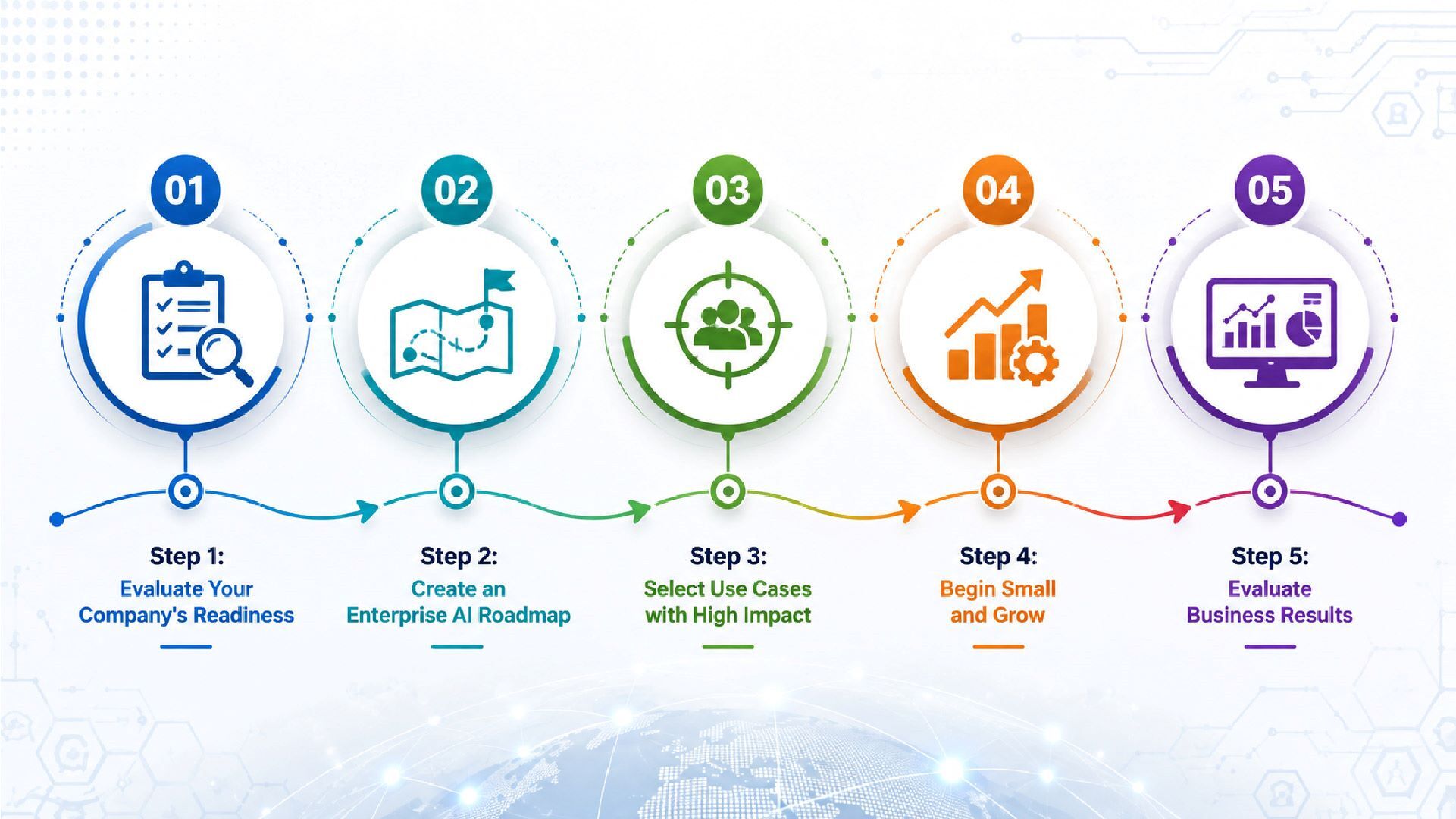
Businesses can minimize risks and maximize AI investments by implementing a systematic enterprise AI adoption strategy.
These are the crucial actions.
Step 1: Evaluate Your Company's Readiness
Examine your company's existing procedures, technology, and personnel preparedness before choosing any AI solution.
Among the questions to ask are:
- Do we have standardized business procedures?
- Is our data trustworthy?
- Which departments stand to gain the most?
The ideal place to start might be found with the assistance of an expert partner who provides AI consulting for enterprises.
Step 2: Create an Enterprise AI Roadmap
A successful enterprise AI roadmap includes the following:
- Business priorities
- AI use cases
- Implementation timeline
- Technology requirements
- Success metrics
Instead of deploying AI throughout the entire company at once, companies should give priority to initiatives that yield immediate results and quantifiable return on investment.
Step 3: Select Use Cases with High Impact
Attempting to automate everything is one of the biggest blunders businesses make.
Instead, start with areas where AI is useful right now.
For instance:
Sales
- Sales Enablement
- Sales forecasting
- Predictive lead scoring
- Sales optimization
Sales teams may find better possibilities, enhance conversion rate optimization, and close deals more quickly with the use of these tools.
Marketing
AI is changing marketing in the following ways:
- Marketing automation
- Hyper-personalization
- AI-powered Chatbots
- Virtual assistance
- Intelligent Content creation
By providing more individualized consumer experiences, these technologies raise CTR (click-through rate), boost customer happiness, and improve customer engagement.
Step 4: Begin Small and Grow
One department or business process is the first focus of a successful enterprise AI implementation strategy.
For instance, a company might automate customer service before implementing AI in operations, finance, or human resources.
This staged strategy lowers implementation risks while fostering organizational confidence.
Step 5: Evaluate Business Results
Business KPIs, not technical measurements, should always be used to gauge the performance of AI.
Among the useful performance indicators are:
- ROI
- Productivity improvements
- Cost reduction
- Faster decision-making
- Customer satisfaction
- Performance metrics
- Revenue growth
Leaders may justify future AI investments by measuring the business benefit.
For more information on creating an enterprise AI adoption strategy, you can have a look at our blog post, “How to Build a Winning Enterprise AI Strategy for Scalable Growth”!
How Businesses Use AI to Grow
Businesses in a variety of sectors are currently figuring out new ways to use AI in their operations.
Typical instances include the following:
- Automation of tedious administrative duties.
- anticipating demand using predictive analytics.
- Natural language processing to enhance customer service.
- Generative AI for knowledge management and documentation.
- Multimodal AI for joint text, image, voice, and video analysis.
- AI and augmented reality for customer interactions, maintenance, and training.
Businesses that build a solid AI foundation now will be better equipped for upcoming advancements as AI technologies continue to advance toward ideas like ASI and AJI.
Why AI Strategy Consulting Matters
AI success cannot be ensured by technology alone.
Businesses want seasoned consultants that are knowledgeable about technology deployment, change management, and company strategy.
Expert AI strategy consulting services assist businesses in:
- Find possibilities for high-value AI.
- Create an AI adoption framework for businesses.
- Create an enterprise AI transformation roadmap.
- Make AI investments a top priority.
- Lower the risks associated with implementation.
- Prepare teams for adoption success.
Expert advice guarantees that AI projects stay in line with corporate objectives, whether you're searching for AI consulting services for business growth or an AI strategy consultant for business.
AI strategy consulting for large companies offers scalable implementation plans, cross-functional alignment, and organized governance.
Partner with Amit Jadhav to succeed in enterprise AI
Many businesses are aware that AI is necessary, but many are unsure of where to start.
Amit Jadhav's enterprise AI consulting services are useful in this situation.
Amit works with business executives to develop useful AI strategies that are specific to their industry, business procedures, and growth goals rather than suggesting generic AI solutions.
His consulting strategy focuses on achieving quantifiable business outcomes, not simply technology acceptance, from creating scalable implementation strategies to creating a how to implement AI in enterprise business roadmap.
Expert consultation may greatly increase your chances of success, whether you are launching your first AI project or want to accelerate your enterprise AI adoption strategy step by step.
Conclusion
AI is transforming business, but successful adoption calls much more than just buying the newest gear.
Organizations may better connect AI activities with business objectives, enhance operational efficiency, boost ROI, and promote sustainable growth with the support of a clearly defined enterprise AI adoption strategy.
Businesses may overcome adoption obstacles and realize AI's full potential with the help of the best AI consulting company for enterprises, a well-organized roadmap, and professional implementation advice.
If your company is prepared to confidently adopt AI, now is the moment to develop a plan that will both prepare your firm for the future and provide quantifiable commercial value today.
- Amit Jadhav
www.amitjadhav.com