
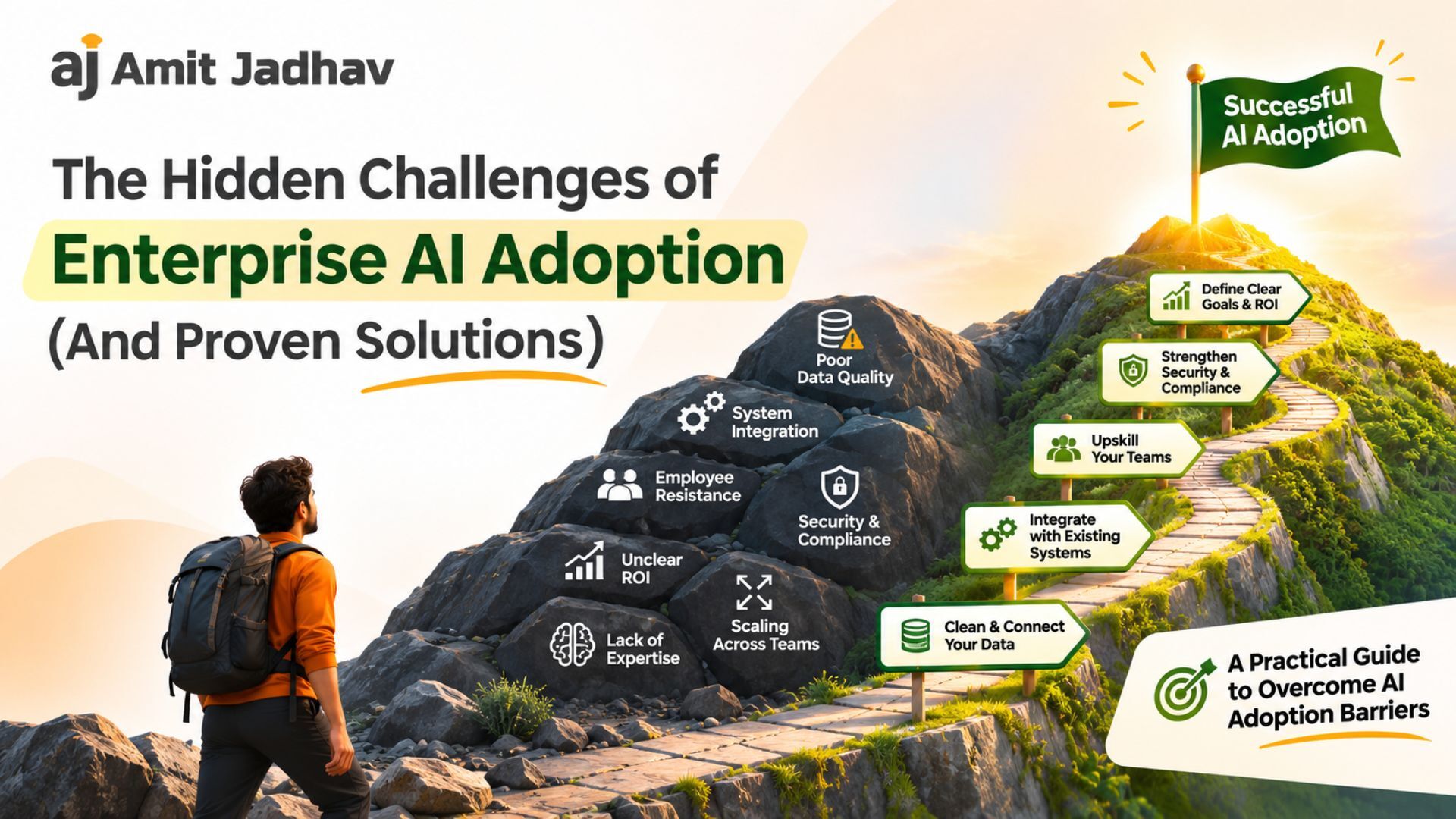
The Hidden Challenges of Enterprise AI Adoption (And Proven Solutions)
Introduction to Enterprise AI Adoption Strategy
Enterprise AI Adoption Strategy is increasingly important for businesses looking to boost productivity, improve decision-making, and remain competitive. However, introducing AI across an organization involves more than purchasing new technology. Without careful planning, even well-intended AI projects may not achieve their goals.
Businesses often encounter obstacles such as unreliable data and employee resistance when adopting AI. Fortunately, a well-planned approach can help overcome these challenges.
Key Barriers to Enterprise AI Adoption and Proven Solutions
Let's examine the key barriers to enterprise AI adoption and the practical ways to address them.
1. Poor Data Quality and Restricted Data Access
AI systems need accurate, reliable data to deliver meaningful results. However, many organizations keep information across separate departments, applications, and databases. Missing records, outdated details, and inconsistent formats can reduce AI accuracy.
For instance, the sales team might track leads in one system while the marketing team maintains customer details elsewhere. If systems are not properly connected, AI may fail to provide useful information for decision-making.
Solution: Assess existing data before introducing AI. Cleaning records, standardising formats, and integrating relevant systems can improve data quality. A well-defined enterprise AI roadmap should also establish data ownership, access controls, and security guidelines.
2. Integrating AI with Existing Systems
Businesses often rely on enterprise applications for finance, sales, marketing, customer support, and daily operations. Integrating AI with these systems can be difficult, especially when older applications lack compatibility with newer technologies.
Poor integration may create disconnected processes and add to employees' workloads instead of reducing them.
Solution: Identify processes where AI can provide immediate benefits. Check whether AI works well with existing systems before introducing it to more departments. Consider infrastructure needs, integration requirements, and future growth.
A well-designed enterprise AI implementation strategy enables businesses to adopt AI while keeping essential operations running smoothly.
3. Employee Resistance and Skills Shortages
Employees may fear that AI will replace their roles or reduce the value of their existing skills. Others may struggle to adapt to unfamiliar tools. Without adequate training, even effective AI solutions may go unused.
Successful adoption depends on helping employees understand how AI works and how it can support their daily responsibilities.
Solution: Engage employees from the beginning and explain how AI can handle repetitive tasks and assist their work. Offer practical training and encourage teams to explore AI applications in their everyday activities.
An effective AI adoption strategy for enterprises should prioritise employee training, leadership involvement, and opportunities to develop relevant skills.
4. Data Security, Privacy, and Compliance Challenges
AI tools often handle sensitive information, including customer records, financial details, business documents, and intellectual property. Using unreliable platforms or failing to manage access properly can put this information at risk.
Generative AI also needs proper supervision, as it may produce incorrect answers or expose confidential information if security measures are inadequate.
Solution: Create clear guidelines for AI usage before implementation. Specify what information employees can share, set appropriate access controls, and review AI providers' security practices. Regular checks and human oversight are equally important.
Businesses in regulated sectors must also ensure their AI systems comply with applicable laws and industry requirements.
5. Uncertain ROI and Lack of Clear Goals
A common mistake is adopting AI without defining how success will be measured. Some businesses invest in advanced technologies to follow industry trends, only to find that these solutions do not address their actual needs.
AI initiatives should deliver measurable business value rather than remain technology experiments without clear objectives.
Solution: Establish specific goals before choosing an AI solution. These might include reducing repetitive work, increasing lead conversions, improving response times, or enhancing customer satisfaction.
Monitor performance metrics such as processing time, conversion rates, error rates, and return on investment (ROI). A well-defined Enterprise AI Adoption Strategy ensures that technology investments support measurable business goals.
6. Challenges in Expanding AI Across Departments
An AI pilot may produce positive results, but implementing the same solution throughout an organization can be more complicated. Departments vary in how they work, the information they need, and the objectives they want to achieve.
For example, a chatbot designed for simple customer queries may require further testing before it can manage complicated support requests.
Solution: Start with a specific pilot, assess its performance, and identify areas for improvement. Once the solution proves effective, introduce it gradually across other departments. Maintain consistent security, governance, and performance standards while accommodating individual team requirements.
This method supports a scalable AI transformation strategy and helps avoid disconnected AI implementations.
7. Lack of Expertise and a Clear Strategy
Some organizations want to adopt AI but lack the expertise to select suitable technologies, oversee implementation, and evaluate results. Without a clear plan, businesses risk investing in solutions that do not support their long-term objectives.
Solution: Create an AI adoption framework for businesses that defines priorities, timelines, responsibilities, and measurable goals. Enterprise AI Strategy Consulting can also help organizations evaluate their readiness, identify suitable opportunities, and plan implementation.
An experienced AI strategy consultant for business can guide leadership teams through technical decisions and align AI initiatives with broader digital transformation plans.
How to Develop an Effective Enterprise AI Roadmap
With a well-defined plan, businesses can turn initial AI experiments into real-world results.
- Define business goals: Identify specific problems that AI can address.
- Evaluate readiness: Assess data quality, infrastructure, existing systems, and employee skills.
- Select appropriate tools: Consider business requirements, security, and integration capabilities.
- Run pilot projects: Test solutions on a smaller scale before expanding.
- Track results: Measure ROI and other relevant performance indicators.
- Refine the approach: Use feedback and performance data to improve AI systems continuously.
Following these steps can minimize implementation risks and help businesses make better investment decisions.
For more information, explore our blog post, “How to Build a Winning Enterprise AI Strategy for Scalable Growth!”
Conclusion: Turn AI Challenges into Business Opportunities
AI offers opportunities to improve productivity, strengthen customer relationships, and support better decision-making. However, success depends on more than adopting new technology. Businesses also need reliable data, trained employees, strong security measures, and clearly defined goals.
A carefully planned Enterprise AI Adoption Strategy helps organizations overcome common barriers while maintaining focus on business priorities.
If your organization is considering AI, begin by identifying the challenges you want to address and the outcomes you hope to achieve. With effective planning, expert support, and continuous improvement, AI can contribute to sustainable business growth.
Visit amitjadhav.com to explore more insights on AI, business growth, and digital transformation.
- Amit Jadhav
www.amitjadhav.com