
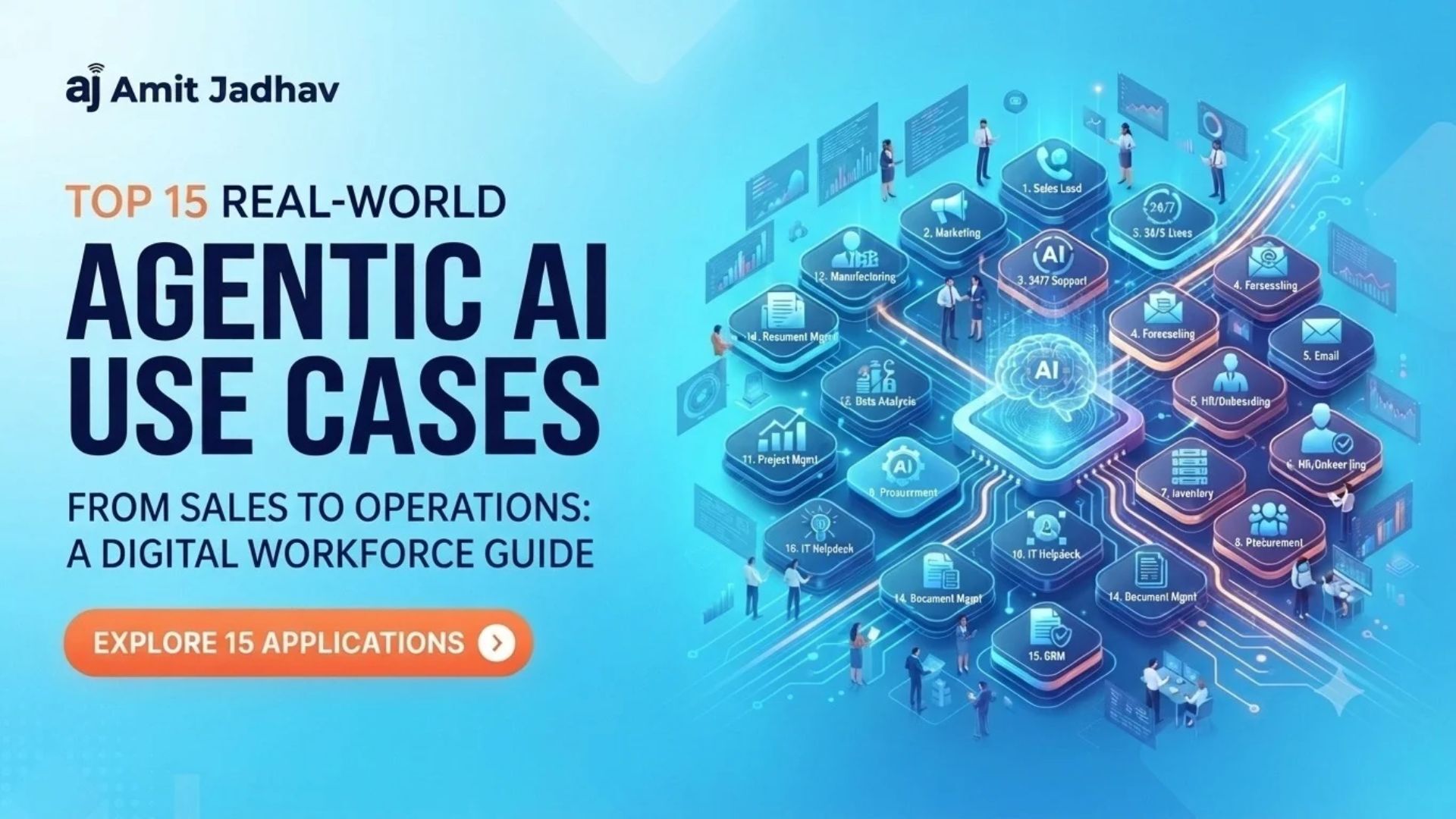
Top 15 Real-World Agentic AI Use Cases Every Business Should Know
Introduction to Agentic AI
Imagine having a digital workforce that can understand business objectives, make decisions, carry out tasks, and interact with other systems with little human involvement. This is the potential of Agentic AI in today's business environment. Rather than only responding to commands, it can take action, handle workflows, and work towards specific business goals.
From sales and marketing to customer support and daily operations, AI Agents are transforming how organizations manage routine activities. Businesses can use them to minimize repetitive tasks, support better decisions, and improve operational efficiency.
To know more about Agentic AI, check out our blog post, “What is Agentic AI? A Complete Guide for Business Owners!”
Let's look at 15 practical applications that demonstrate how this technology can contribute to business growth.
Real-World Agentic AI Use Cases
1. Sales Lead Generation and Qualification
Identifying potential customers and finding the most promising prospects can be time-consuming. AI Agents can assist with lead generation by gathering information from approved sources, studying customer profiles, and finding prospects who fit a business's target audience.
With predictive lead scoring, they can help sales teams rank leads using factors such as customer interest, business needs, and past interactions.
This strengthens sales enablement and helps teams concentrate on prospects with a higher chance of conversion.
2. Personalized Marketing Campaigns
Consumers are more likely to react to communications that align with their interests than to generic advertisements. AI can study customer preferences, browsing patterns, and purchase history to enable hyper-personalized communication.
AI Agents can assist in dividing audiences into segments, creating tailored messages, and managing marketing automation across multiple channels.
Companies can also track performance metrics such as CTR (click-through rate), engagement, and conversions to measure campaign effectiveness and improve ROI.
3. 24/7 Customer Support
Customer questions can come in at any time, including outside regular working hours. AI-powered chatbots and virtual assistants can respond to common queries, share product details, and help customers complete basic tasks.
Advanced systems can understand customer requests, find relevant information, and trigger appropriate actions. If a query needs human support, it can be forwarded to the right team along with the conversation history.
This helps businesses respond faster and improve customer satisfaction.
4. Intelligent Sales Forecasting
Sales forecasting allows companies to estimate future revenue and plan their sales strategies. AI Agents can examine past sales data, active sales pipelines, market developments, and customer behavior.
By using Predictive Analytics and Data Analysis, they can identify trends, detect possible demand changes, and generate useful sales insights.
Sales managers can use this information to revise targets, distribute resources, and make informed decisions.
5. Automated Email and Follow-Up Management
Regular communication with prospects, customers, and business partners is essential. However, keeping track of several email conversations and follow-up schedules can be challenging.
AI Agents can sort incoming emails, identify priority messages, prepare response drafts, and plan follow-ups according to set rules. They can also help sales teams stay connected with prospects throughout different stages of the sales funnel.
For important or sensitive messages, businesses can keep human approval as part of the process.
6. HR and Employee Onboarding
New employees may need guidance with joining procedures, company policies, training plans, and documentation. AI Agents can assist new hires by answering common HR questions, collecting necessary details, guiding them through onboarding steps, and informing the concerned departments about pending tasks. This makes the onboarding process smoother and reduces routine administrative responsibilities.
7. Inventory Management and Reordering
Businesses need to maintain suitable stock levels to prevent shortages and avoid unnecessary inventory. AI systems can track stock records, study consumption patterns, and identify products that may require replenishment. They can also generate reorder requests or notify purchasing teams when inventory reaches a specified limit.
8. Procurement and Supplier Management
Procurement departments manage supplier discussions, quotations, purchase requests, and order updates. AI Agents can help evaluate supplier details, organize quotations, track deliveries, and identify unexpected changes in prices or delivery schedules. They can also start purchase-related workflows while leaving final authorization to the responsible employees.
9. Financial Reporting and Invoice Processing
Finance departments manage many routine tasks, such as reviewing invoices, sorting expenses, sending payment reminders, and creating reports. AI Agents can collect invoice details, compare them with purchase records, spot potential mismatches, and prepare financial reports for checking. This can save manual work and improve accuracy.
10. IT Helpdesk and Technical Support
Employees often approach IT teams with issues related to passwords, software permissions, system errors, and other technical concerns. AI Agents can understand these requests, recommend fixes, generate support tickets, and handle frequently reported problems. Issues that need expert attention can be forwarded to the appropriate technical team along with the necessary information.
11. Project Management and Task Coordination
Keeping track of project deadlines, assigned work, and updates across different teams can be difficult. AI Agents can monitor task status, send alerts, create meeting summaries, and update project management platforms. They can also spot tasks that are falling behind schedule and inform managers, improving team coordination.
12. Business Data Analysis and Reporting
Organizations generate data across sales, marketing, finance, customer support, and operations. AI Agents can collect relevant information, detect patterns, generate reports, and point out unusual changes. Rather than checking several dashboards manually, managers can access meaningful insights to make quicker and more informed decisions through AI Decision Making.
13. Manufacturing and Supply Chain Operations
Manufacturers can use AI Agents to follow production data, check material availability, and coordinate work between departments. These agents can highlight potential delays, provide stock updates, and assist with maintenance planning. With Multi-Agent Systems, specialized agents can work together to manage different activities across production and supply chain processes.
14. Document Management and Compliance Monitoring
Companies work with various documents, including contracts, policies, proposals, and reports. AI Agents can organize files, collect important details, monitor renewal deadlines, and identify missing information. They can also create document summaries to support reviews. However, legal and compliance decisions should continue to involve authorized professionals.
15. Customer Relationship Management and Retention
Building lasting customer relationships requires consistent communication and timely follow-ups. When connected to Customer Relationship Management (CRM) platforms, AI Agents can record customer interactions, identify accounts with limited activity, schedule reminders, and recommend suitable offers. These actions can strengthen customer engagement and support better customer retention.
How Businesses Can Start Using AI Agents
Businesses do not need to automate all their departments immediately. A better starting point is to select one well-defined, repetitive activity where automation can produce measurable improvements.
A practical implementation process includes:
- Identify the challenge: Choose a task that takes up considerable employee time.
- Set the goal: Clearly define the expected outcome from the agent.
- Select suitable technology: Assess relevant AI Agent Solutions and integration needs.
- Establish controls: Set permissions, human approval requirements, and escalation procedures.
- Evaluate performance: Monitor time savings, accuracy, cost reduction, and other performance metrics.
For more complex business needs, organizations can explore custom AI solutions and expert AI Consulting to develop a suitable AI Agent Development plan.
The Role of Multi-Agent Systems in Business Growth
The possibilities extend beyond automating individual activities. Companies can connect specialized agents, each handling a particular responsibility, to build coordinated AI Powered Workflows.
For instance, a sales agent may find a potential customer, a marketing agent may create relevant communication, and a CRM agent may update the customer's records. Working together, these agents can manage connected activities more efficiently.
Such AI-driven systems can also integrate with Natural Language Processing, Multimodal AI, and existing business software. In certain industries, technologies like Augmented Reality can create further opportunities for digital transformation.
Conclusion
The applications of Agentic AI are growing across sales, marketing, finance, HR, customer service, and business operations. By managing repetitive tasks, coordinating processes, and assisting with decisions, AI Agents can help companies increase productivity and focus on their business priorities.
However, successful implementation involves more than selecting an AI tool. Businesses need defined goals, dependable data, proper system integration, and effective human supervision.
Amit Jadhav helps businesses explore practical AI adoption, enterprise automation, and AI strategy. His focus is on finding relevant business applications and turning AI experimentation into meaningful implementation.
Businesses can begin by identifying processes where intelligent automation can deliver real value and gradually move towards a more connected and efficient workplace.
- Amit Jadhav
www.amitjadhav.com