
What is Enterprise AI Adoption Strategy? Complete Beginner Guide!
Getting Started
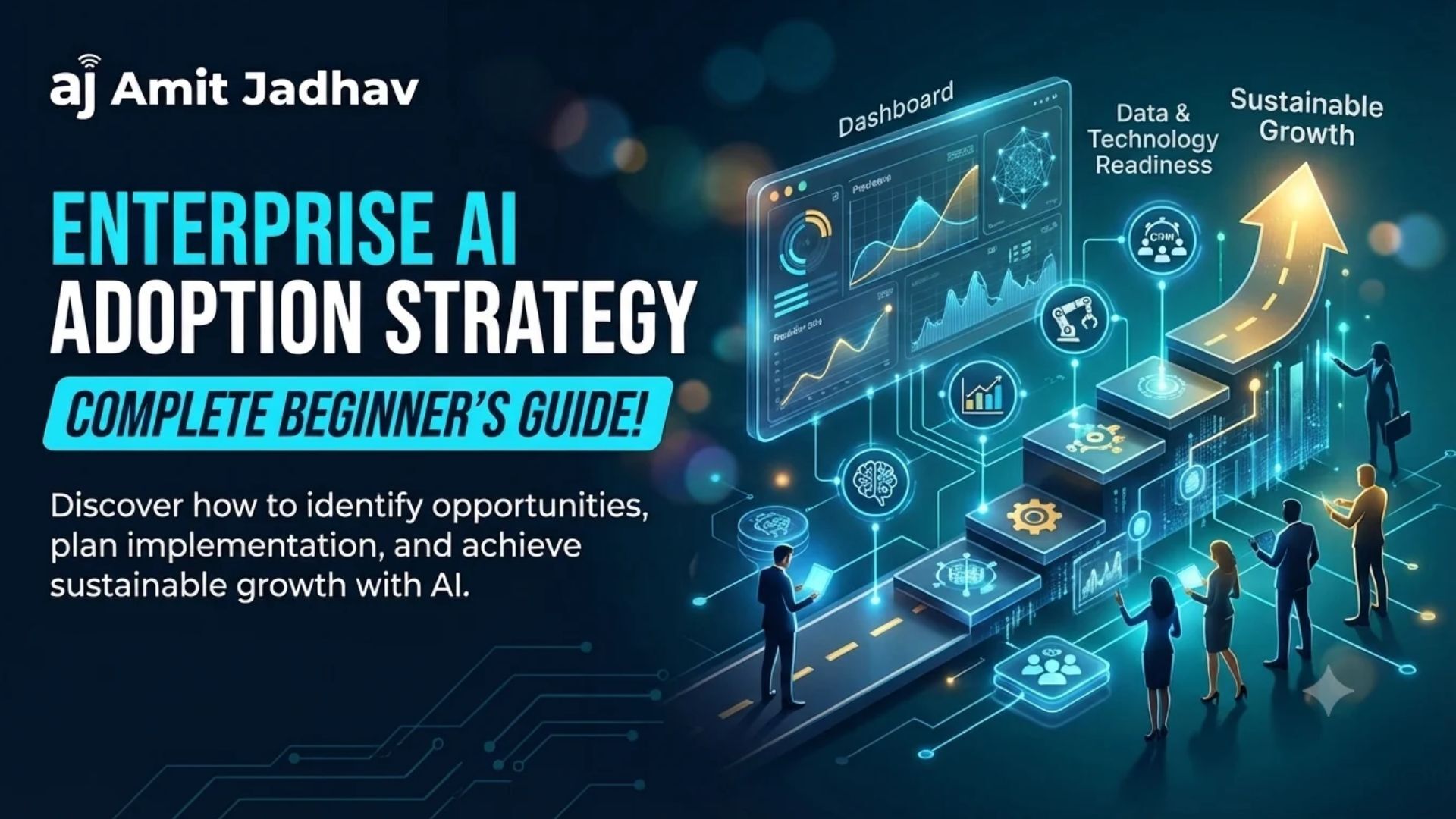
Artificial Intelligence is transforming the way businesses manage operations, make decisions, and interact with customers. However, introducing AI into an organization involves more than just investing in new technologies. A well-defined Enterprise AI Adoption Strategy helps businesses identify valuable AI opportunities, plan implementation, and achieve sustainable growth.
From handling routine activities to enhancing customer interactions and forecasting market trends, AI offers many possibilities for modern enterprises. However, without a clear plan, organizations may find it difficult to achieve the desired outcomes from their AI investments.
In this beginner-friendly guide, let's explore the meaning of an enterprise AI strategy, its importance, and the steps businesses can follow to adopt AI successfully.
What is an Enterprise AI Adoption Strategy?
An Enterprise AI Adoption Strategy is a well-organized approach that guides businesses in introducing and integrating Artificial Intelligence into their operations. It describes business requirements, suitable AI technology, implementation objectives, and anticipated outcomes.
Instead of investing in AI just because it is gaining popularity, organizations should focus on finding areas where the technology can address existing challenges and improve business performance.
For instance, a manufacturing company can use Predictive Analytics to identify potential equipment failures and plan maintenance. Similarly, a retail business can use AI-driven recommendations to understand customer interests and increase sales.
An effective strategy guaranties that AI expenditures complement overarching company objectives. It also covers employee training, data protection, technology infrastructure, and performance tracking.
Why Do Enterprises Need an AI Adoption Strategy?
AI can support different business activities, but implementing it without proper planning may result in unnecessary costs and disappointing outcomes.
A clear AI adoption strategy for enterprises enables organizations to:
- Increase operational efficiency through Automation.
- Minimize repetitive tasks and improve employee productivity.
- Make informed decisions using Data Analysis and Predictive Analytics.
- Strengthen customer engagement through personalized interactions.
- Discover new revenue opportunities and business possibilities.
- Control operational expenses and improve overall performance.
It also encourages better collaboration between departments. When AI solutions are implemented with specific objectives, different teams can make better use of available data and technology.
Additionally, businesses can track ROI and evaluate whether their AI investments are producing the expected business value.
Enterprise AI Adoption Strategy Step by Step
Introducing AI across an organization requires proper planning and a practical roadmap. Businesses should begin with smaller projects, evaluate their performance, and gradually expand their AI capabilities.
Let's look at the important steps involved:
Step 1: Define Business Goals and Identify Challenges
Before investing in AI tools, businesses should clearly understand their objectives. Identify operational difficulties, repetitive processes, and activities that require excessive manual effort.
For example, when sales teams find it difficult to follow up with potential customers, AI-powered CRM solutions can help organize customer details and automate follow-up reminders.
Step 2: Assess Data and Technology Readiness
AI solutions rely on data to deliver meaningful results. Therefore, organizations must examine their existing data sources, software, IT infrastructure, and security systems.
Ensure that business data is accurate, properly organized, and easily accessible. Companies should also check whether their current systems can work smoothly with new AI technologies.
Step 3: Select Suitable AI Solutions
Every AI tool serves a different purpose. Companies should select technologies that align with their needs and long-term goals.
Some commonly used options include:
- Generative AI for creating content, summarizing documents, and supporting business communication.
- Predictive Analytics for estimating sales and identifying upcoming trends.
- Chatbots and Virtual Assistance for managing customer support.
- Natural Language Processing for interpreting customer questions and business documents.
- Multimodal AI for comprehending text, pictures, and audio, among other information types.
The focus should be on selecting technologies that address actual business needs rather than introducing unnecessary complexity.
Step 4: Begin with a Pilot Project
Rather than implementing AI throughout the organization immediately, businesses should first test it through a small project.
For instance, a company can use an AI chatbot to respond to common customer questions or introduce AI-powered Automation to manage invoice processing.
Review the outcomes, understand possible limitations, gather employee feedback, and make necessary changes before expanding the implementation.
Step 5: Train Employees and Build Confidence
Successful AI implementation requires more than technology. Employees should know how to use AI solutions effectively as part of their everyday responsibilities.
Conduct training programs, demonstrate practical applications, and explain how AI can make their work easier. This helps employees feel more comfortable with new technologies and encourages wider adoption.
Step 6: Measure Performance and Make Improvements
After implementing an AI solution, businesses should regularly evaluate its performance. Track important performance metrics such as time savings, cost reductions, accuracy, productivity, ROI, and customer satisfaction.
These measurements help organizations identify successful initiatives, understand existing gaps, and determine where additional improvements are needed.
How Enterprises Use AI to Improve Sales and Marketing
Sales and marketing are two areas where AI can deliver significant benefits. It enables teams to understand customer needs, discover new opportunities, and make informed decisions.
AI in Sales
AI-powered sales enablement tools support sales teams in managing customer data, automating follow-ups, and improving overall performance.
Common applications include:
- Sales forecasting to estimate future revenue and market demand.
- Predictive lead scoring to find prospects with a higher chance of conversion.
- Customer relationship management (CRM) driven by AI to handle client information and expedite follow-ups.
- To find possibilities and boost conversion rates, use sales optimization.
AI in Marketing
AI also enables marketing teams to develop relevant campaigns and build stronger customer connections.
Key applications include:
- Marketing automation to handle routine marketing tasks.
- Hyper-personalization to provide tailored content and recommendations.
- Chatbots to respond to customer queries.
- AI-driven content creation to generate marketing ideas and materials.
- Conversion Rate Optimization (CRO) to analyze customer behavior and improve CTR (click-through rate).
Together, these applications help businesses enhance campaign results, increase customer satisfaction, and improve marketing ROI.
What Challenges Do Businesses Face During Enterprise AI Adoption?
While AI provides many advantages, businesses can encounter several obstacles when integrating it into their existing operations.
Some of the key challenges are:
- Data Quality Issues: Missing, outdated, or inconsistent information can reduce the accuracy of AI results.
- High Initial Investment: Setting up AI infrastructure, purchasing software, integrating systems, and training employees can involve significant costs.
- Data Security and Privacy: Organizations need to safeguard sensitive information and maintain proper data governance practices.
- Employee Resistance: Employees may be reluctant to use AI due to a lack of knowledge or concerns about changes to their roles.
- Integration Challenges: It might be challenging to integrate AI tools with older business systems and current applications.
Identifying and addressing these issues early allows businesses to create a more effective and sustainable AI transformation strategy.
For more information, you can check out our informative blog post, “The Hidden Challenges of Enterprise AI Adoption (And Proven Solutions)!”
How AI Strategy Consulting Supports Business Growth
Implementing AI across different departments requires careful planning and coordination, particularly in large organizations. Enterprise AI Strategy Consulting can help simplify this process.
AI consulting for enterprises enables businesses to identify potential AI use cases, assess their technical needs, and prepare a clear implementation roadmap.
An experienced AI strategy consultant for business can help with:
- Reviewing existing operations and assessing AI readiness.
- Finding relevant AI applications and automation opportunities.
- Creating an AI implementation strategy based on business goals.
- Suggesting appropriate tools and technologies.
- Organizing employee training and change management.
- Setting performance indicators and estimating ROI.
Organizations planning to hire an AI consultant for enterprise projects can also consider AI strategy consulting services and enterprise AI consulting services to guide their transformation journey.
A suitable consulting approach keeps AI adoption connected to business objectives instead of treating it as a standalone technology initiative.
Prepare Your Business for the Future with the Right AI Strategy
AI adoption is no longer restricted to technology companies. Businesses in manufacturing, healthcare, retail, finance, education, and other sectors are using AI-driven solutions to improve operations and customer experiences.
However, successful implementation requires clear objectives, appropriate technology, quality data, skilled employees, and regular performance reviews.
A well-planned Enterprise AI Adoption Strategy enables businesses to move beyond small experiments and make AI part of their daily operations. With proper direction, organizations can increase productivity, build better customer relationships, improve sales and marketing activities, and identify new opportunities for growth.
Businesses do not need to begin with a major investment or replace their entire technology infrastructure. They can start with one business problem, test a suitable AI solution, evaluate the results, and expand its use over time.
The future belongs to businesses that not only adopt AI but also use it with a clear strategy.
- Amit Jadhav
www.amitjadhav.com