

How to Build a Winning Enterprise AI Strategy for Scalable Growth
Let’s Start
Enterprise AI Adoption Strategy is now essential for companies trying to grow effectively and maintain their competitiveness, not just a concept for the future. Organizations may take advantage of new opportunities, enhance decision-making, and promote sustainable growth across departments with the aid of a well-thought-out enterprise AI adoption strategy.
Imagine being able to automate tedious operations, anticipate client wants, and make quicker business choices based on real-time analytics. This is the potential of AI when it is backed by a well-defined plan and implementation schedule.
Why Companies Require an Enterprise AI Adoption Strategy
Globally, industries are changing due to artificial intelligence. Businesses are discovering new ways to apply AI to increase productivity and profitability in everything from marketing and customer service to sales and operations.
However, implementing AI without a well-thought-out plan frequently ends in bad outcomes and squandered investments. A successful AI adoption strategy for enterprises guarantees that AI activities are in line with workforce capabilities, technology infrastructure, and business objectives.
Companies that use AI without strategic planning are less likely to achieve quantifiable commercial outcomes than those that follow a clear AI roadmap, according to a new industry poll.
For more understanding, read our informative blog post, “Enterprise AI Adoption Strategy: A Complete Guide for Business Leaders (2026)”!
Recognizing the Basis of an Enterprise AI Strategy
Knowing where AI can have the biggest impact is the first step in developing a successful business AI strategy.
Prior to making a technology investment, businesses should assess:
- Present-day business difficulties
- Current data availability and quality
- Technology preparedness
- Skills and competencies of employees
- Anticipated business results
A solid enterprise AI implementation strategy that fosters long-term growth and innovation is built upon this assessment.
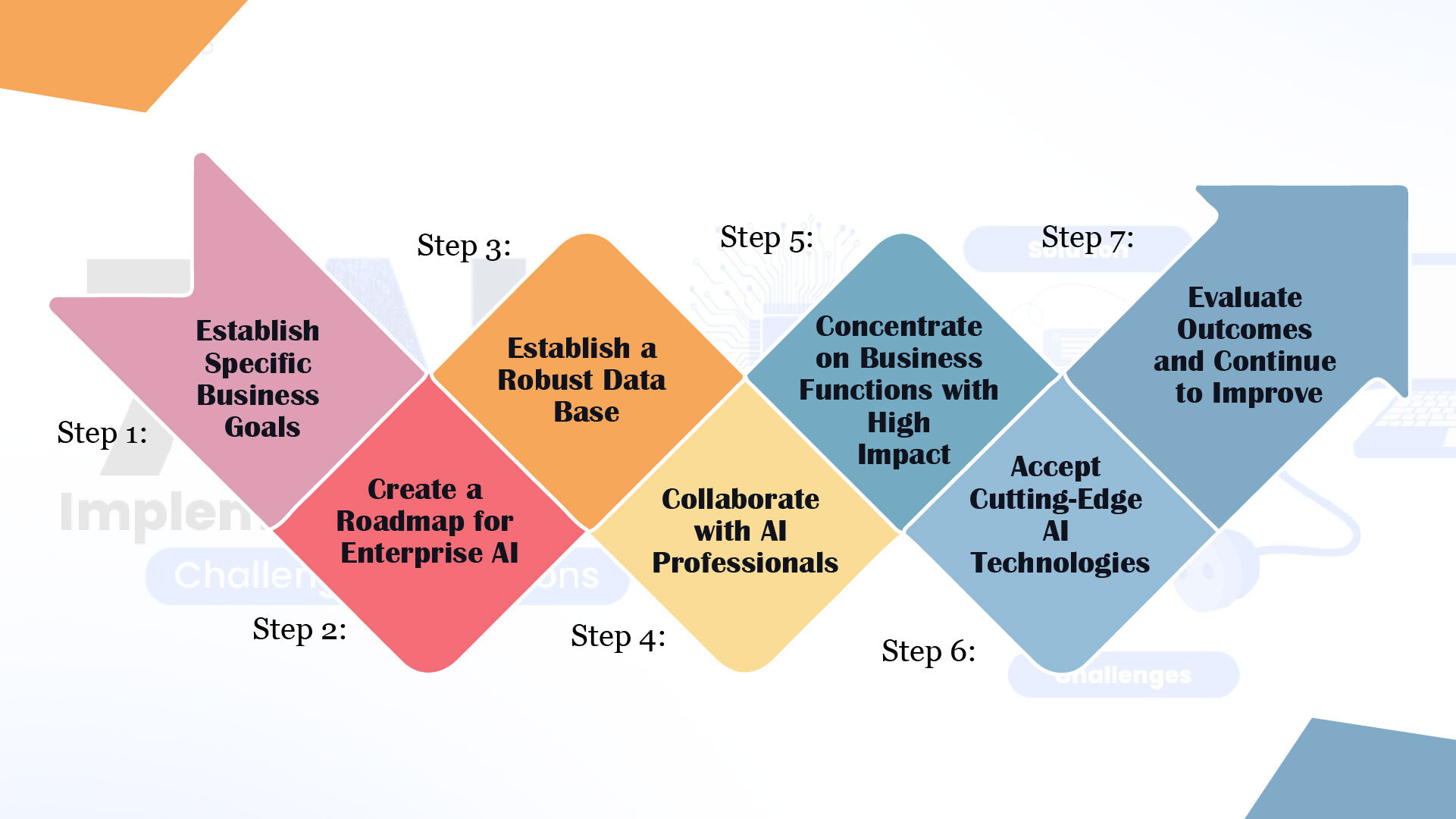
Step 1: Establish Specific Business Goals
Establishing business objectives is the initial stage in any step-by-step enterprise AI adoption strategy.
Instead of adopting AI just because it's popular, businesses should concentrate on finding solutions to particular problems.
For instance, a business would wish to:
- Boost client interaction
- Boost the effectiveness of operations
- Increase the precision of sales forecasting
- Automation can help reduce manual labor
- Boost client satisfaction
Businesses can more effectively monitor ROI and overall effectiveness when AI investments are connected to quantifiable objectives.
Step 2: Create a Roadmap for Enterprise AI
An efficient enterprise AI roadmap guarantees that each AI project contributes to business expansion and offers guidance.
The following should be on the roadmap:
Assessment of the Current State
Examine current data sources, procedures, and systems.
Identification of Opportunities
Determine high-impact areas where AI can produce rapid results.
Pilot Initiatives
Prior to spreading throughout the entire organization, begin with small-scale projects.
Planning for Scalability
Make sure your solutions can expand to meet changing business needs.
During this stage, a lot of companies go for Enterprise AI Strategy Consulting assistance to create practical plans and steer clear of typical implementation issues.
Step 3: Establish a Robust Data Base
Data is necessary for AI systems to produce insights and suggestions.
Even the most sophisticated AI models will find it difficult to provide value in the absence of trustworthy data.
Priorities for organizations should be:
- Enhancement of data quality
- Governance of data
- Compliance and security
- Advanced Capabilities for Data Analysis
Businesses may optimize the advantages of AI-driven decision-making and prediction models by implementing strong data processes.
Step 4: Collaborate with AI Professionals
Developing an internal AI strategy can be difficult, particularly for big companies with intricate procedures.
This is where businesses can benefit from AI consulting for enterprises.
Skilled consultants can assist companies:
- Determine AI prospects
- Create plans for implementation
- Choose the right technology
- Use performance measures to gauge success
To speed up adoption and lower risks, many businesses use specialized enterprise AI consulting services or collaborate with an AI strategy consultant for business.
AI strategy consulting for large companies can offer the knowledge required to match AI investments with more general business goals for enterprises.
Step 5: Concentrate on Business Functions with High Impact
Using AI in divisions that have a direct impact on growth is one of the best strategies to attain early success.
AI in Sales
Sales operations are being transformed by contemporary AI technologies through:
- Lead prediction scoring
- Advanced Forecasting of Sales
- Improved Sales Enablement
- Enhanced Sales Optimization
Sales teams may concentrate on high-value opportunities by using AI to evaluate customer behavior and identify prospects who are most likely to convert.
This frequently results in higher ROI and better conversion rate optimization.
AI in Marketing
AI is being used more and more by marketing teams for:
- Marketing automation
- Hyper-personalization
- Intelligent Chatbots
- Virtual assistance
- AI-powered Content creation
AI-powered marketing initiatives can increase click-through rate (CTR) while providing more individualized consumer experiences.
AI in Customer Service
Businesses are utilizing AI to enhance customer service and engagement.
Businesses may improve customer happiness, comprehend customer intent, and respond more quickly with the use of technologies like natural language processing.
Step 6: Accept Cutting-Edge AI Technologies
Businesses should investigate cutting-edge solutions that facilitate future expansion as AI capabilities continue to develop.
Among the most promising developments are:
Generative AI
Content creation, code generation, documentation automation, and corporate communication support are all possible with generative AI.
Predictive Analytics
Organizations may forecast trends, anticipate consumer behavior, and make proactive decisions with the aid of predictive analytics.
Multimodal AI
To provide more thorough business insights, multimodal AI integrates text, image, audio, and video inputs.
Integration of Augmented Reality
Some businesses are combining AI and augmented reality to improve customer interactions, training, and product visualization.
As companies investigate the potential of intelligent systems in the future, new ideas like ASI and AJI continue to spark interest.
Step 7: Evaluate Outcomes and Continue to Improve
Adoption of AI is a continuous process.
Successful businesses constantly assess results and improve their tactics.
Some examples of key performance indicators are:
- ROI
- Revenue growth
- Cost savings
- Customer satisfaction
- Productivity improvements
- CTR improvements
- Sales conversion rates
Organizations can better understand what is working and where improvements are needed by monitoring these performance measures.
Typical Obstacles to Enterprise AI Adoption
Even though the advantages are substantial, businesses frequently encounter a number of challenges when putting them into practice.
The following are some challenges in enterprise AI adoption:
- Low-quality data
- Opposition to change
- Insufficient knowledge of AI
- Integration challenges
- Uncertain business goals
Organizations can overcome these obstacles and speed up implementation success by collaborating with seasoned AI consulting services for business growth.
How Businesses Use AI to Grow
Businesses in a variety of sectors are using AI to spur expansion by:
- Making better decisions
- Increased interaction with customers
- Automation of processes
- Quicker innovation
- Increased effectiveness of operations
These illustrations show how enterprises use AI for growth while developing scalable and long-lasting business strategies.
Businesses are starting to see AI as a long-term competitive advantage rather than a stand-alone technology investment as part of a larger AI transformation strategy.
In conclusion
It takes more than just introducing new technologies to have an effective enterprise AI adoption strategy. It entails formulating a clear goal, building a solid data base, constructing a workable strategy, and consistently tracking results.
Organizations that implement AI in an organized manner are better positioned for long-term success, whether through internal transformation teams, enterprise AI consulting services, or an expert AI consulting company for enterprises.
Businesses that invest in a well-thought-out Enterprise AI Adoption Strategy now will be better equipped to grow, innovate, and compete in the AI-driven economy of the future as digital transformation quickens.
- Amit Jadhav
www.amitjadhav.com