
The Ultimate Guide to AI Automation for Enterprises (Step-by-Step Strategy)
Introduction to AI Automation For Enterprises
AI automation for enterprises is becoming a business necessity rather than a future idea in today's rapidly changing digital ecosystem. Businesses in a variety of sectors are using AI-driven systems to improve customer engagement, expedite processes, and generate quantifiable return on investment. Businesses are using automation to scale effectively and remain competitive, from intelligent workflow solutions to predictive analytics.
This thorough guide helps you understand how to move from traditional operations to a fully automated, AI-powered ecosystem by outlining a methodical strategy to deploying AI Automation for Enterprises.
AI Automation for Businesses: What is it?
The term "AI Automation for Enterprises" describes how artificial intelligence technologies are incorporated into business processes to streamline workflows, automate repetitive jobs, and facilitate data-driven decision-making. It provides intelligent automation at scale by fusing machine learning, natural language processing, and sophisticated data analysis.
Enterprise AI automation solutions go beyond rule-based systems, in contrast to basic automation. They use real-time data and predictive analytics to continuously learn, adapt, and enhance performance.
AI Automation's Advantages for Businesses
It's important to comprehend the advantages of AI automation for businesses before beginning implementation:
- Increased Productivity: Automating repetitive tasks lowers manual labor and boosts output.
- Improved Decision-Making: Through sophisticated data analysis, AI-driven insights allow for smarter business decisions.
- Cost Reduction: Automation maximizes resource allocation and reduces operating expenses.
- Improved Customer Experience: Virtual help tools and chatbots increase customer engagement and satisfaction.
- Increased ROI: Better performance measurements and streamlined procedures result in higher returns.
Because of these benefits, enterprise AI transformation strategy is a top concern for modern companies.
A Comprehensive Step-by-Step AI Automation Strategy for Businesses
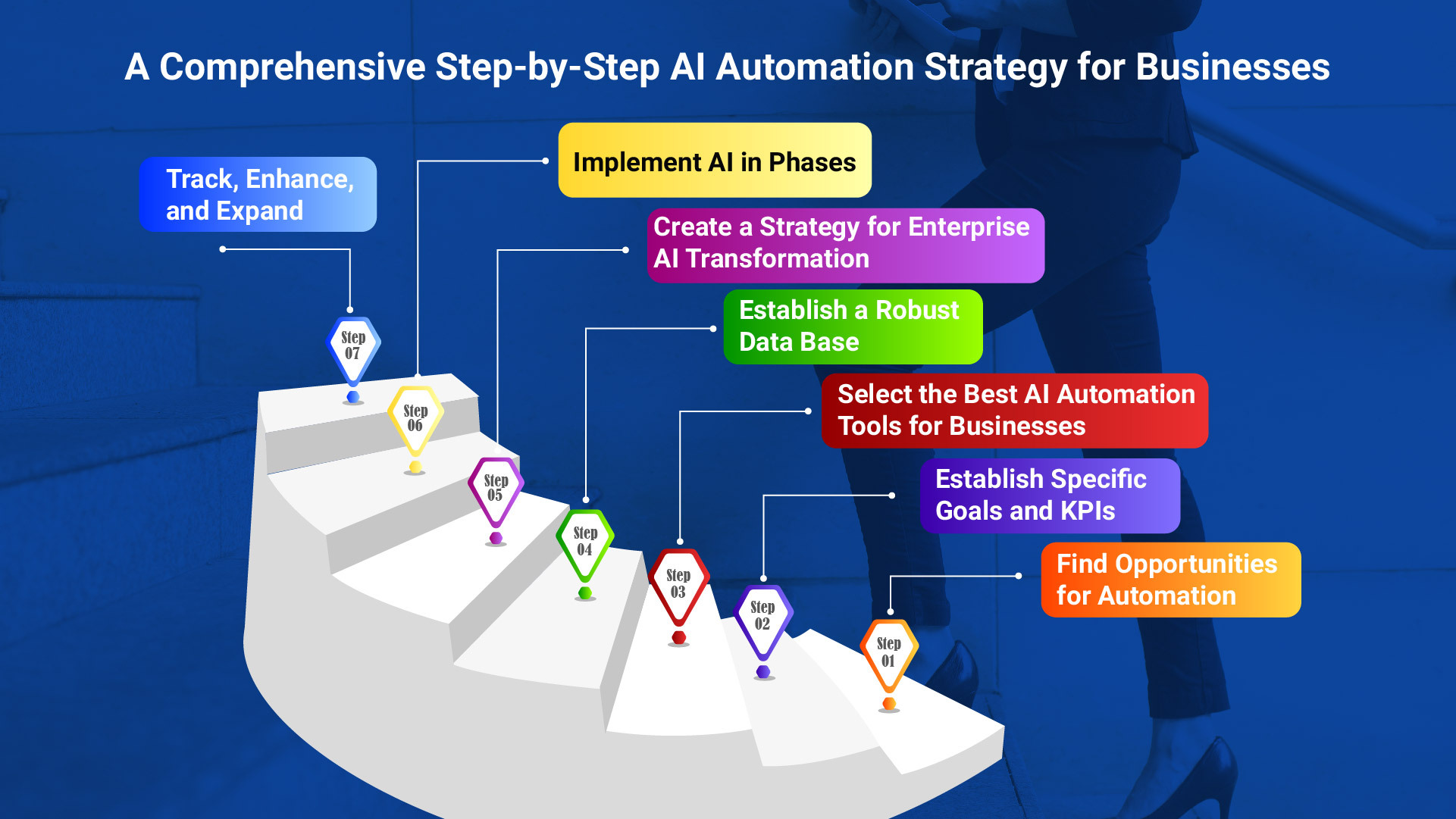
Step 1: Find Opportunities for Automation
Finding procedures that can be automated is the first step in any AI automation strategy for businesses. Pay attention to:
- Repeated tasks
- Workflows that rely heavily on data
- Procedures for customer engagement
- Marketing and sales activities
Chatbots for customer service, predictive lead scoring, and automated reporting systems are typical corporate applications of AI automation.
Step 2: Establish Specific Goals and KPIs
Establish quantifiable objectives that complement your company's goals. Describe important performance indicators like:
- ROI
- Conversion rate optimization
- CTR (click-through rate)
- Customer satisfaction scores
This guarantees that your AI-powered business process automation produces measurable outcomes.
Step 3: Select the Best AI Automation Tools for Businesses
Choosing the appropriate tools is essential for success. The following are well-liked AI automation technologies for businesses:
- CRM systems that use AI to forecast sales
- Tools for hyper-personalization in marketing automation
- Chatbots driven by AI to interact with customers
- Platforms for enterprise process automation
For optimum impact, make sure the tools you select enable natural language processing, multimodal AI, and predictive analytics.
To learn more about AI automation tools, explore our blog post, “The Rise of AI Automation Tools: Revolutionizing Industries”!
Step 4: Establish a Robust Data Base
Data is crucial to AI systems. Make sure your business has:
- Data that is organized and clean
- Systems of integrated data
- Capabilities for processing data in real time
In order to improve automation accuracy and enable AI-driven insights, data analysis is essential.
Step 5: Create a Strategy for Enterprise AI Transformation
Scaling automation projects requires a clear enterprise AI transformation plan. This comprises:
- Aligning AI projects with corporate objectives
- Educating groups on AI technology and techniques
- Developing a phased implementation strategy
In order to speed up digital transformation and maintain their competitiveness in the global market, Indian organizations are progressively implementing business AI solutions.
Step 6: Implement AI in Phases
Take a phased approach rather than a full-scale rollout:
- Pilot project (implemented on a small scale)
- Optimization and testing
- Complete departmental deployment
This strategy lowers risk and guarantees more seamless AI deployment for companies.
Step 7: Track, Enhance, and Expand
Long-term success requires constant observation. Monitor performance indicators and use insights to improve workflows.
Make use of predictive analytics to:
- Boost the ability to sell
- Boost client interaction
- Improve advertising campaigns
Businesses may get the most out of your AI automation offerings by scaling automation across departments.
Examples of AI Automation in Large Companies
AI automation is already being effectively used by numerous international businesses. Here are some instances of AI automation in big businesses:
- AI is used by e-commerce platforms to provide dynamic pricing and tailored product suggestions.
- Predictive analytics is used by banking organizations to automate fraud detection.
- AI-driven automation is used by manufacturing firms for predictive maintenance and quality assurance.
- Marketing teams employ generative AI to optimize campaigns and produce content.
These illustrations show how companies can use AI to automate business processes and attain operational excellence.
Automation of Sales and Marketing with AI
AI is changing marketing and sales roles in businesses.
Sales Automation
- Targeting is improved by predictive lead scoring.
- Planning accuracy is improved by sales forecasting.
- Conversion rates are raised through sales optimization.
Marketing Automation
- The customer experience is enhanced via hyper-personalization
- Chatbots allow for round-the-clock customer service.
- AI-powered content production increases interaction
Businesses may greatly increase overall performance and customer happiness by utilizing AI.
Important Technologies Driving AI Automation
Businesses need to comprehend the fundamental technologies involved in order to properly use workplace AI automation solutions:
- Natural language processing: Chatbots and virtual assistants are made possible by natural language processing (NLP).
- Predictive analytics: Forecasting and decision-making are powered by predictive analytics.
- Generative AI: Streamlines communication and content production
- Multimodal AI: Provides improved insights by combining text, image, and video data.
- Augmented Reality: Improves training procedures and customer experience
These technologies serve as the foundation for contemporary automation systems.
Challenges in AI Automation Implementation
Despite the substantial advantages, businesses may encounter difficulties like:
- Data privacy issues
- Connectivity to legacy systems
- High initial outlay of funds
- Teams' skill gaps
These obstacles can be removed and successful deployment ensured by collaborating with AI automation consulting specialists.
How to Successfully Implement AI Automation in Businesses
In conclusion, the following are some strategies for successfully implementing AI automation in businesses:
- Determine high-impact use cases
- Establish precise objectives and KPIs.
- Select the appropriate AI tools
- Construct a robust data infrastructure
- Create a plan for transformation.
- Execute in stages
- Continue to scale and optimize
Long-term success and sustainable growth are guaranteed by adhering to this methodical strategy.
Why Enterprises Need to Take Action Now
Digital change is happening at a very quick speed. Companies that don't use AI-driven automation run the danger of lagging behind rivals.
As the use of AI in business grows, companies need to concentrate on:
- Increasing the operational efficiency
- Increasing customer engagement
- Using AI to drive innovation
In order to future-proof their operations, forward-thinking companies are already investing in AI automation services.
Final Thought
Businesses' operations, competitiveness, and expansion are being completely transformed by AI Automation for Enterprises. Businesses can achieve unprecedented levels of productivity, creativity, and client pleasure by utilizing corporate AI automation technologies.
In addition to enhancing internal operations, a well-executed AI automation strategy for businesses produces quantifiable business results. AI has endless potential, whether it is used for enterprise workflow automation, marketing automation, or sales optimization.
The time has come to embrace AI-driven transformation and set up your business for long-term success.
- Amit Jadhav
www.amitjadhav.com