
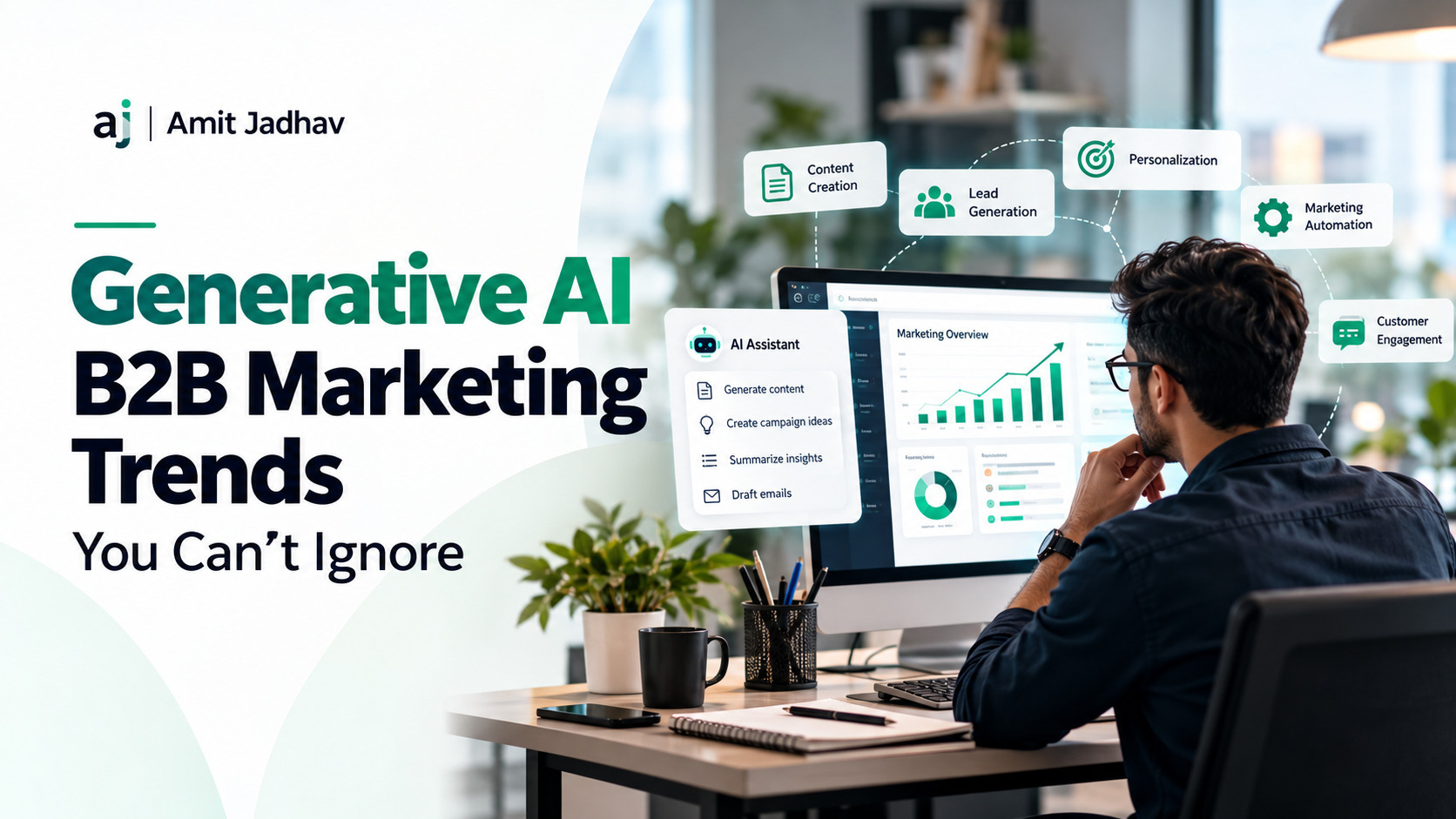
Generative AI B2B Marketing Trends You Can’t Ignore
Getting Started
More than content creation, generative AI for B2B marketing is transforming. It is altering how marketers interact with sales teams, create leads, understand customers, and personalize communications.
However, there's a catch.
Using AI alone is no longer sufficient when practically every company can use it to generate a blog, email, social media post, or campaign idea. Knowing when to use it, when not to use it, and how to integrate it with human thought processes is where the true benefit lies.
These are the trends that companies should be aware of.
To know more about B2B marketing with generative AI, read our comprehensive blog post, “B2B Marketing with Generative AI: A Complete 2026 Playbook!”
Trends That Companies Need to Watch
1. Generative AI B2B Marketing Will Transition from Testing to Regular Use
AI began as an experiment for many businesses. It was used by marketing teams to generate ideas, produce first drafts, or summarize research.
That is rapidly evolving.
86.4% of marketing teams employ AI in at least some marketing operations, according to HubSpot's 2026 State of Marketing study. Common applications include content production, media production, advertising optimization, administrative automation, and strategic planning.
This demonstrates how AI in B2B marketing is permeating regular processes.
Companies are looking at where AI can add the most value across their marketing activities rather than asking, "Should we use AI?".
This change will probably influence b2b marketing trends 2026 with ai and beyond.
2. AI-Powered B2B Marketing Will Become More Individualized
B2B purchasers don't want to be treated like a number on a list.
A pharmaceutical company seeking quality-management solutions can have quite different needs than a manufacturing company seeking ERP software. Sending the identical message to both businesses could not result in the same outcome.
AI-powered b2b marketing can be helpful in this situation.
AI can assist marketers in crafting more pertinent communications by analyzing consumer information, behavior, industry statistics, and prior interactions.
Hyper-personalization in emails, landing sites, ads, and other touchpoints can be supported by this.
93.2% of marketers claim that segmented or personalized experiences have increased leads or sales, according to HubSpot's 2026 study.
Therefore, personalization by name alone is not the next step. It is providing information based on the customer's real demands and stage of the purchasing process.
3. B2B Marketing Automation with AI Can Take Care of Repetitive Tasks
Marketing teams often spend a significant amount of time handling routine activities that do not always require creative thinking.
Managing email schedules, organising leads, creating reports, repurposing existing content, and tracking campaign results can take up valuable working hours.
This is where B2B marketing automation with AI can make a practical difference.
With Marketing automation, businesses can set up processes that automatically respond to customer actions. For instance, when a prospect downloads a report or fills out a form, an automated follow-up email can be triggered. AI can also help analyse engagement and identify prospects who appear more interested and may be ready for a conversation with the sales team.
According to HubSpot's 2026 research, 47.38% of marketers identified leveraging automation as one of the key marketing trends for the year.
However, automation does not mean removing people from the process. The real value lies in using AI to handle repetitive work while marketing professionals spend more time on strategy, creativity, and Customer engagement.
The goal is not to automate every marketing activity. The goal is to automate the right tasks at the right time, while allowing people to focus on what they do best.
4. Generative AI Marketing Strategies Still Need a Human Touch
AI can produce content within seconds. But producing content quickly does not necessarily mean producing content that people will find valuable.
This is becoming an important consideration as more businesses adopt Generative AI for marketing.
When different companies use similar prompts and tools, their blogs, emails, and social media content can begin to sound alike. As a result, original ideas, industry knowledge, authentic experiences, and a recognisable brand voice become even more important.
HubSpot's 2026 research found that 62.7% of marketers believe businesses need more unique, human-centred content as AI-generated content becomes more common.
For this reason, generative AI marketing strategies should not be focused simply on increasing content output.
AI can assist with research, brainstorming, outlines, editing, and content creation. But human marketers still need to bring context, experience, creativity, opinions, and editorial judgement to the final piece.
The future isn’t about choosing between humans and AI - it’s about bringing the two together to achieve better results.
It is about finding the right balance between human expertise and AI capabilities.
5. B2B Lead Generation Using AI Will Become More Focused
Generating a large number of leads may look impressive, but the real challenge is finding prospects who are genuinely relevant to the business.
AI can help marketers analyse customer behaviour, engagement patterns, and available business data to identify potentially valuable prospects. This can support Predictive lead scoring, audience segmentation, customer research, and campaign targeting.
For businesses exploring how to get b2b leads using ai, the opportunity goes beyond sending automated emails to a larger audience.
AI can help marketers answer important questions:
- Which prospects are showing stronger buying signals?
- Which industries are engaging most with our content?
- Which campaigns are producing qualified leads?
These insights can create a stronger connection between marketing and Sales enablement, sales forecasting, and Sales optimization.
The purpose is not simply to fill the sales pipeline with more names.
In other words, AI can help move B2B lead generation from a quantity-focused approach to a more data-driven and quality-focused approach.
6. AI Content Generation for B2B Companies Will Expand Across Channels
A detailed industry report, for example, can be transformed into a blog article, LinkedIn post, email newsletter, presentation, video script, or short social media post.
Businesses get more value with this approach from the content they have already created.
Multimodal AI can further support this approach by helping marketing teams work with different types of content and formats.
According to HubSpot, 35.08% of marketers identified content repurposing as a marketing trend for 2026.
For B2B companies, this approach can help marketing teams make better use of their time and content investments. Instead of starting from scratch for every platform, teams can adapt useful information for different audiences and channels.
However, effective repurposing is not about posting the exact same message everywhere.
A LinkedIn audience may respond to a thought-provoking insight, while an email subscriber may prefer a practical takeaway. Each channel needs content that fits its audience, format, and purpose.
7. AI-Driven Marketing Can Bring Marketing and Sales Closer
Marketing and sales work towards the same business goal, but they do not always work as closely together as they should.
AI can help bridge that gap.
Marketing teams can use AI to identify potential customers, analyse engagement, and understand buying signals. Sales teams can then use these insights to better understand prospects and prepare for more relevant conversations.
AI can support Customer engagement, lead qualification, sales forecasting, and Conversion rate optimization throughout this process.
McKinsey's 2026 B2B research, which included nearly 4,000 buyers and sellers across 13 countries, found that businesses are increasingly experimenting with AI. However, fragmented data and disconnected processes can limit the value organisations get from these technologies.
This highlights an important point: purchasing more AI tools for B2B marketing does not automatically improve marketing or sales performance.
The tools need to work together, share useful information, and fit into the company's existing processes.
When marketing and sales have access to better-connected data, they can work towards a more consistent customer journey.
8. Marketing ROI is Vital Compared To Marketing Volume
AI has made it easier for businesses to create content, send campaigns, and reach audiences at scale.
But producing more does not necessarily mean achieving more.
Publishing more blogs does not automatically generate more leads. Sending more emails does not guarantee more sales. What matters is whether these activities are contributing to meaningful business outcomes.
This is why marketing teams will need to pay closer attention to ROI, CTR (click-through rate), conversion rates, qualified leads, Performance metrics, and Customer satisfaction.
Predictive Analytics and Data Analysis can help marketers identify patterns in campaign performance and understand which activities are delivering results.
As a result, the focus is likely to move from:
"How much marketing content did we create?"
to:
"What did our marketing efforts actually achieve?"
The Future of B2B Marketing Is Not More AI. It Is a Better Use of AI.
AI should not be viewed as a shortcut that eliminates the need for marketing expertise.
Its real value comes from helping people work more effectively.
AI can speed up research. Automation can take care of repetitive tasks. Predictive Analytics can reveal useful patterns in customer data. Generative AI can help marketing teams develop and adapt content faster.
But technology alone cannot tell a business what its customers truly need.
The future of b2b marketing with generative AI will depend on how well companies combine AI capabilities with human understanding, creativity, and business knowledge.
So, before asking how to scale marketing with ai, businesses should first ask:
What are we trying to improve?
Is it lead quality? Customer engagement? Content performance? Conversion rates? Marketing ROI?
When the problem is well defined, it becomes easier to identify where AI can add value.
Used thoughtfully, AI can help businesses work smarter, understand customers more effectively, and turn marketing activity into measurable business value.
The future of B2B marketing is not about creating more content, sending more messages, or using more tools. It is about using technology intelligently to create better customer experiences and make every marketing interaction count.
- Amit Jadhav
www.amitjadhav.com