
B2B Marketing with Generative AI: A Complete 2026 Playbook
Let’s Start
B2B marketing with Generative AI is becoming a commercial need rather than a fad. Businesses that use generative AI for B2B marketing are enhancing marketing performance, producing high-quality leads, and improving customer experiences without appreciably raising expenses.
Over the past few years, there has been a significant shift in how firms market to other businesses. Before making a purchase, buyers anticipate individualized communication, quicker responses, and insightful content. Conventional marketing strategies are no longer sufficient on their own. Here, AI in B2B marketing combines automation, data analysis, and creativity to help businesses operate more intelligently.
By increasing efficiency across industries, generative AI has the potential to boost the world economy by trillions of dollars, according to McKinsey. Sales and marketing are two of the corporate divisions that are anticipated to gain the most. Even while AI is strong, its true benefits come from applying it in conjunction with human experience and a well-defined business strategy.
In this playbook, we'll look at where generative AI is most useful, how firms can use it effectively, and how to create a successful AI-driven marketing plan in 2026.
Why Generative AI is Transforming B2B Marketing
In contrast to conventional automation technologies, generative AI is capable of more than merely repetitive tasks.
Businesses can now use AI-powered B2B marketing to:
- Faster production of superior marketing content
- Adapt communications to the needs of various client segments
- Boost marketing effectiveness with predictive analytics
- Give sales teams more insightful support
- Cut back on manual marketing initiatives
- Boost the total ROI
AI serves as a smart assistant to help teams make quicker and better decisions rather than taking the place of marketers.
To understand it more, check out our blog, “Why B2B Companies Are Investing in Generative AI Marketing”!
Why Conventional B2B Marketing is Inadequate
A lot of businesses still use one-size-fits-all messaging, manual prospect research, and boilerplate email marketing. As competition grows, these strategies frequently lead to:
- Low customer engagement
- Poor CTR (Click-Through Rate)
- Higher customer acquisition costs
- Low conversion rates
- Difficulty measuring campaign performance
If you're wondering why B2B marketing isn't working, the explanation is frequently straightforward: although many companies continue to deliver generic marketing messages, clients demand personalized.
This problem is addressed by generative AI, which enables large-scale hyper-personalization.
Step-by-Step AI-Powered B2B Marketing
Instead of choosing AI tools first, an effective B2B marketing automation with AI approach starts with knowing your marketing objectives.
Step 1: Recognize Your Audience
Understanding customers is the first step in any successful marketing.
AI is capable of analyzing:
- Customer behavior
- Website interactions
- Previous purchases
- CRM data
- Industry trends
By utilizing natural language processing and predictive analytics, marketers may ascertain what potential customers are looking for and create more pertinent advertising.
Step 2: Produce Better Content More Quickly
Content creation is one of the most challenging responsibilities for marketing companies.
Generative AI can help with:
- Blog writing
- Email campaigns
- Landing page content
- Social media posts
- Product descriptions
- Ad copy
- Sales presentations
This does not imply that content produced by AI should be published without review. For accuracy, brand voice, and trustworthiness, human editing is still crucial.
When a manufacturing company introduces a new automation solution, for instance, it may swiftly create many iterations of an email campaign for several industries, like automotive, pharmaceutical, and aerospace, while the marketing team polishes the final wording.
Without compromising quality, this method greatly enhances AI content generation for B2B companies.
Step 3: Boost Lead Generation for B2B
One of the most difficult marketing tasks has always been locating qualified business leads.
In order to find prospects who are more likely to convert, B2B lead generation utilizing AI now incorporates customer data, website behavior, CRM information, and predictive lead scoring.
Marketers can benefit from AI:
- Determine high-value prospects
- Score leads on their own
- Recommend follow-up actions
- Personalize outreach
- Prioritize sales opportunities
Sales teams can concentrate on prospects who are more likely to make a purchase rather than reaching out to hundreds of cold leads.
This is one of the reasons why many businesses now spend money on B2B lead generation services with AI to increase productivity.
Step 4: Marketing Campaign Automation
Marketing automation is a significant benefit of AI.
Businesses can now automate B2B marketing with AI by handling several tasks from a single process, such as:
- Email nurturing
- Customer segmentation
- Campaign scheduling
- Chatbots
- Virtual assistance
- Lead nurturing
- Follow-up reminders
Automation ensures that prospects receive timely and pertinent communications throughout their purchasing journey while reducing repetitive work.
How AI Increases ROI in Marketing
Better ROI is a goal shared by all marketing teams.
By continuously assessing campaign success and making recommendations for enhancements based on performance metrics, AI facilitates conversion rate optimization.
Among the quantifiable advantages are:
- Increased open rates of emails
- Increased CTR
- Enhanced interaction with customers
- Increased client satisfaction
- Reduced expenses for marketing
- Quicker campaign implementation
Marketers can use real-time data analysis to make decisions instead of depending on conjecture.
For instance, AI can automatically suggest utilizing similar language in subsequent advertisements if one email subject line consistently outperforms another.
Best AI Tools for Business-to-Business Marketing
Just as crucial as having the correct plan is selecting the appropriate technology. These days, businesses may boost sales and marketing productivity with the help of several AI tools for B2B marketing.
Among the well-liked categories are:
- AI content creation tools
- CRM platforms with AI capabilities
- Marketing automation software
- Predictive analytics platforms
- Chatbots and virtual assistance solutions
- Sales enablement tools
- Predictive lead scoring platforms
The best AI tools for B2B lead generation aren't just the most feature-rich ones; they're also the ones that work well with your current systems and address actual business issues.
Build an AI-Driven Marketing Strategy for Long-Term Growth
Success cannot be ensured by technology alone. Companies must have a well-defined AI-driven marketing plan that supports their overarching company goals.
A practical strategy should consist of:
- Clearly defined marketing objectives
- Superior client information
- Clearly defined success metrics
- AI governance that is responsible
- AI-generated content is reviewed by humans
- Constant optimization of campaigns
Instead than replacing marketers, consider AI as a business accelerator. Successful B2B marketing still depends on human ingenuity, industry understanding, and relationship-building.
AI-Powered Emerging B2B Marketing Trends in 2026
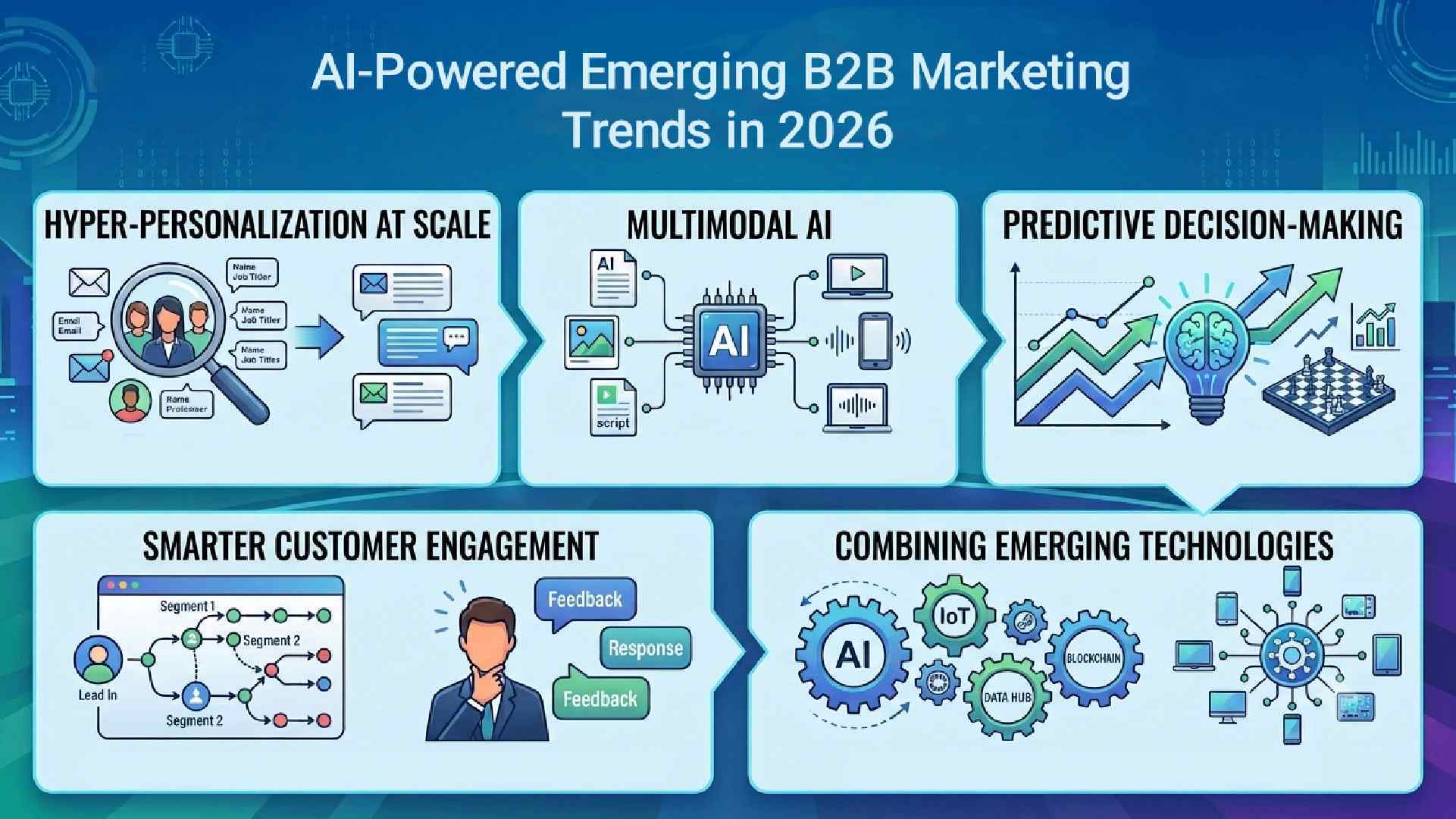
AI's role in business is changing quickly. Businesses will see more sophisticated marketing possibilities as AI technology evolves.
Key B2B marketing trends 2026 with AI include:
Hyper-Personalization at Scale
AI will produce tailored content for each decision-maker based on their interests, industry, and purchasing stage rather than developing a single campaign for thousands of consumers.
Multimodal AI
Future AI systems will use text, pictures, audio, and video to provide more comprehensive marketing experiences from a single query.
Predictive Decision-Making
Before marketers even ask, AI will increasingly use data analysis and predictive analytics to suggest the best course of action for marketing or sales.
Smarter Customer Engagement
AI-driven chatbots and virtual assistants will become more conversational, assisting companies with round-the-clock meeting scheduling, lead qualification, and customer service.
Combining Emerging Technologies
AI will collaborate with technologies like augmented reality to produce more engaging product demos and virtual customer experiences as digital transformation advances.
Common Mistakes Businesses Should Avoid
Even though AI has a lot of potential, many businesses don't get the desired outcomes since they only pay attention to the technology.
Here are some typical errors:
- AI use without a well-defined marketing strategy
- Relying solely on content produced by AI without human review
- Disregarding CRM accuracy and data quality
- Measuring content production alone rather than business results
- Ignoring long-term partnerships and consumer satisfaction
Successful businesses are aware that AI enhances human interaction rather than taking the role of strategic thought.
A Basic Illustration
Consider a software company that focuses on manufacturing companies.
Without AI, prospect research, email writing, blog post creation, and lead follow-up are all done by hand by the marketing staff. The process often takes weeks, and the results are not always consistent.
The group can use generative AI to:
- Create customized emails for various sectors
- Create content faster for blogs and social media
- Leads are graded based on their propensity to purchase
- Automate campaigns for follow-up
- Before meetings, give the sales staff customer insights
Faster execution, better client engagement, better sales optimization, and more time for teams to concentrate on high-value discussions are the outcomes.
AI-Ready Companies Will Rule the Future
These days, generative AI is more than simply a fad in marketing. It is turning into a competitive advantage for companies looking to expand effectively.
Success depends on integrating AI with a solid business plan, high-quality data, and human skills, whether your objective is how to get B2B leads using AI, how to scale marketing with AI, reduce marketing cost using AI, or improve marketing ROI with automation.
Businesses will be in a better position to draw clients, increase conversion rates, and maintain an advantage over rivals in 2026 and beyond if they begin testing now, keep learning, and develop ethical AI policies.
Final Thought
B2B marketing with Generative AI is transforming how companies draw in, interact with, and win over clients. AI helps marketing and sales teams produce better outcomes more quickly, from intelligent content generation and marketing automation to personalized customer engagement and predictive lead scoring.
Nonetheless, companies who see AI as a strategic business competency rather than just another software tool are the most successful. Businesses can increase ROI, foster sustainable growth, and strengthen customer connections by fusing AI-driven insights with human creativity and domain expertise.
Now is the ideal moment to invest in the appropriate plan, the appropriate expertise, and the appropriate execution method as AI continues to develop. Companies who carefully use AI now will be at the forefront of their respective sectors tomorrow.
- Amit Jadhav
www.amitjadhav.com