
Enterprise AI Adoption Strategy: A Complete Guide for Business Leaders (2026)
Introduction to Enterprise AI Adoption Strategy
In 2026, companies want to know how quickly they can implement AI correctly rather than if they should. Nowadays, a key component of contemporary digital transformation is an efficient enterprise AI adoption strategy. Businesses that do nothing run the danger of lagging behind rivals that are already using data analysis, predictive analytics, and AI-driven automation to boost productivity and customer satisfaction.
AI is changing how businesses function, from hyper-personalization in marketing to sales optimization. However, investments can soon become costly trials if businesses don't have a planned AI adoption strategy for enterprises. Everything corporate executives need to know to create a profitable, scalable, and future-ready strategy is broken down in this guide.
An Enterprise AI Adoption Strategy: What is it?
An organized plan that describes how an organization incorporates AI technology into its operations, procedures, and decision-making systems is called an enterprise AI adoption strategy. It guarantees quantifiable ROI and long-term growth by coordinating AI projects with corporate objectives.
A solid business AI strategy concentrates on long-term effect, encompassing everything from infrastructure and personnel to governance and performance measures, in contrast to standalone AI projects.
Why Businesses Will Require an AI Transformation Strategy by 2026
Adoption of AI is growing worldwide. More than 70% of businesses currently use AI in some capacity, according to recent industry studies. However, only a fraction achieve significant ROI due to lack of a clear enterprise AI implementation strategy.
Here's why having a clear strategy is important:
- Better decision-making: Faster and more precise insights are made possible by AI-driven data analysis
- Operational efficiency: Automation minimizes errors and manual labor.
- Revenue growth: Predictive lead scoring and AI-powered sales forecasting increase conversions
- Customer experience: Virtual help and chatbots increase participation and pleasure
A successful AI transformation strategy guarantees that these advantages are achieved methodically as opposed to haphazardly.
Step-by-Step Enterprise AI Adoption Strategy
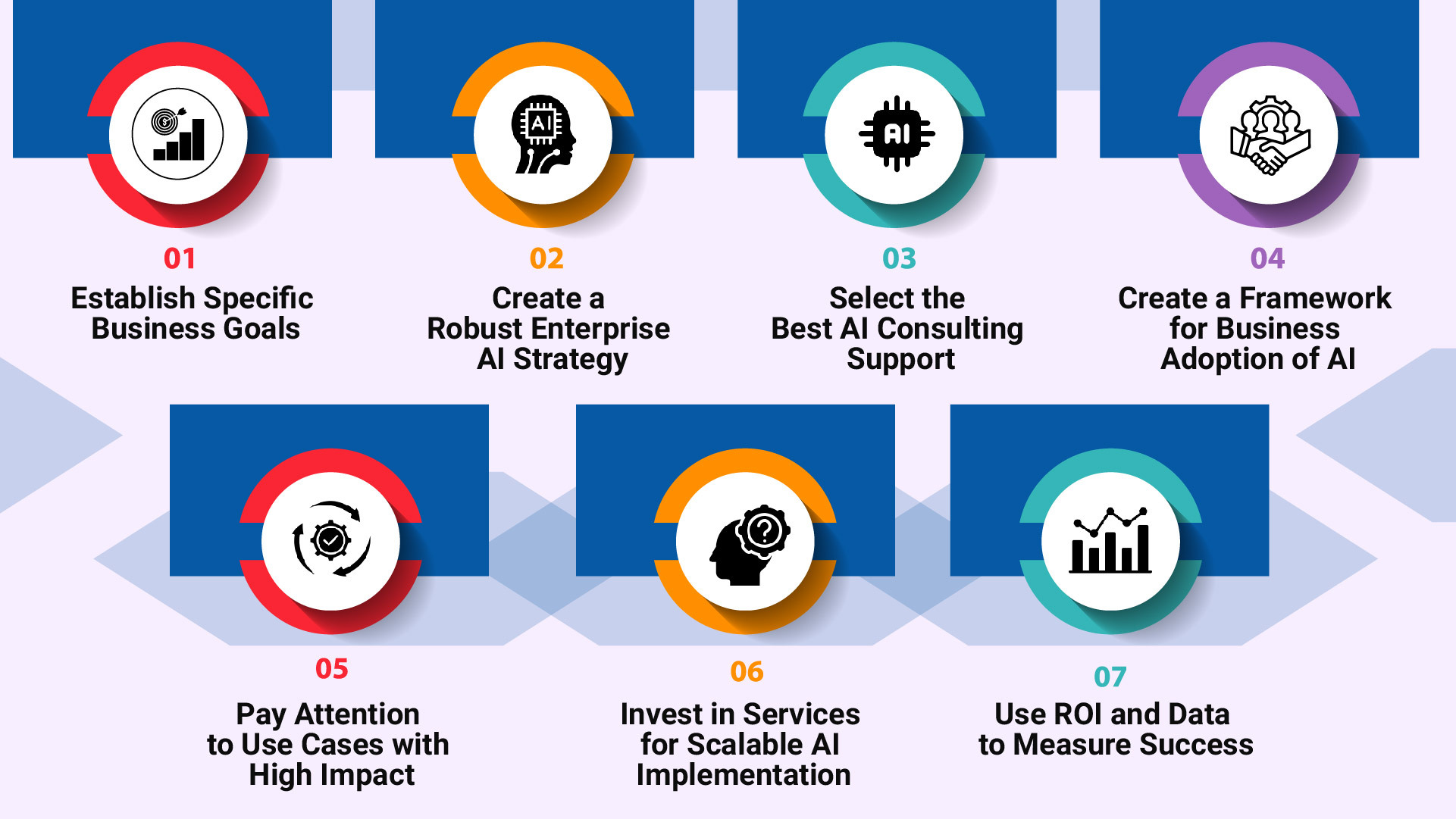
1. Establish Specific Business Goals
Determine the areas where AI can be most beneficial first. Inquire:
- Do you wish to increase client interaction?
- Do you want to optimize your conversion rate more effectively?
- Do you require improved sales support?
For instance, a B2B company would concentrate on predictive analytics for sales forecasting, whereas a retail company might use generative AI for content generation and marketing automation.
2. Create a Robust Enterprise AI Strategy
Your blueprint is an enterprise AI roadmap that is well stated. It ought to consist of:
- Short-term gains (such as customer service chatbots)
- Mid-term objectives (predictive lead scoring systems, for example)
- Long-term change (such as departmental integration of multimodal AI)
This methodical strategy guarantees quantifiable success while lowering risk.
3. Select the Best AI Consulting Support
AI consulting for enterprises is essential because many organizations lack internal knowledge. Collaborating with an AI strategy consultant for business facilitates:
- Finding use cases with a high impact
- Creating designs that are scalable
- Maintaining Governance and Compliance
Expert advice can greatly speed up success, whether you collaborate with an AI consulting company for enterprises or hire an AI consultant for enterprise purposes.
4. Create a Framework for Business Adoption of AI
Consistency and scalability are guaranteed by a strong foundation for AI adoption framework for businesses. It ought to include:
- Data quality and preparedness
- Selection of technology stacks
- Integration with current systems
- AI ethics and governance regulations
For instance, clean, organized data and appropriate training models are needed to execute natural language processing for consumer inquiries.
5. Pay Attention to Use Cases with High Impact
Prioritize use cases with a clear return on investment rather than attempting everything at once.
Regarding Sales:
- Using predictive lead scoring to find high-value prospects
- Forecasting sales to increase pipeline precision
- Optimizing sales with AI-driven insights
Revenue and performance metrics can both be directly improved by these applications.
Regarding marketing:
- Extreme customization for focused advertising
- Automation of marketing to improve workflows
- Chatbots for instantaneous consumer communication
Businesses that use AI in marketing frequently report increased customer satisfaction and CTR (click-through rate).
6. Invest in Services for Scalable AI Implementation
Many strategies fail during execution. Trustworthy AI implementation services for businesses guarantee:
- Smooth implementation
- Integration of systems
- Constant observation and improvement
By bridging the gap between strategy and execution, enterprise AI consulting services provide value in this situation.
7. Use ROI and Data to Measure Success
Monitoring performance is crucial. Important metrics consist of:
- ROI from AI projects
- Enhancements in conversion rate optimization
- Scores for customer satisfaction
- Increases in operational efficiency
For instance, a business using AI-driven customer engagement solutions can see a 20-30% increase in customer satisfaction and response times.
How Businesses Use AI to Grow
Businesses in a variety of sectors are using AI creatively:
- Retail: Predictive analytics-based personalized suggestions
- Finance: Using sophisticated data analysis to identify fraud
- Healthcare: AI-powered automation and diagnosis
- Manufacturing: Process optimization and predictive maintenance
Immersion customer experiences and more intelligent processes are made possible by emerging technologies like multimodal AI and augmented reality.
Obstacles in the Adoption of Enterprise AI
Adoption of AI has drawbacks despite its advantages:
- Data silos: Inadequate data integration reduces the efficacy of AI
- Gaps in skills: Absence of qualified experts
- High starting expenses: Costs associated with infrastructure and implementation
- Resistance to change: Organizational culture barriers
A mix of leadership dedication, training, and the appropriate AI strategy consulting services are needed to address these issues.
Advantages of AI Implementation in Businesses
When done properly, the advantages are significant:
- AI-driven insights for quicker decision-making
- Enhanced productivity through automation
- Improved client interaction with chatbots and online help
- Improved marketing results with hyper-personalization
- Increased market competitiveness
In the end, a well-thought-out enterprise AI adoption strategy turns AI from a technology into a fundamental business capability.
The Function of Generative AI and New Trends
Enterprise operations are being transformed by generative AI, particularly in the areas of customer engagement, product design, and content production. It allows for more intelligent automation and human-like communication when combined with natural language processing.
Future developments include multimodal AI systems, ASI & AGI talks, and AI-driven digital transformation. The next wave of innovation will be led by companies that continue to take the initiative.
Concluding Remarks
Adopting AI is now a strategic must rather than an option. Organizations may move past experimentation and achieve genuine commercial impact with the help of a well-defined and organized Enterprise AI Adoption Strategy.
Business executives may fully utilize AI by developing a solid enterprise AI strategy, utilizing professional AI consulting for enterprises, and concentrating on quantifiable results.
The secret is straightforward: start small, scale wisely, and maintain alignment with your company's objectives.
- Amit Jadhav
www.amitjadhav.com