
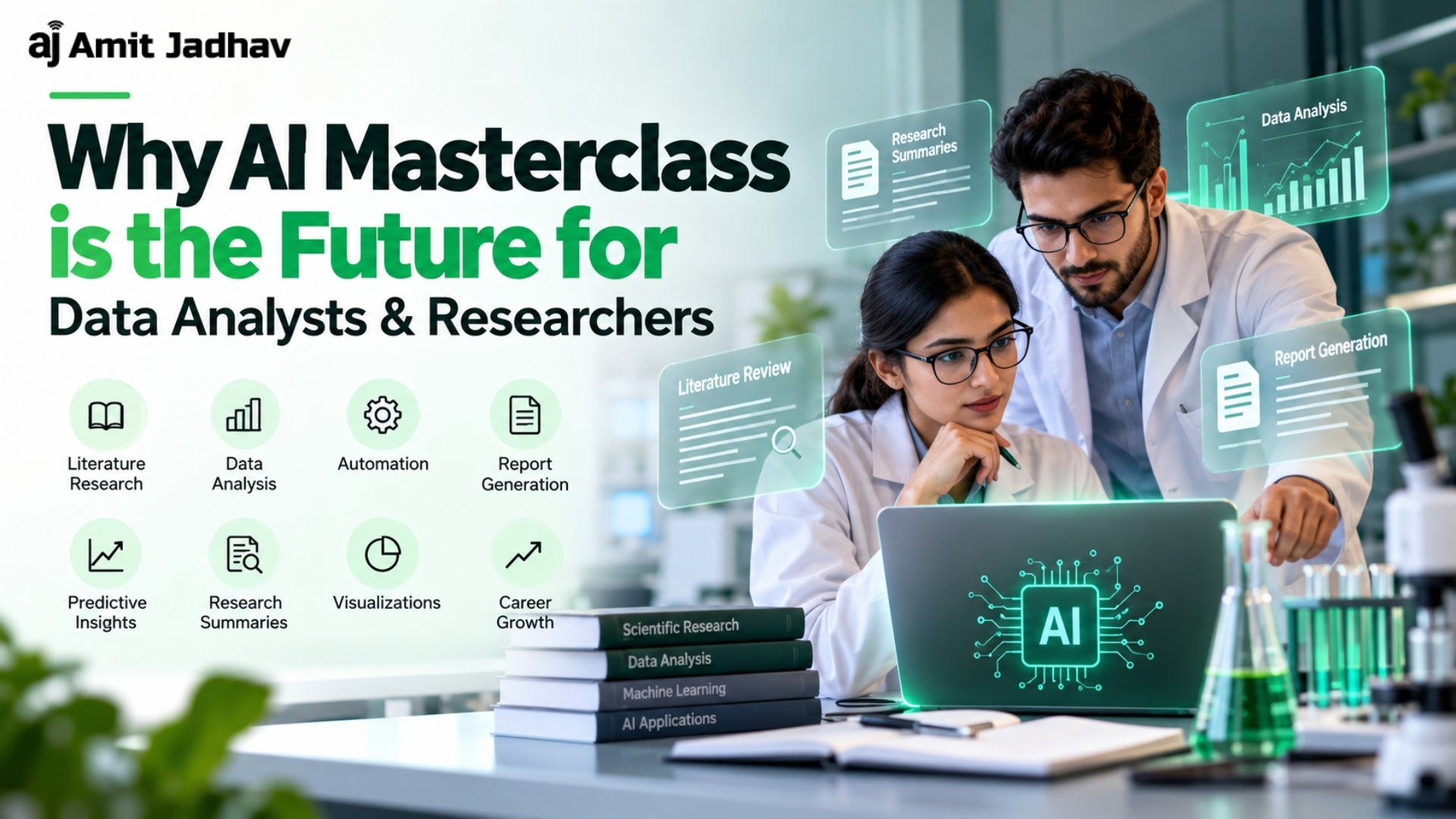
Why AI Masterclass is the Future for Data Analysts & Researchers
About AI Masterclass for Scientists & Analysts
With AI changing the way professionals collect, understand, analyze, and present information, AI Masterclass for Scientists & Analysts is becoming an increasingly valuable learning opportunity. AI is no longer merely a new tool for researchers and data analysts. In a data-driven workplace, it is becoming a useful skill for working more quickly, gaining greater insights, and remaining relevant.
From literature reviews and data analysis to report authoring and automation, AI for scientists and AI for data analysts can eliminate repetitive tasks and free up specialists to concentrate more on interpretation and decision-making.
The Significance of AI for Researchers and Analysts
Traditional data analysis frequently entails several difficult steps. Cleaning datasets, looking through research articles, developing code, preparing presentations, and making reports can all take hours for professionals.
Such limitations in conventional data analysis can lead to delays in research and commercial decision-making.
AI can assist in automating a number of repetitive tasks. Professionals can summarize vast amounts of data, spot trends, produce preliminary insights, make visualizations, and enable predictive analytics using the appropriate AI tools for analysts.
For instance, a researcher can utilize AI to organize data and find pertinent themes before performing a thorough human review, as opposed to manually going through hundreds of pages.
This does not imply that human expertise will be replaced. Rather, it refers to leveraging technology to increase the productivity of human skills.
AI's Expanding Use in Data Analysis and Research
AI is already shaping the future of research. According to a 2025 survey of over 3,200 researchers in 113 countries, 58% of them used AI tools in their work, up from 37% in 2024. Additionally, 38% of respondents to the poll reported employing AI to analyze research data.
More than 6,000 researchers from Germany's Max Planck Society and Fraunhofer Society participated in a different study that revealed 25.9% of them used AI for work at least every day. AI has been used, according to researchers, for jobs like writing, coding, testing, literature reviews, and research analysis.
These figures demonstrate a significant change: AI is transitioning from research and development to regular professional application.
For this reason, studying a few well-known AI technologies may not be as beneficial as structured AI training for scientists and analysts.
AI Masterclass for Scientists and Analysts: Learning AI Beyond the Basics
It is insufficient to simply know that AI exists. Professionals must know how to use it appropriately for their particular tasks.
An AI Masterclass for Scientists & Analysts can introduce researchers and data analysts to practical AI applications, including:
- Automating repetitive processes related to data analysis
- Research and reporting with Generative AI
- Managing big datasets effectively
- Developing prompts to improve analytical outcomes
- Analyzing text with natural language processing
- Using predictive analytics to spot patterns
- Research paper and report summaries
- Making documentation and presentations based on data
- Recognizing the limitations, accuracy, privacy, and verification of AI
In this situation, an AI masterclass with practical training can be more beneficial than just theoretical learning.
In addition to learning what a tool does, professionals can also learn when to use it, how to formulate appropriate suggestions, and how to confirm the results.
The Use of AI in Research by Scientists
Data collection is only one aspect of research. Research questions must be determined, literature must be reviewed, data must be analyzed, conclusions must be interpreted, and results must be communicated.
AI can make several of these activities easier and more efficient.
AI can be used, for instance, to organize literature, extract information from lengthy texts, compare results, help with coding, and uncover trends in datasets. AI can also help with documentation, summarization, and content generation.
But scientific judgment is still crucial. Information produced by AI may be inaccurate or lead to false conclusions. As a result, researchers must verify sources, verify computations, and interpret findings in the proper scientific context.
This makes AI skills for researchers and analysts increasingly important. The aim is not to accept AI-generated results without question, but to use AI as a productivity tool that complements human expertise.
AI vs Traditional Analysis: What Changes?
The key difference between AI-assisted and traditional analysis is not just speed. It is the ability to combine automation with human judgement and decision-making.
Consider a large dataset with thousands of customer records. Traditional analysis can involve significant manual preparation before meaningful patterns emerge. AI can help with data preparation, pattern identification, segmentation, and predictive analysis.
In marketing, for instance, AI can support hyper-personalization, marketing automation, chatbots, virtual assistance, and content creation. In sales, it can assist with sales forecasting, predictive lead scoring, sales enablement, and conversion rate optimization.
The same approach applies to research and scientific work: automate repetitive tasks and spend more time on valuable analysis and decision-making.
Why Practical AI Training Matters for Career Growth
AI is reshaping professional roles across industries. Data analysts are increasingly working with AI-powered analytics, while researchers need to learn new ways to manage, analyse, and interpret information.
This makes an AI course for analysts or an AI masterclass for research scientists focused on practical applications highly relevant.
An AI course with real-world projects allows learners to develop confidence through hands-on experience instead of relying only on theoretical knowledge.
It can also contribute to AI training for career growth, particularly for professionals who already have expertise in areas such as science, analytics, research, finance, healthcare, marketing, or business.
Explore the importance of an AI Masterclass for Scientists & Analysts and learn how it can help future-proof your career in our blog, “Future-Proof Your Career with an AI Masterclass for Scientists & Analysts”!
In India, the growing need for professionals who can combine industry knowledge with technology skills is also increasing interest in specialized AI training programs in India.
What Should Professionals Learn in an AI Masterclass?
Effective AI learning should go beyond basic prompt writing.
A strong AI program for analysts and scientists should introduce practical areas such as Generative AI, automation, multimodal AI, natural language processing, predictive analytics, data analysis, and responsible AI practices.
Professionals should also understand how AI contributes to wider digital transformation.
For business-focused analysts and researchers, AI can help improve areas such as ROI, performance metrics, CTR, productivity, and customer satisfaction. Understanding these connections makes AI learning more useful in real-world professional settings.
An AI workshop for professionals can therefore connect AI capabilities with practical business, analytical, and research requirements.
The Future Belongs to AI-Ready Professionals
The future is unlikely to be a simple choice between AI vs traditional analysis. Instead, it will favour professionals who can combine human judgement with AI-driven capabilities.
While more professionals are adopting AI, many still need better training to use it effectively. Elsevier's 2025 survey found that only 27% of researchers felt they had sufficient training to use AI effectively.
This gap creates a valuable opportunity.
Professionals who invest in AI learning for data-driven professionals can learn how to save time using AI tools, work with large datasets more efficiently, automate repetitive processes, and focus more on meaningful insights.
Whether you are a scientist, researcher, data analyst, or business professional, an AI Masterclass for Scientists & Analysts can help transform AI from an emerging technology into a practical workplace skill.
The future of research and analytics will not simply belong to those who understand AI. The future will favour professionals who know how to use AI in an effective, responsible, and strategic way.
- Amit Jadhav
www.amitjadhav.com