
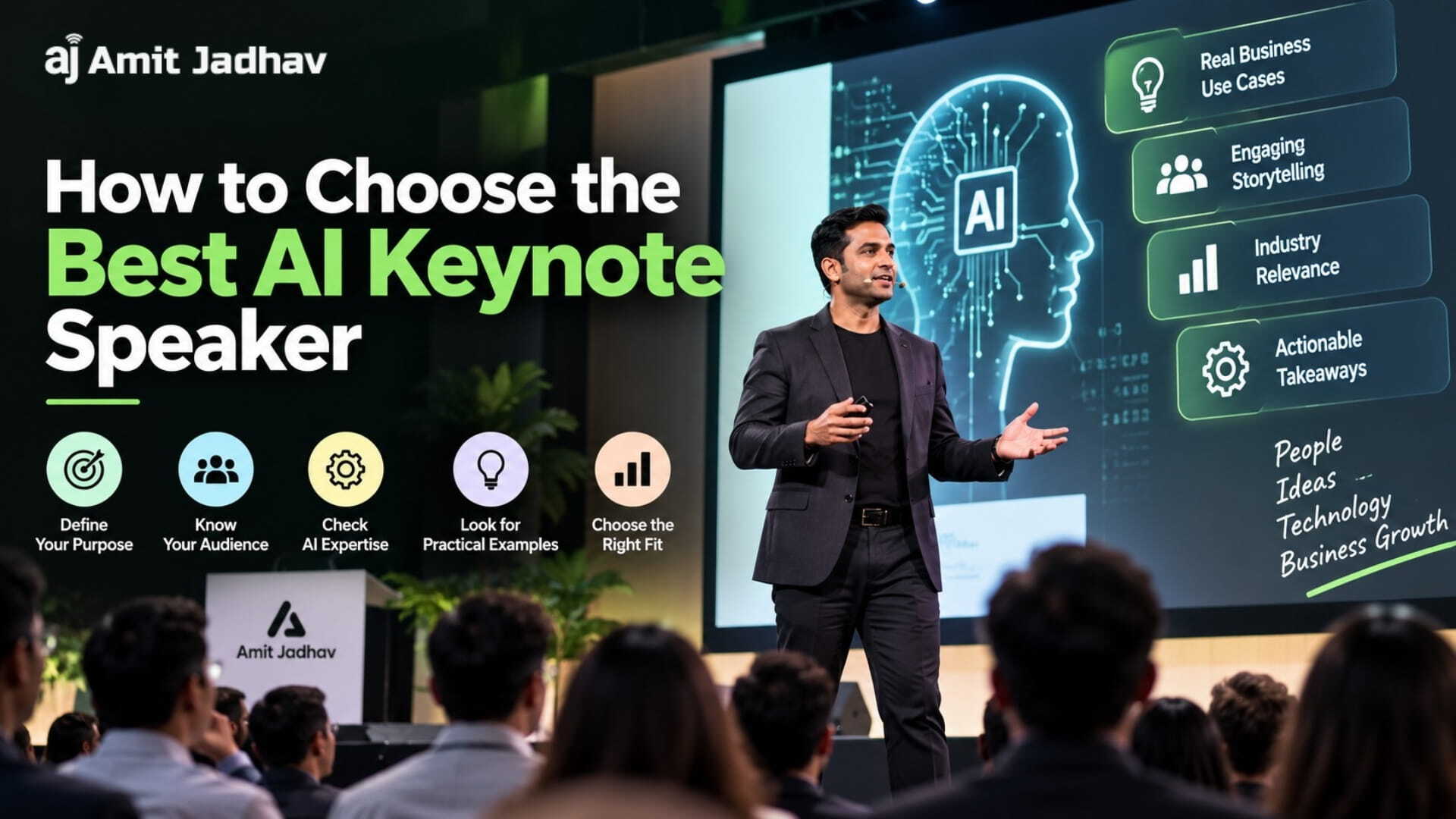
How to Choose the Best AI Keynote Speaker
Let’s Begin
AI is influencing almost every part of modern business, from sales and marketing to decision-making and day-to-day operations. However, knowing what AI can do is very different from explaining how it can actually create value for a business. This is why selecting the right AI Keynote Speaker can play an important role in making an event meaningful and engaging.
The right speaker should go beyond simply explaining Artificial Intelligence. They should be able to connect AI with real business situations, explain complex ideas in simple language, and give the audience practical takeaways. Whether it is a corporate event, leadership programme, technology conference, or business event, a well-chosen speaker can make AI easier to understand and more relevant to the people in the room.
For better understanding, let’s learn more about an AI keynote speaker in our informative blog post, “What Does an AI Keynote Speaker Do?”.
How You Will Choose the Best AI Keynote Speaker
1. Begin With the Purpose of Your Event
Before searching for an Artificial Intelligence Speaker, be clear about what you want the audience to gain from the session.
Are you introducing employees to AI for the first time? Do you want senior leaders to understand digital transformation? Are sales and marketing teams looking for practical AI applications? Or is the objective to encourage employees to become more comfortable with new technology?
The answers to these questions can help you identify the right type of speaker.
For instance, a technology conference may benefit from an AI Conference Speaker who can explain emerging developments and industry trends. On the other hand, a corporate programme may be better suited to a Corporate AI Speaker who can connect AI with productivity, business strategy, and employee adoption.
Having a clear objective also makes the selection process easier because you can evaluate speakers based on how well their expertise matches the purpose of your event.
2. Prioritize Business Experience Along With AI Knowledge
AI is evolving rapidly, but understanding the technology alone does not necessarily mean knowing how to apply it in a business environment.
A capable AI Business Speaker should be able to connect AI with practical areas such as productivity, automation, customer experience, sales, marketing, operations, and business decision-making.
When evaluating potential speakers, look for someone who can explain AI for Business through relevant use cases instead of focusing only on technical concepts.
For example, sales professionals may gain more value from a discussion about sales forecasting, predictive lead scoring, customer engagement, or sales optimization than from a detailed explanation of how a machine-learning model works.
A good speaker understands the difference between explaining AI and showing people how AI can help them. They should also be able to adapt the discussion according to the audience's industry, experience level, and business goals.
3. Check Whether the Speaker Understands Current AI Trends
AI is evolving continuously. Technologies such as Generative AI, multimodal AI, natural language processing, automation, and AI-driven decision-making are influencing the way businesses work.
A good AI Expert Speaker should keep up with these developments and explain them in a way that is easy for the audience to understand.
If your event is focused on emerging technologies, an AI Innovation Speaker can help explain where AI is heading and what businesses can do to prepare for these changes.
Similarly, a Generative AI Speaker can be a good choice when the session focuses on applications that are transforming content creation, research, customer support, knowledge management, and everyday work.
The focus should always be on relevance. Instead of simply discussing every new AI trend, the speaker should highlight technologies that are meaningful to the audience and their work.
4. Consider Your Audience Before Selecting the Speaker
A keynote designed for technology professionals may not have the same impact on sales teams, business owners, or employees who are just beginning to explore AI.
Before choosing a speaker, consider the audience's knowledge level, industry, roles, and expectations.
For senior leaders, an AI Leadership Speaker may focus more on business strategy, AI adoption, risk, investment, and long-term transformation. For employees, an AI Motivational Speaker may combine practical AI applications with insights on adaptability and continuous learning.
The speaker should be able to explain AI clearly while still giving the audience enough depth to understand its real business impact.
5. Look for Practical and Relevant Examples
AI can sound impressive when explained using technical terms and concepts. However, audiences are often more likely to connect with practical examples that relate to their everyday work.
Find out whether the speaker can show how AI can address common business challenges.
For example, AI-driven solutions can support marketing automation, chatbots, virtual assistance, hyper-personalization, and content creation. Sales teams can explore applications such as predictive lead scoring and sales forecasting, while customer-facing teams can use AI to strengthen customer engagement.
Even a simple demonstration or relatable example can make it easier for the audience to understand how AI can be applied to their own roles and responsibilities.
6. Evaluate the Speaker's Communication Style
Strong technical knowledge does not always translate into an engaging keynote.
An effective AI Event Speaker should be able to explain complex concepts simply, use relevant stories, interact with the audience, and keep the session engaging from beginning to end.
Before making a decision, review recordings of previous sessions, audience feedback, testimonials, or event videos. Look beyond the speaker's subject knowledge and consider how effectively they connect with the audience.
Can they make complex ideas easy to understand? Can they link AI concepts to real business outcomes? Do they encourage the audience to look at technology from a different perspective?
These communication skills can be just as important as the speaker's technical expertise.
7. Look Beyond Technology and Focus on ROI
For a corporate audience, adopting AI should ultimately deliver meaningful business value.
A good speaker should be able to connect AI initiatives with measurable outcomes such as ROI, productivity, cost reduction, revenue growth, and improved customer satisfaction.
For marketing teams, relevant metrics may include CTR (click-through rate), conversion rate optimization, campaign performance, and customer satisfaction. Sales teams may focus on pipeline growth, forecasting accuracy, lead quality, and conversion rates.
An effective AI Transformation Speaker can help audiences understand that successful AI adoption is not about using as many AI tools as possible. It is about choosing the right use cases and evaluating the results they deliver.
8. Check Whether the Speaker Understands Digital Transformation
AI does not usually operate on its own. It is often part of a broader digital transformation strategy that involves people, processes, data, technology, and organisational culture.
This becomes especially important for corporate and leadership events.
An Enterprise AI Speaker should be able to address practical questions such as where an organisation should start, which processes can be automated, how employees should be trained, what data is needed, and how performance metrics should be measured.
Discussing these areas can help leaders move beyond simply being interested in AI and start thinking about how it can be adopted responsibly and effectively.
9. Consider the Future, Not Just Today's AI
A strong keynote should encourage the audience to think about what the future may bring.
A Future of AI Speaker can help audiences explore how emerging technologies could influence business models, jobs, customer experiences, and workplace productivity.
Topics such as multimodal AI, automation, natural language processing, and emerging concepts such as ASI & AJI can provide a broader perspective on the possible direction of AI.
However, the discussion should remain practical. Audiences do not need predictions about every new technology. They need to understand which developments are worth following and why they could matter to their businesses.
10. Choose a Speaker Who Can Inspire Action
A successful keynote should have an impact beyond the presentation itself. It should give the audience clear reasons and ideas to take action.
Whether you choose an AI Motivational Speaker, AI Leadership Speaker, or AI Expert Speaker, the session should ideally leave people with practical takeaways they can apply in their own work.
For example, employees may identify a repetitive task that could be automated. Sales teams could explore predictive lead scoring, while marketing teams may consider AI-assisted content creation or hyper-personalization. Leaders could also start assessing where AI can contribute to their wider transformation strategy.
This practical focus can turn a keynote from an informative presentation into a valuable business experience.
Final Thoughts
Choosing the right AI Keynote Speaker involves more than finding someone with knowledge of Artificial Intelligence. The right speaker should understand your audience, industry, and the purpose behind your event.
They should be able to explain complex AI concepts in simple terms, connect them to practical business applications, and encourage the audience to consider how technology can be used more effectively.
Whether you are looking for an AI Conference Speaker, Corporate AI Speaker, AI Transformation Speaker, or AI Business Speaker, consider factors such as relevance, credibility, communication skills, practical expertise, and measurable business value.
AI will continue to evolve, but the most valuable keynote is not necessarily the one that discusses the most advanced technology. It is the one that helps your audience understand what AI means for their work, their business, and the opportunities ahead.
- Amit Jadhav
www.amitjadhav.com