
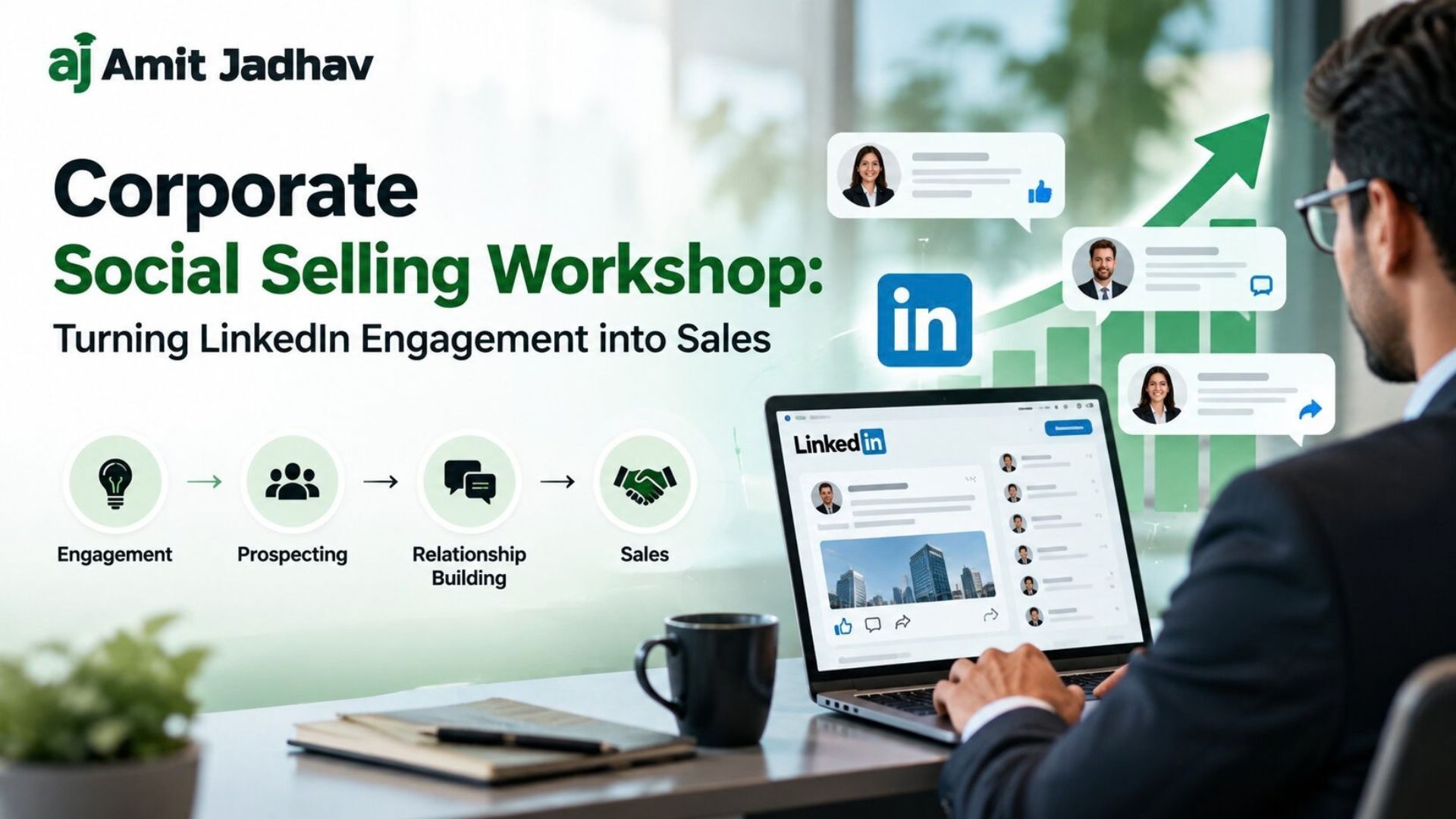
Corporate Social Selling Workshop: Turning LinkedIn Engagement into Sales
About Social Selling Workshop
A social selling workshop is not simply about teaching sales professionals how to become more active on LinkedIn. It is about showing them how to use every stage of a LinkedIn interaction - from creating the first impression to engaging with prospects and following up with the right conversation.
After all, getting a like takes seconds.
Turning that interaction into a genuine business conversation takes much more.
LinkedIn has become an important platform for B2B professionals, sales teams, consultants, founders, and business leaders. However, having a well-written profile or posting regularly does not automatically bring new customers. Businesses need a clear process that connects LinkedIn engagement, prospecting, relationship building, and sales.
This is where corporate social selling becomes relevant. It gives sales teams a structured way to use LinkedIn not just for visibility, but as part of their wider sales process.
Why Social Selling Is Becoming Important in Modern Sales
For a long time, sales started with a prospect list, a cold call, an email, or a direct product pitch.
Social selling takes a different approach.
Instead of immediately reaching out with a sales pitch, professionals can first build relationships, familiarity, and credibility with potential customers. They can share useful insights, engage with industry discussions, understand what their prospects are interested in, and gradually build a professional relationship.
This is why relationship-based selling has become an important part of modern sales strategies.
A clear social selling strategy can also strengthen LinkedIn lead generation for sales. The aim is not merely to increase the number of connections. It is to find the right people, understand their business needs, and create meaningful conversations that may eventually develop into genuine sales opportunities.
LinkedIn Engagement Does Not Automatically Mean a Lead
This is one of the areas where many businesses misread LinkedIn activity.
Someone likes a salesperson’s post. Another person leaves a comment on an article. A potential customer visits the profile. These actions show interest, but they do not necessarily mean that the person is ready to become a sales lead.
Engagement is an indication of interest, not a promise of a sales opportunity.
A corporate social selling workshop can help sales teams understand how to look beyond these basic interactions. Instead of immediately treating every engagement as a reason to pitch, sales professionals can consider the person's role, organization, interests, previous interactions, and whether there is a genuine business connection.
This makes LinkedIn prospecting techniques more focused and purposeful.
The approach can move away from:
Like → Connection → Pitch
and towards:
Engagement → Relevance → Conversation → Relationship → Opportunity
This small change can make LinkedIn a much more useful part of the sales process.
Turning Content Engagement into Real Conversations
Creating content is only one part of social selling.
A salesperson may share an insightful post about an industry problem and receive several comments. But if those interactions are never followed up, the opportunity to start a meaningful conversation may disappear.
This is where social selling techniques can make a difference.
Instead of immediately sending a promotional message, sales professionals can continue the discussion naturally. For instance, if a prospect responds to a post about supply-chain challenges, the salesperson could ask about their experience or challenges in that area. If the discussion reveals a genuine business need, it can then move towards a private conversation.
The key is relevance and timing—not turning every LinkedIn interaction into a sales pitch.
This is how digital selling strategies and social media selling strategies can move from being concepts on paper to practical tools that support everyday sales conversations.
Creating a LinkedIn Sales Funnel
LinkedIn can play a role at different points in the sales journey, rather than being used only for finding new contacts.
At the awareness stage, useful and relevant content can help sales professionals get noticed by the right audience. When prospects move into the consideration stage, educational content, industry observations, case studies, and meaningful discussions can help establish credibility and demonstrate expertise.
The next step is the opportunity stage. Here, one-to-one conversations can help sales professionals understand whether a prospect has a genuine business need and whether there is a reason to continue the discussion.
This approach can also support B2B lead generation without ads. Paid campaigns may be useful for certain businesses, but organic engagement offers another way to build connections with potential customers over time.
However, consistency matters.
One LinkedIn post is unlikely to generate a sale on its own. Regularly sharing useful information and engaging with the right people can gradually build familiarity, trust, and stronger business relationships.
What Should Sales Teams Learn Through Social Selling Training?
Effective social selling training should involve much more than learning how to use LinkedIn's basic features.
Sales professionals need to understand how LinkedIn can fit into their existing sales process and how everyday activity on the platform can support prospecting and relationship building.
A practical training program can cover areas such as:
- Building a professional profile that establishes credibility
- Identifying and researching relevant prospects
- Applying effective LinkedIn prospecting techniques
- Finding common interests, business needs, and relevant conversation points
- Writing personalized connection requests
- Creating useful and relevant sales content
- Engaging meaningfully with prospects' content
- Following up naturally without making conversations feel overly promotional
- Tracking engagement and conversion-related performance metrics
- Connecting LinkedIn activity with the broader sales process
This makes social selling training for sales teams part of sales enablement, rather than treating LinkedIn as a separate marketing activity.
The objective is not simply to make salespeople more active on LinkedIn. In fact, the focus is on helping them use the platform effectively and strategically to support their wider sales efforts.
For more insights into what sales teams can learn through social selling training, explore our blog post, “Social Selling Workshop for Sales & Marketing Teams: A Practical Guide by Amit Jadhav!”
How AI Can Support Social Selling
AI in business is also becoming relevant to the way sales teams approach social selling.
Today, sales professionals can use Generative AI to brainstorm content ideas, draft messages, assist with research, and create initial versions of sales content. Automation can take care of repetitive activities, while Data Analysis can help teams understand which types of content and interactions are generating useful engagement.
AI-driven tools can also contribute to areas such as predictive lead scoring, sales forecasting, and sales optimization when they have access to relevant and reliable business data.
However, technology should make relationships easier to build—not remove the human element from them.
An automated message may be quick to create, but if it sounds too generic, it may fail to create a meaningful connection. Effective Hyper-personalization requires more than inserting a prospect's name. It means understanding their role, organisation, business challenges, interests, and the context of the conversation.
So, while AI can improve efficiency, human judgement and genuine interaction remain important parts of social selling.
Measuring What Actually Matters
Another challenge businesses face is focusing too heavily on visible numbers.
Likes and follower counts can indicate reach and awareness, but they do not necessarily show whether LinkedIn activity is contributing to sales. Sales teams should therefore track relevant performance metrics that provide a clearer picture of progress.
Depending on the organisation's goals, these could include:
- Relevant profile visits
- Quality connections with potential prospects
- Meaningful business conversations
- Qualified leads
- Meetings generated from LinkedIn activity
- CTR (click-through rate) for posts or links
- Lead-to-opportunity conversion
- Customer engagement
- ROI
The objective is not to turn social selling into another complicated reporting exercise.
Instead, these measurements should help sales teams understand what is working, where prospects are engaging, and whether their LinkedIn activities are helping move conversations forward in the sales process.
Why Corporate Training Can Make a Difference
Sales professionals can learn social selling techniques on their own, often by experimenting with different approaches. However, when an entire sales team works with a common framework, it becomes easier to maintain consistency in how the organisation approaches LinkedIn and digital selling.
A social selling workshop for corporates can help bring sales, marketing, and leadership teams together around a shared approach. It can also help employees understand how LinkedIn activity can support prospecting, relationship building, and the wider sales process.
For instance, Amit Jadhav's Social Selling Master Class covers areas such as the 7 steps to social selling, social media for lead generation, changes in the marketing mix, and real-time marketing. His professional profile also highlights his work with corporate teams and his focus on social selling and digital business growth.
For organisations exploring social selling training for companies in Pune, LinkedIn sales training India, or B2B sales training India, the focus should be on how effectively the training connects LinkedIn activities with the company's existing sales process.
The Goal Is Not Simply to Be More Active on LinkedIn
Sales teams do not need to spend hours every day posting and scrolling through LinkedIn.
What matters is how purposefully they use the platform.
The role of a social selling workshop is not simply to increase the number of posts, connections, or likes. It should help sales professionals understand how everyday LinkedIn activity can contribute to genuine business relationships.
A comment can open the door to a conversation.
A useful conversation can build familiarity and trust.
And over time, that relationship may develop into a relevant business opportunity.
That is the difference between simply maintaining a LinkedIn presence and using LinkedIn social selling as part of a broader modern sales strategy.
So, instead of asking:
“How many people are interacting with our content?”
sales teams could ask a more meaningful question:
“How many meaningful business conversations are we starting through that engagement?”
- Amit Jadhav
www.amitjadhav.com