
How AI Agents Are Transforming Sales, Marketing & Customer Support
Let’s Begin
Businesses' perspectives on automation are evolving due to agentic AI. Businesses can now employ intelligent systems that comprehend objectives, make decisions, take action, and finish multi-step processes rather than relying just on AI to produce content or respond to inquiries.
This change is important for teams in charge of sales, marketing, and customer service. Businesses can transition from basic task automation to AI-powered workflows that continuously analyze data, respond to clients, assist staff, and enhance business procedures with the aid of agentic AI.
Amit Jadhav's approach to AI is heavily focused on real-world commercial purposes, such as no-code automation, sales, marketing, and productivity. Moving from AI awareness to real-world application is another focus of his AI projects.
Agentic AI: What is it?
Conventional automation often adheres to predetermined guidelines: take a certain response if something occurs. AI agents are capable of more. With little assistance from humans, they are able to comprehend an objective, evaluate the facts at hand, determine what must be done, and carry out a number of tasks.
When someone downloads an eBook, for instance, a conventional marketing automation system may send an email. An AI bot might examine the prospect's profile, comprehend their behavior, gather pertinent data, tailor the follow-up, update the CRM, and recommend the sales team's next course of action.
This is the point at which AI automation gains intelligence.
Businesses can develop linked AI-Powered Workflows that support entire processes rather than automating a single isolated task.
To understand more about Agentic AI, explore our blog post, “What is Agentic AI? A Complete Guide for Business Owners!”
Sales Are Changing Due to AI Agents
Sales teams invest a lot of time in prospect research, CRM record updating, proposal preparation, follow-up, and pipeline data analysis. Intelligent automation and AI agents can help with a lot of this job.
Potential prospects may be found, customer data can be analyzed, leads can be prioritized, customized outreach can be prepared, and salespeople can be reminded when follow-up is needed using an AI-driven sales workflow.
Improved Lead Generation and Sales Facilitation
Sales teams can find prospects who are more likely to convert with the use of predictive lead scoring. AI can analyze past interactions, engagement levels, company data, and behavioral cues rather than treating every lead similarly.
By analyzing pipeline data and historical sales trends, AI can also assist with sales forecasting. Sales executives can use this information to better allocate resources and create goals.
Predictive lead scoring, sales forecasting, sales enablement, and AI-powered sales optimization are highlighted as significant applications of AI in modern business in Amit Jadhav's sales-focused AI content.
Replacing salespeople is not the aim. The goal is to free up more time for salespeople to engage in conversations, build connections, negotiate, and close deals by reducing administrative tasks.
AI in Marketing: From Automation to Hyper-Personalization
Automation for emails, social media, advertising, and consumer segmentation has already been implemented in marketing. Increasing the intelligence of these systems is the next phase.
By integrating customer data, campaign results, behavioral data, and engagement signals, agentic AI can assist marketers in achieving hyper-personalization.
For instance, an AI-driven system can recognize several consumer categories and suggest various messages, offers, or content rather than sending the same email to every database.
Smarter Marketing Automation
AI is able to assist:
- Content creation and campaign planning
- Audience segmentation
- Marketing automation
- Predictive analytics
- Customer journey analysis
- Conversion rate optimization
- Ad and campaign optimization
- Social media content planning
Additionally, it is capable of analyzing marketing performance metrics such as lead quality, engagement, conversions, and CTR (click-through rate).
As a result, marketing is less reliant on speculation. Data analysis can be used by teams to identify what is effective and make ongoing campaign improvements.
Similar emphasis is placed on AI-powered marketing, hyper-personalization, predictive analytics, campaign optimization, and quantifiable ROI in Amit Jadhav's digital marketing materials.
Customer Service Becomes Quicker and Smarter
The expectations of customers have evolved. Consumers seek prompt responses, pertinent information, and multichannel help.
Businesses have already benefited from chatbots and virtual help by offering automated responses. Agentic AI, however, has the potential to improve customer service by making it more action-oriented and contextual.
An AI agent is capable of comprehending a customer's inquiry, analyzing the facts at hand, determining the problem, offering a solution, generating a service request, updating the CRM, and, if required, elevating the issue to a human.
This can speed up response times while freeing up support staff to work on more difficult issues.
Enhancing the Customer Experience
AI for customer service is capable of analyzing conversations, recognizing recurrent issues, summarizing exchanges, and identifying common complaints.
Businesses can learn more about the behavior and expectations of their customers when they integrate customer data analysis.
A more consistent customer experience, quicker resolution, and maybe increased customer satisfaction are the outcomes.
Crucially, AI shouldn't imply eliminating human interaction. Human judgment is still needed for complex complaints, delicate circumstances, and valuable customer relationships.
Sales, Marketing, and Support Are Connected by Enterprise AI
Connecting departments rather than using AI independently in each function is one of the major prospects.
Think about a consumer who engages with a business through a marketing effort, talks to a salesperson, buys a product, and then gets in touch with customer service.
The customer might have to repeat information more than once if each department uses different data.
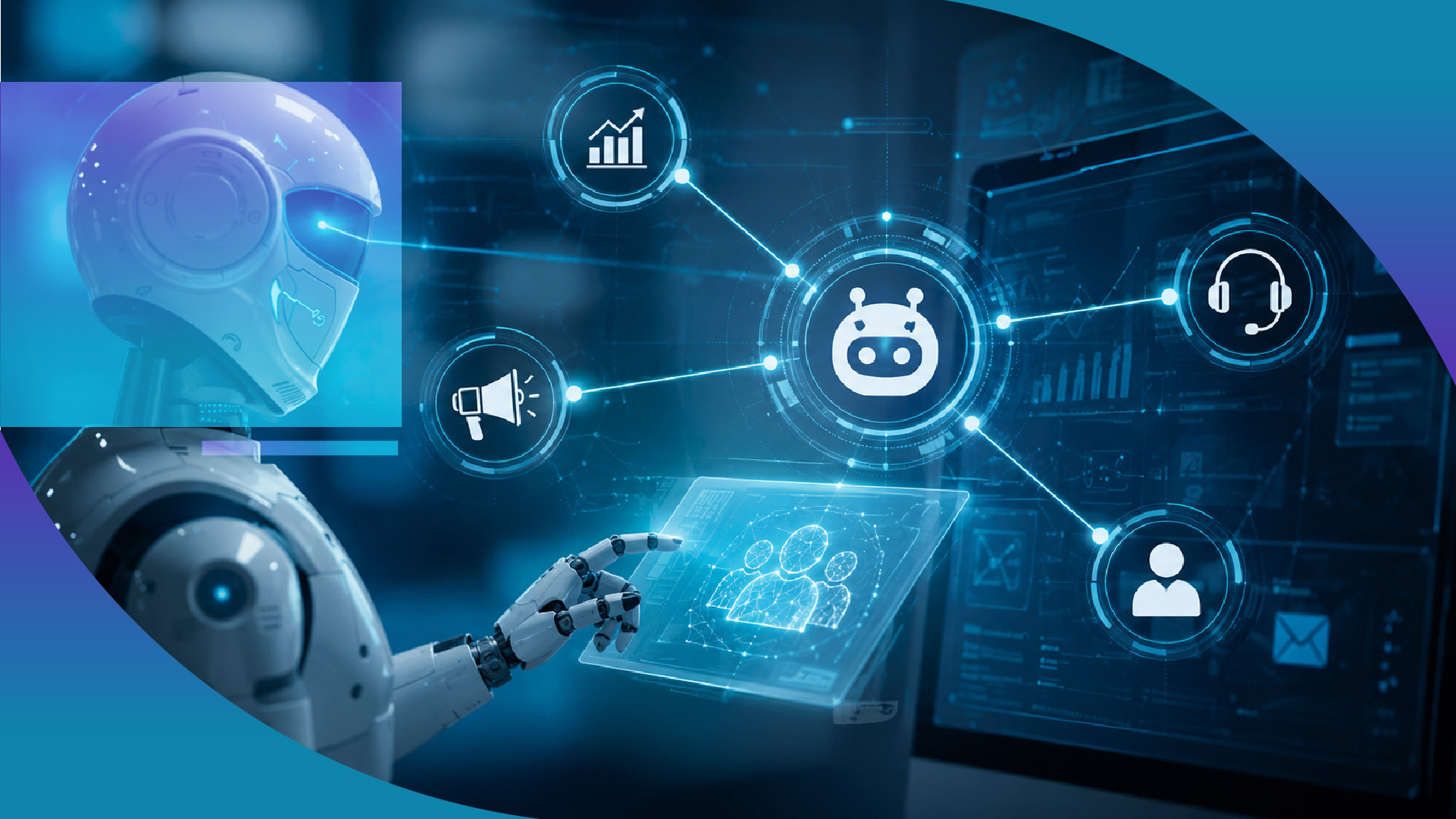
A more comprehensive picture of the consumer can be produced by linked systems using Enterprise AI.
Sales is able to comprehend marketing engagement. Sales results may teach marketing. Purchase and interaction history is visible to customer service.
As a result, enterprise automation is created across the client lifecycle.
Instead of requiring every organization to utilize the same workflow, AI Agent Development may be used to construct Custom AI Solutions for certain business processes.
Multi-Agent Systems: The Next Development
Multi-Agent Systems, in which various AI agents collaborate, may be a feature of the future.
For instance:
Sales agent → Prospects are identified and qualified by the sales agent.
Marketing Agent → develops customized advertising campaigns
Research Agent → collects data on the market.
CRM Agent → Customer records are updated by CRM agents.
Support Agent → Regular client requests are handled by the.
Analytics Agent → keeps track of outcomes and suggests enhancements.
When combined, these platforms can facilitate departmental AI Workflow Automation.
Developing an AI-enabled corporate operating model is a significant change from utilizing AI as a stand-alone tool.
What Companies Need to Measure
The number of AI tools used by employees should not be the sole indicator of AI adoption. Companies require quantifiable results.
Among the crucial metrics are:
- ROI
- Lead conversion rate
- Sales cycle duration
- CTR
- Customer satisfaction
- Response time
- Cost per lead
- Revenue per salesperson
- Marketing conversion rate
- Time saved through automation
Leadership teams may determine whether implementing AI is truly generating corporate value with the use of these performance KPIs.
How to Begin Using AI
Automating everything at once is not necessary for businesses. Starting with a single high-value, repeated operation is a sensible strategy.
Find a workflow that takes up a lot of staff time first. Analyze the relevant data and systems after that. Next, decide if the best course of action is automation, generative AI, or an AI agent.
AI consulting and structured AI agent development can assist in identifying appropriate use cases, integration requirements, governance needs, and estimated ROI for companies with more complicated requirements.
This practical approach - using AI tools and workflows to tackle actual business challenges rather than considering AI as a purely theoretical technology - is emphasized in Amit Jadhav's AI programs.
AI Will Drive Business in the Future
An essential development in corporate automation is agentic AI. AI, automation, data, decision-making, and execution are all integrated into interconnected workflows.
The effects will go beyond customer service, marketing, and sales. The same concepts can be gradually applied by businesses to operations, supply chain, finance, human resources, and other areas.
Using more AI technologies is not the true opportunity. It involves creating an organization where intelligent systems and people collaborate well.
Businesses can develop faster, more responsive, and more scalable operations by learning how to integrate human expertise with autonomous AI agents, intelligent automation, and business process automation as digital transformation with AI picks up speed.
AI is progressing from responding to inquiries to acting. In the next stage of digital transformation, companies that figure out how to focus that action on quantifiable results will have a greater advantage.
- Amit Jadhav
www.amitjadhav.com