
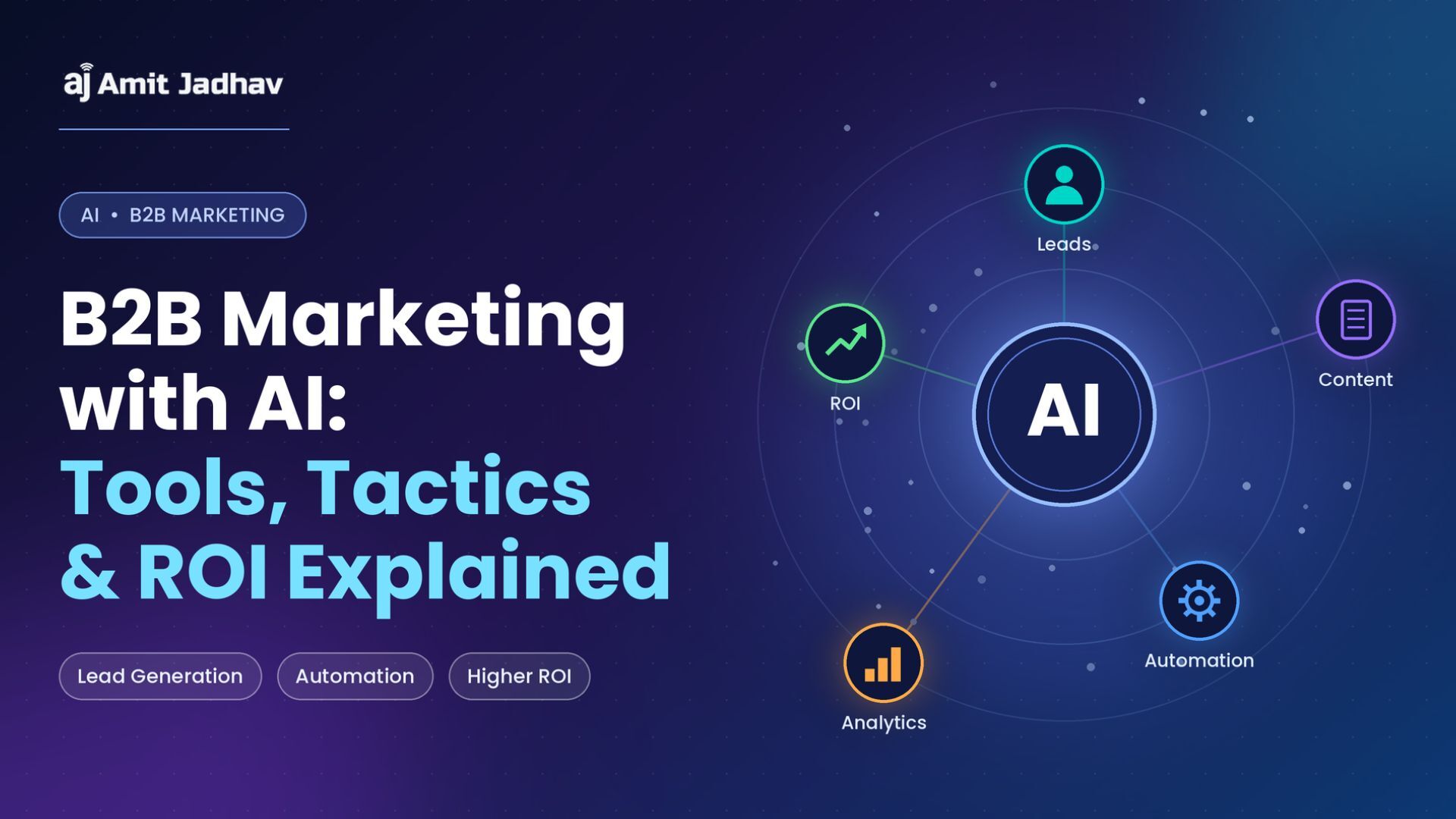
B2B Marketing with AI: Tools, Tactics & ROI Explained
Let’s Start
Finding potential business customers, developing strong connections, and turning prospects into paying clients can be challenging. B2B marketing with generative AI offers businesses a smarter way to manage these activities. It helps companies understand customer needs, develop relevant content, handle routine tasks, and make informed marketing decisions.
Traditional B2B marketing usually involves lengthy sales processes, several decision-makers, and regular communication with prospects. AI is making these activities more manageable by improving the way sales and marketing teams work. Whether it is finding new leads, creating content, engaging customers, or monitoring campaign results, businesses can use AI to make their marketing efforts more productive.
Let's look at the tools, techniques, and advantages of using AI for B2B marketing.
How AI is Changing the B2B Marketing Landscape
Unlike B2C marketing, B2B marketing often involves longer buying cycles. Businesses take time to compare available solutions, understand pricing, and evaluate the potential benefits before making a purchase.
AI in B2B marketing allows companies to study these purchasing patterns and reach suitable prospects with relevant information.
Here are some important ways AI is improving B2B marketing:
- Customer Insights: AI examines customer interests, behavior, and past interactions to discover potential business opportunities.
- Content Development: Generative AI supports the creation of blogs, emails, social media content, and promotional campaigns.
- Lead Identification: AI helps find prospects who are more likely to be interested in a company's offerings.
- Marketing Automation: Companies can streamline email campaigns, follow-up messages, and other routine marketing activities.
- Campaign Analysis: AI evaluates marketing performance and highlights areas where improvements may be needed.
With these capabilities, marketing professionals can reduce manual tasks and dedicate more time to important business activities.
Useful AI Tools for B2B Marketing
Selecting suitable technology plays an important role in developing a successful marketing plan. Businesses can use different AI solutions to support their marketing requirements.
Let's explore some popular categories of AI tools for B2B marketing:
1. Generative AI Content Platforms
These platforms help create different types of marketing material, such as blogs, website content, email copies, product descriptions, and social media posts. They can also generate fresh ideas and improve existing content.
2. AI-Enabled CRM Systems
Customer Relationship Management (CRM) platforms with AI features help businesses maintain customer records, monitor interactions, and discover potential sales opportunities.
3. Predictive Analytics Solutions
These solutions study previous data and customer activities to estimate future purchasing behavior. They also help identify promising leads and support more accurate sales forecasting.
4. AI Chatbots and Virtual Assistants
Chatbots respond to frequently asked questions, share product details, and collect information from potential customers. They also allow businesses to stay connected with customers beyond normal business hours.
5. Marketing Automation Software
These platforms simplify activities such as email marketing, customer segmentation, lead nurturing, and follow-up communication.
Combining these technologies can help businesses manage their marketing operations more smoothly.
Generative AI Marketing Strategies to Generate Quality Leads
Finding relevant prospects remains one of the major challenges in B2B marketing. Reaching more people does not necessarily mean getting more business. Companies need to attract audiences who have a genuine requirement for their products or services.
Generative AI marketing strategies help improve lead generation by making customer targeting and communication more relevant.
Some effective approaches include:
- Customized Email Marketing: AI helps prepare emails according to customer preferences, business sectors, and previous interactions.
- Industry-Specific Content: Companies can create relevant blogs, case studies, and landing pages to attract their target audience.
- Predictive Lead Scoring: AI studies prospect details and gives scores based on their chances of becoming customers.
- Social Media Campaigns: AI can suggest relevant content topics, create posts, and support better audience engagement.
- Automated Follow-Ups: Businesses can send timely and personalized messages depending on customer responses and activities.
For instance, a business offering manufacturing software can use AI to identify companies searching for production planning solutions. It can then approach these prospects with useful information about its products and services.
This makes B2B lead generation using AI more targeted and allows sales teams to concentrate on prospects with stronger business potential.
How to Automate B2B Marketing Using AI
Marketing professionals spend a significant amount of time sending emails, creating reports, maintaining customer information, and contacting potential buyers.
B2B marketing automation with AI helps simplify these responsibilities by managing repetitive activities and connecting different marketing functions.
A basic automated marketing process may work like this:
- A potential customer visits your website and fills out an enquiry form.
- AI collects the provided details and arranges the lead data systematically.
- The CRM platform groups the prospect according to their interests and business needs.
- An automated email provides relevant product or service information.
- The sales team gets an alert when the prospect shows interest in making a purchase.
This process enables businesses to connect with prospects quickly and maintain regular communication throughout the buying journey.
AI-driven Automation also helps strengthen sales enablement, improve sales optimization, and create better coordination between sales and marketing departments.
How AI Helps Businesses Achieve Better B2B Marketing ROI
Marketing results should not be evaluated only by looking at website traffic or the number of leads generated. Companies must also consider the revenue their marketing efforts bring in compared to the investment made.
B2B marketing with generative AI can help businesses improve returns by making campaigns more productive and cutting down on manual activities.
Here are some essential performance metrics to keep an eye on:
- Cost Per Lead: Calculates the expense involved in generating each potential customer.
- Conversion Rate: Shows the percentage of potential customers who complete a purchase.
- CTR (Click-Through Rate): Tracks the percentage of people clicking on marketing links or advertisements.
- Customer Acquisition Cost: Shows how much a business invests in acquiring each new customer.
- Customer Satisfaction: Shows how effectively a company's communication and marketing efforts meet customer needs.
- Marketing ROI: Determines the financial returns received from marketing expenditure.
AI can evaluate these performance metrics and help companies recognize which marketing campaigns are performing well.
For instance, if an email campaign attracts good engagement but receives very few enquiries, AI-powered Data Analysis can help identify what needs to change in the email content, audience selection, or landing page.
How to Create an Effective AI-Driven B2B Marketing Strategy
Businesses do not need to bring automation into every marketing activity immediately. Adopting AI in stages can make the process easier to manage.
Here are some practical steps:
Step 1: Recognize Your Marketing Requirements
Find out which areas need attention, whether it is generating leads, creating content, improving customer engagement, or managing campaigns.
Step 2: Pick the Appropriate AI Tools
Look for solutions that support your business objectives instead of selecting tools just because they are currently popular.
Step 3: Keep Customer Data Organized
Well-maintained and accurate customer information helps AI produce meaningful insights and reliable predictions.
Step 4: Begin with Basic Automation
Start by automating everyday activities such as drafting emails, organizing leads, and managing customer follow-ups.
Step 5: Evaluate Your Results
Regularly check marketing performance metrics and improve your approach based on the results.
Following these steps can help companies expand their marketing operations using AI while managing their expenses effectively.
What is the Future of B2B Marketing with Generative AI?
The future of B2B marketing with generative AI will focus more on personalized interactions, intelligent automation, and data-driven marketing decisions.
Technologies such as Multimodal AI, Natural Language Processing, and Predictive Analytics will allow businesses to understand customer preferences and expectations more accurately. Augmented reality may also introduce new possibilities for interactive product presentations and demonstrations.
As digital transformation progresses, businesses will increasingly adopt AI-driven marketing solutions to strengthen customer engagement, enhance sales forecasting, and improve overall productivity.
However, adopting AI successfully involves more than implementing the latest technology. Companies need a clear marketing direction, accurate data, and human expertise to ensure their communication remains meaningful and relevant.
For more interesting information, you can explore our comprehensive blog post, “How Generative AI Is Revolutionizing B2B Marketing!”
Conclusion
AI is giving businesses new ways to strengthen their marketing and sales activities. Whether it is creating content, attracting potential customers, automating campaigns, or analyzing results, AI can contribute to different stages of the B2B marketing process.
However, achieving meaningful results requires businesses to use AI according to their specific goals instead of concentrating only on automation.
With suitable tools, well-planned strategies, and consistent performance monitoring, companies can increase marketing efficiency, attract more relevant prospects, and improve ROI.
The future of successful B2B marketing lies in bringing together AI technology, human creativity, strategic thinking, and valuable customer relationships.
- Amit Jadhav
www.amitjadhav.com