
Agentic AI vs Generative AI: What is the Real Difference?
Introduction to Agentic AI
Agentic AI is changing the way businesses use artificial intelligence. Agentic AI can plan, make judgments, and finish tasks with little assistance from humans, whereas Generative AI can only produce material.
You are not alone if you've been hearing phrases like "AI Agents," "Autonomous AI," and "Generative AI" all the time. A common misconception is that they all have the same meaning. In actuality, they address quite different business issues.
When it comes to producing text, photos, movies, and code, generative AI excels. However, Agentic AI is a superior option when companies need AI to analyze data, make decisions, communicate with other systems, and carry out intricate processes autonomously.
Businesses are rapidly transitioning to intelligent automation, as seen by a prediction that by 2028, over one-third of enterprise software products will have Agentic AI capabilities.
Let's examine the true distinctions between these two technologies and the reasons behind companies' growing investment in Agentic AI.
Agentic AI: What is it?
AI systems that can autonomously plan, reason, decide, and carry out actions to accomplish a certain objective are referred to as "agentic AI."
Agentic AI can determine what has to be done next and keep working until the goal is accomplished, in contrast to typical AI systems that wait for human instructions after each step.
AI Agents, which power these intelligent systems, are capable of:
- Understand goals
- Break them into smaller tasks
- Use different software tools
- Learn from outcomes
- Improve future decisions
They are therefore perfect for contemporary enterprise AI applications where automation, speed, and accuracy are crucial.
Generative AI: What is it?
The main goal of generative AI is to produce original material in response to human input.
It is capable of producing:
- Articles
- Emails
- Pictures
- Videos
- Software Code
- Marketing content
ChatGPT and other large language models (LLMs) are well-known instances of generative AI.
For instance:
Generative AI will produce the material in a matter of seconds if you ask it to write a LinkedIn article about AI.
However, it cannot complete the entire workflow by itself if you want it to find prospects, customize emails, set up meetings, update the CRM, and send follow-up reminders.
Agentic AI can help with that.
Agentic AI vs Generative AI: The Key Differences
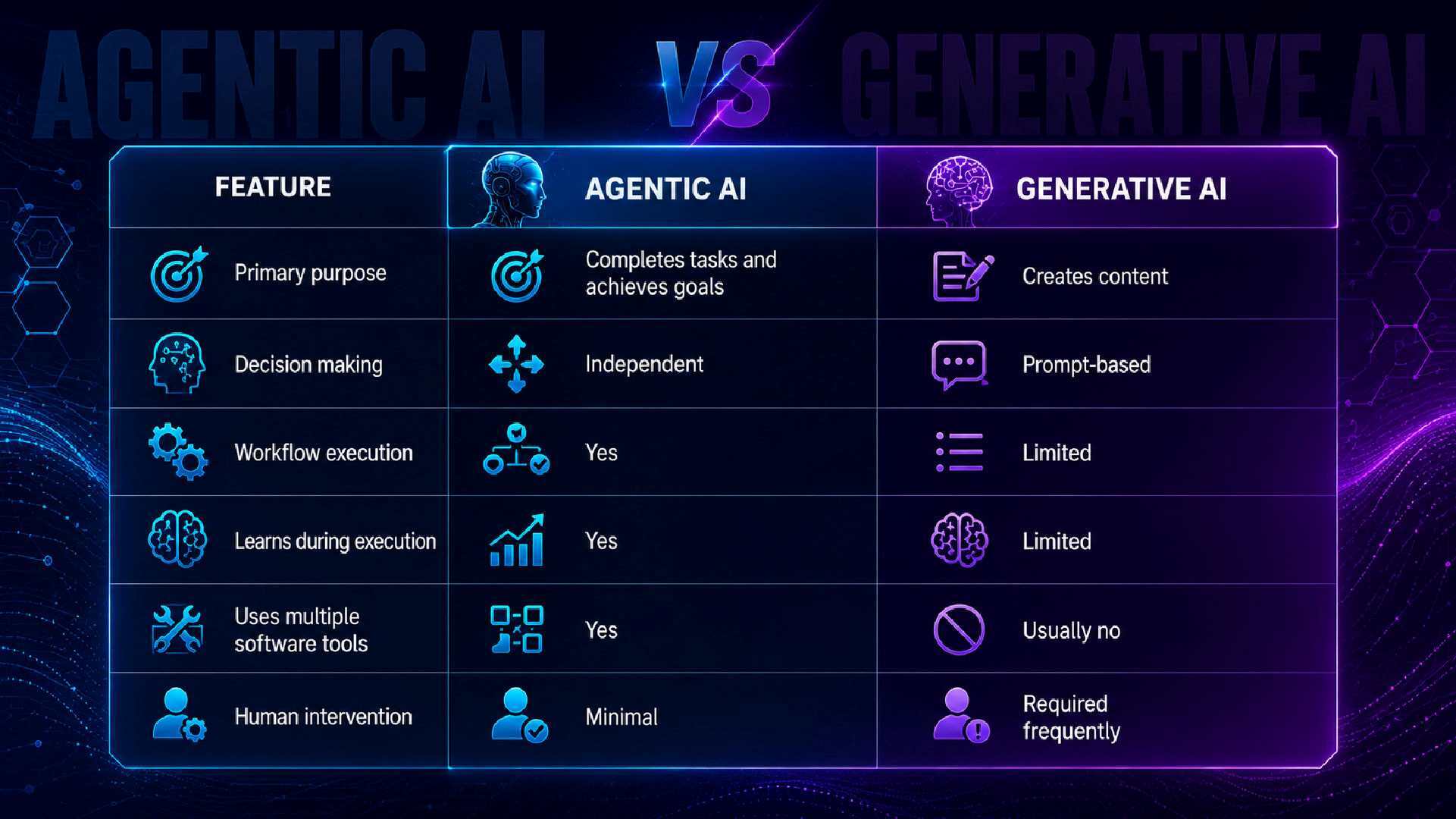
Consider it this way:
Generative AI is comparable to a skilled writer.
Agentic AI is comparable to a highly competent project manager who not only writes but also organizes, assigns, carries out, keeps track of developments, and produces the finished product.
Why Businesses are Moving Towards Agentic AI
Businesses nowadays require more than just content creation.
They want AI that can make judgments more quickly, increase productivity, and decrease manual labor.
For this reason, business AI is developing from basic chatbots to sophisticated digital workers.
Among the main advantages are:
- Quicker execution of tasks
- Lower operating expenses
- Improved decision-making
- An increase in worker productivity
- Increased productivity in business
- Improved client experience
These skills are revolutionizing the future of AI for business across industries.
There are several other benefits of agentic AI. To find out, check out our comprehensive blog post, “Benefits of Agentic AI for Small and Medium Businesses (SMBs)”!
The Impact of AI Agents
AI Agents are the true power of Agentic AI.
Without constant supervision, these clever software agents carry out activities on behalf of people.
A sales AI agent, for instance, can:
- Locate possible leads
- Examine consumer behavior
- Use predictive lead scoring
- Send customized emails
- Set up meetings
- Revise CRM data
- Create performance evaluations
Using Multi-Agent Systems, where each agent specializes in a specific activity, several agents can collaborate rather than finishing one task at a time.
This leads to increased efficiency and quicker execution.
Applications of Agentic AI in Real Business
AI automation is being implemented across departments in modern enterprises.
Sales
AI agents can enhance:
- Sales enablement
- Sales forecasting
- Sales optimization
- Conversion rate optimization
AI continuously evaluates consumer interactions and suggests the best course of action in place of manually tracking leads.
Marketing
Agentic AI is being used by marketing teams for:
- Hyper-personalization
- Marketing automation
- Intelligent Chatbots
- Virtual assistance
- Automated Content creation
In order to increase CTR (click-through rate) and customer engagement, AI analyzes data, researches consumer behavior, and creates customized ads.
Customer Support
Intelligent support systems made possible by agentic AI can:
- Resolve customer queries
- Escalate complex issues
- Update support tickets
- Recommend solutions
This shortens response times while increasing customer satisfaction.
Business Operations
Agentic AI is also used by organizations for:
- Invoice processing
- HR onboarding
- Procurement
- Compliance monitoring
- Finance approvals
These use cases integrate intelligent decision-making with business process automation.
Developing AI Agents: Creating Smart Digital Teams
Every company has different needs.
For this reason, rather than employing general AI technologies, businesses are increasingly investing in AI Agent Development.
ERP, CRM, HRMS, databases, and business applications are all integrated with custom-built AI agent solutions.
By performing AI Workflow Automation, these agents assist businesses in automating tedious processes while retaining total visibility and control.
Instead of just introducing another AI tool, technology leaders like Amit Jadhav assist companies in understanding how tailored AI agents may solve actual operational difficulties.
The Emergence of Autonomous AI Agents: Going Beyond Automation
The development of Autonomous AI Agents is one of the most significant developments in AI.
In contrast to automation based on rules, these agents are able to:
- Examine circumstances
- Make a plan of action
- Adjust to shifting circumstances
- Make wise choices.
- Work along with other AI systems
They use advanced reasoning, natural language processing, and predictive analytics to carry out challenging commercial activities with little oversight.
These agents will process text, images, audio, videos, and documents simultaneously as multimodal AI develops, further improving organizational procedures.
Although today's businesses are mostly focused on useful Agentic AI solutions that provide quantifiable value, technologies like ASI and AGI may further enhance AI capabilities in the future.
Digital Transformation and Agentic AI
AI-powered digital transformation is increasingly being driven by agentic AI.
Businesses are utilizing it to accomplish:
- Faster Enterprise Automation
- Better AI Decision Making
- Smarter AI Powered Workflows
- Improved AI Process Automation
- Scalable Custom AI Solutions
In order to find the best use cases, apply AI ethically, and optimize ROI through quantifiable performance measures, many companies also look for AI consulting services.
In order to provide immersive training, maintenance, and customer interaction experiences, companies are investigating technologies like augmented reality in conjunction with AI as it advances.
Final Thought
Agentic AI is changing how businesses run, while generative AI has changed how we produce content. It can plan, determine, carry out, and constantly improve entire workflows rather than just producing responses.
Agentic AI is assisting businesses in achieving greater efficiency, improved decision-making, and quicker digital transformation through anything from intelligent sales automation and marketing campaigns to corporate operations and customer service.
Companies that strategically implement AI now will be better equipped for the future. Organizations can go beyond basic automation and create intelligent systems that genuinely collaborate with people by integrating Enterprise AI, AI Workflow Automation, and customized AI Agent Solutions.
AI's future is about producing results, not simply content. And that's precisely where Agentic AI is crucial.
- Amit Jadhav
www.amitjadhav.com