
AI Taxonomy Explained: A Complete Guide to the Types and Categories of AI in 2026
Introduction to AI Taxonomy
As artificial intelligence advances from straightforward automation to generative AI, reasoning models, AI agents, and physical systems, AI taxonomy is increasingly crucial. Businesses may learn what each sort of AI accomplishes, where it belongs, and how to utilize it efficiently by understanding the AI taxonomy 2026.
AI is no longer a single technology. It encompasses a wide range of concepts, capabilities, applications, infrastructure, and deployment strategies. The question of "Should we use AI?" is no longer the only one facing company executives. "Which type of AI do we actually need?" is a more pertinent question.
AI Taxonomy: What is it?
An organized method of classifying various forms of artificial intelligence according to its construction, capabilities, and applications is called an AI taxonomy.
Instead of treating all AI systems equally, a helpful artificial intelligence taxonomy divides AI into several tiers. For instance, Amit Jadhav's 2026 architecture divides the AI landscape into three main layers: Foundations, Capabilities, and Applications, which are surrounded by Infrastructure and Governance & Control.
This method provides answers to three fundamental questions, which facilitates AI classification:
- How is AI constructed?
- What is it capable of?
- Where is it being used?
It also emphasizes a crucial point: an AI application, an AI model, and an AI capability are not the same.
Three Fundamental Layers of the AI Taxonomy Framework
Three layers can be used to understand a useful AI taxonomy framework.
1. Foundations: How AI Is Built
The technologies behind modern AI systems are part of the foundation layer.
This comprises:
- Machine learning
- Deep learning
- Foundation models
- Large language models (LLMs)
- Small and domain-specific models
- Fine-tuning
- Retrieval-Augmented Generation (RAG)
- Training and inference
The more general technology that enables systems to identify patterns in data is called machine learning. Multiple-layer neural networks are used in deep learning to find ever-more-complex patterns.
For many AI applications, foundation models offer a reusable base. LLMs are a type of foundation model that is specifically created for tasks involving language.
Because they can provide cheaper costs, more control, and deployment on private or specialized infrastructure, smaller and domain-specific models are also becoming more significant in 2026.
2. Capabilities: What AI Can Do
AI capabilities are the emphasis of the second layer. This makes it easy to comprehend many of the various forms of artificial intelligence.
Important categories of capabilities consist of:
Perception AI: Recognizes and deciphers information from sensory data, including audio, video, and images. It can be used, for instance, for automated quality control in a manufacturing organization.
Generative AI: Text, photos, code, music, video, and designs can all be created with generative AI. It is now one of the most talked-about forms of AI technology.
Reasoning AI: Designed to solve intricate, multi-step problems before coming up with a solution. For analysis, engineering, coding, and decision support, it is becoming more and more important.
Agentic AI: Does more than just provide solutions. AI agents are able to plan tasks, use tools, communicate with other systems, and operate in a way that advances a predetermined objective.
Multimodal AI: Utilizes a variety of data types, such as text, pictures, audio, video, and diagrams. In engineering and industry, where crucial information may be found in drawings, inspection photos, manuals, and reports, this is very helpful.
Physical AI: Enables AI to observe and act in the physical environment by integrating it with robotics, automation, and sensors.
These classifications demonstrate why it can be deceptive to refer to everything as "AI."
3. Applications: Where AI Is Deployed
The third layer focuses on how AI is applied to address practical business issues. Sales and marketing, finance, human resources, customer service, engineering, manufacturing, and healthcare are a few examples of applications.
For instance, predictive AI may assist with forecasting and risk analysis, while generative AI can enhance content development and document analysis. This layer links AI capabilities to real-world use cases and commercial consequences.
AI Types and Categories: How They Differ
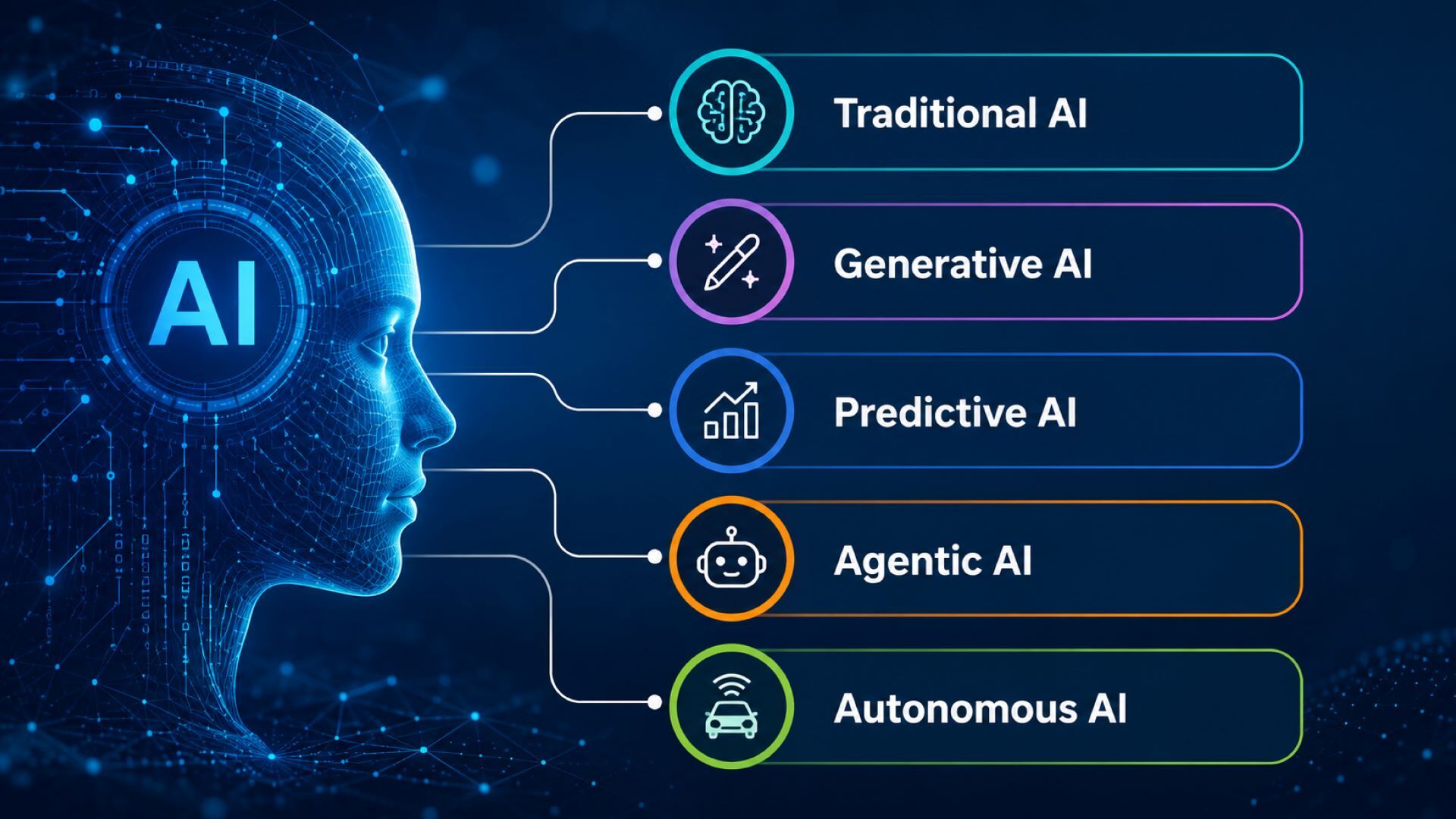
Discussing AI based on its degree of capacity is another popular method for artificial intelligence classification.
Traditional AI
Conventional AI systems typically use machine learning models, statistical methods, or predetermined rules to design for certain tasks. Common examples include fraud detection, recommendation engines, predictive analytics, and predictive maintenance.
Generative AI
Using patterns discovered in its training data, generative AI creates new material. Companies utilize it for knowledge support, customer service, content production, summarization, and coding.
Predictive AI
Predictive AI forecasts future outcomes by analyzing past and present data. Applications include demand forecasting, sales forecasting, equipment failure prediction, risk analysis, and predictive lead scoring.
Agentic AI
The transition from AI that reports to AI that takes action is known as agentic AI. With little assistance from humans, an AI agent may be given a task, plan several stages, access authorized resources, and finish portions of a process.
For this reason, it's crucial to distinguish between AI agents vs. generative AI. The main functions of generative AI are creation and response. Generation can be used by agentic AI as a part of a larger action-oriented system.
Autonomous AI
This idea is expanded upon by autonomous AI systems, which carry out tasks with little assistance from humans. Nonetheless, the degree of autonomy must be determined by the associated danger. Human approval may still be necessary for financial transactions, consumer communications, or modifications to important records.
AI Categories by Business Use
Rather than the underlying model, the most beneficial AI categories for organizations are frequently determined by what they achieve.
AI in Sales
AI is able to assist:
- Sales enablement
- Sales forecasting
- Predictive lead scoring
- Customer engagement
- Sales optimization
- Conversion rate optimization
For instance, generative AI may assist sales teams in creating emails, proposals, and meeting summaries, while predictive models can determine which leads are more likely to convert.
AI in Marketing
AI can be used by marketing teams for:
- Hyper-personalization
- Marketing automation
- Chatbots
- Virtual assistance
- Content creation
- Customer analysis
CTR, conversion rates, and customer happiness are examples of performance indicators that can be used to assess if these apps are yielding significant business outcomes.
AI in Manufacturing and Operations
Some of the most promising real-world uses for AI are in manufacturing. While perception AI can assist visual inspection, predictive maintenance can spot possible equipment problems.
Industrial systems can be made more responsive by combining digital twins, IoT, robotics, and physical AI.
What's Next: Agentic AI vs. Generative AI
As companies transition from experimentation to workflow automation, the distinction between agentic AI vs. generative AI will become more crucial.
An employee could write a report with the aid of generative AI. It is possible that an AI agent may collect the necessary data, evaluate it, compile the report, submit it for approval, and update the pertinent system.
But increased autonomy also comes with increased risks. Despite high predictions for future adoption, Amit Jadhav's 2026 framework acknowledges that only a small number of enterprises have used AI agents at the time of its publishing.
Therefore, rather than using agentic AI just because it's popular, enterprises should concentrate on defined use cases, governance, human oversight, and quantifiable ROI.
AI Ecosystem: Models to Implementation
AI models are only one aspect of the current AI ecosystem.
It also consists of:
- AI architecture
- AI infrastructure
- Cloud and on-premise computing
- Edge and IoT devices
- Data pipelines
- APIs and integrations
- Security and governance
- AI deployment platforms
AI's operating environment can be just as significant as its capabilities. Private, on-premise, edge, or sovereign AI implementation may be necessary for organizations that handle sensitive engineering, financial, healthcare, or government data.
Equally vital is governance. Controls for data access, model evaluation, security, privacy, hallucinations, and safe AI use are necessary for businesses.
The Significance of AI Classification in 2026
The field of AI classification is evolving quickly. Businesses shouldn't chase every new AI label, even while new models and applications are always emerging.
Rather, begin with the business issue.
Do you require automation? Think about AI agents or workflow automation.
Do you require more accurate forecasts? Examine predictive analytics and AI.
Do you require code or content? It might be suitable to use generative AI.
Do you need to comprehend industrial data or images? Think about multimodal AI or perception.
Do you need AI to interact with machines? IoT, robots, and physical AI might be more relevant.
Using the most cutting-edge AI technology is not the aim. Selecting the technology that produces the best business result is the aim.
Conclusion: Comprehending the 2026 AI Environment
Machine learning foundations, generative and predictive capabilities, agentic AI, multimodal systems, physical AI, and business applications are all included in the AI taxonomy 2026 landscape, which is more expansive than before.
Organizations may assess technologies, vendors, deployment strategies, and use cases more clearly when they are aware of these AI types and categories.
The most significant change is that AI is evolving from standalone tools to integrated commercial solutions. The companies that use AI the most won't always be the ones that prosper. They will be the ones who know which AI to use, where to put it, how to control it, and how to gauge its effects.
AI is no longer a single category. It is an ecosystem, and understanding how it functions as a whole is turning into a competitive advantage.
- Amit Jadhav
www.amitjadhav.com