
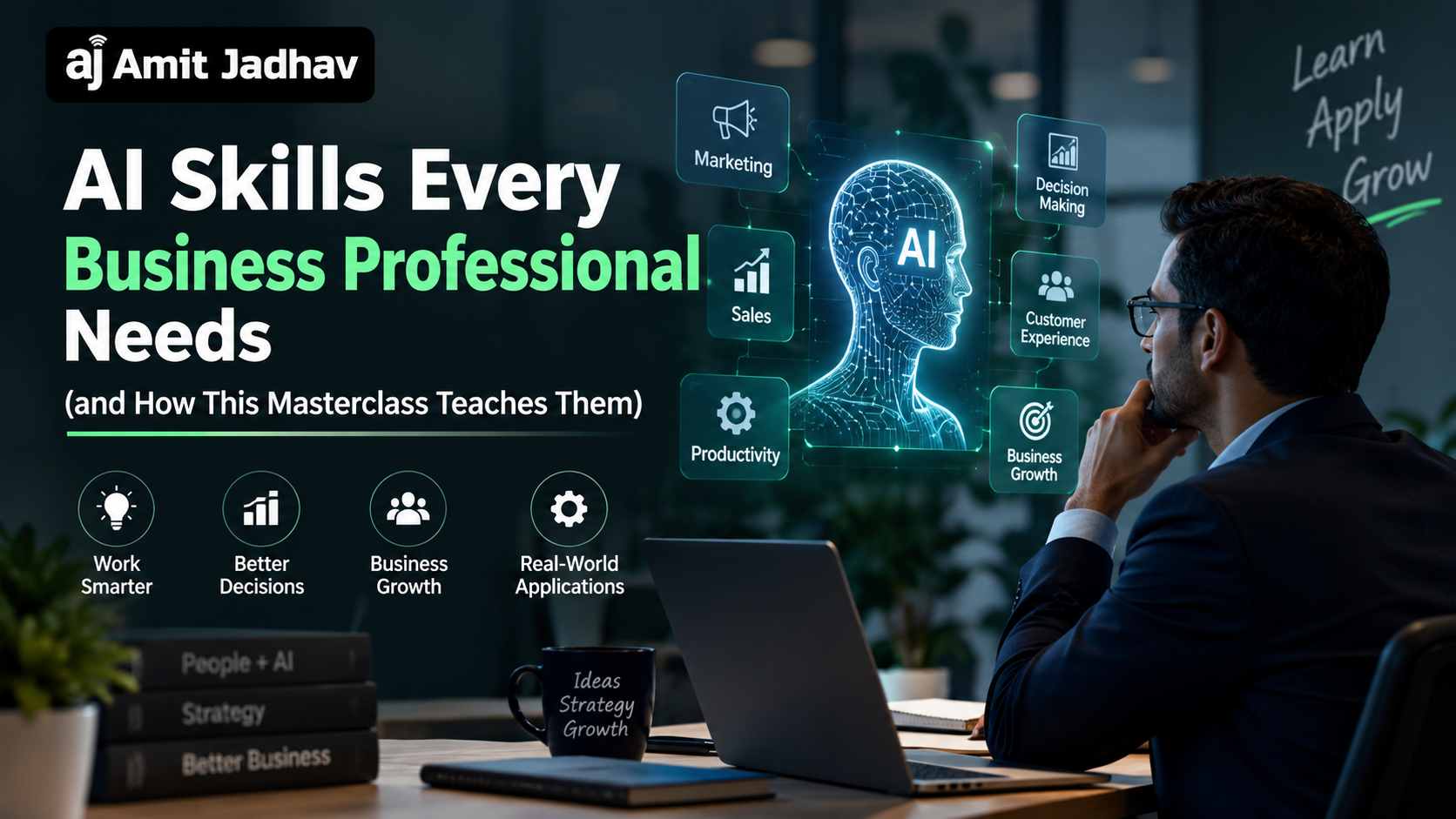
AI Skills Every Business Professional Needs (and How This Masterclass Teaches Them)
Introduction to AI Masterclass For Business Professionals
An AI masterclass for business professionals can help individuals move beyond understanding the basics of AI and learn how to apply it to real-world business situations. From marketing and sales to productivity and decision-making, AI is increasingly becoming a valuable part of today’s workplace.
The focus is no longer simply on asking, “Should businesses embrace AI?” Instead, it is, “Do business professionals have the skills to use AI effectively?”
AI is transforming how organizations operate, interact with customers, analyse data, and make business decisions. However, successful AI adoption involves more than simply being familiar with popular AI tools. Professionals need to understand how to identify suitable AI use cases, provide clear and effective instructions, assess AI-generated results, and align AI applications with broader business objectives.
AI for Business Growth: Understanding Where AI Fits
One of the key skills business professionals need is knowing how to recognize areas where AI can deliver real business value and support growth.
AI should not be adopted just because it is a current trend. Businesses should first examine their existing workflows and identify processes where AI can make a meaningful difference—whether by improving efficiency, increasing productivity, enhancing customer experience, or supporting revenue growth.
For instance, organizations can use AI automation for business to handle repetitive administrative tasks and save valuable time. Sales teams can apply AI for lead generation, while marketing teams can use AI to evaluate campaign performance, identify patterns, and gain deeper insights into customer behaviour.
To determine whether AI is the right solution, professionals should consider questions such as:
- What particular business challenges can AI help us solve?
- Can AI make this process faster, easier, or more effective?
- What data or information will AI need?
- What kind of ROI can the business expect?
- Which performance metrics can be used to measure the results?
This business-first mindset plays an important role in building practical and effective AI business strategies.
For more understanding, you can read our blog post, “AI for Business Growth: What You will Learn in Amit Jadhav's Masterclass (Step-by-Step)”!
Generative AI for Business: Learning to Work With AI
Generative AI is changing the way professionals handle many everyday business tasks. It can assist with creating content, summarizing information, brainstorming ideas, developing presentations, and conducting research.
However, getting valuable and relevant results from AI involves more than simply typing a question into an AI tool. Professionals need to know how to provide the right context, clearly communicate the expected outcome, set appropriate limitations, and carefully review AI-generated responses before using them.
These skills can be particularly valuable for AI for content creation, research, business communication, presentations, and documentation. With the right approach, professionals can use generative AI to save time while maintaining quality and relevance.
Another significant development is multimodal AI, which enables AI systems to work with different types of information, such as text, images, audio, and documents. Learning how these capabilities work can help business professionals identify new AI applications and improve existing workflows without requiring advanced technical expertise.
AI in Marketing and Sales: Turning Data Into Action
Marketing and sales teams can benefit from several practical applications of AI in their everyday activities. Understanding AI in marketing and sales allows professionals to explore areas such as customer segmentation, campaign planning, lead qualification, customer engagement, and performance measurement.
In marketing, AI can help with:
- Hyper-personalization of customer communication
- Marketing automation
- Chatbots and virtual assistants
- Content creation
- Campaign performance analysis
- CTR (click-through rate) analysis
- Monitoring other key performance metrics
For sales teams, AI can support sales enablement, sales forecasting, predictive lead scoring, customer engagement, and sales optimization.
For example, AI can analyze customer interactions and help sales professionals identify leads that may need further attention. Similarly, marketing teams can examine campaign data to determine which content, messages, or approaches are generating stronger engagement.
While AI can provide valuable insights and improve efficiency, it should complement human judgment rather than replace it. Professionals still need a clear understanding of their customers, market, brand, and overall business objectives to use AI effectively.
AI for Decision Making: Turning Data Into Useful Insights
Businesses collect large volumes of information from sales, marketing, customer interactions, operations, and various other activities. The real challenge is converting this data into meaningful insights that can support business decisions.
This is where AI for decision making, Data Analysis, and Predictive Analytics can play an important role.
AI can process large datasets, identify patterns, summarise information, and help professionals recognise potential trends. Predictive Analytics can further support business activities such as sales forecasting, demand planning, and identifying possible future outcomes.
Business professionals do not necessarily need advanced data science skills to benefit from these capabilities. Instead, they should know how to interpret AI-generated insights, critically evaluate the results, and relate them to specific business objectives.
This is especially important because AI-generated information may sometimes be incomplete, misleading, or inaccurate. Human expertise and review therefore remain essential when using AI to support business decisions.
AI Automation for Business: Knowing What to Automate
Automation is another valuable area that business professionals should understand when working with AI.
Many organizations spend significant employee time on repetitive activities such as preparing reports, organising information, managing data, answering routine queries, and sending follow-up messages.
AI automation for business can help simplify and streamline suitable tasks, allowing employees to focus more on creative, analytical, and strategic responsibilities.
However, automation needs to be implemented with care. Not every business activity is suitable for automation. Professionals should assess which tasks can be automated effectively and determine where human review, decision-making, or approval should remain part of the process.
This becomes especially important when automated workflows involve sensitive business data, customer information, financial decisions, or important business communications.
AI Tools for Business Growth: Choosing the Right Technology
With a wide range of AI solutions available today, businesses have plenty of options to choose from. The real challenge is identifying which tools can deliver meaningful value for a specific business and its requirements.
Professionals should learn how to assess AI tools for business growth by considering factors such as:
- Business requirements
- Ease of use
- Data privacy and security
- Integration capabilities
- Cost
- Accuracy
- Scalability
- Expected ROI
Rather than adopting several tools simply because they are widely used or trending, businesses should choose solutions that address specific needs and deliver measurable results.
Therefore, knowing how to evaluate AI tools is just as important as knowing how to use them effectively.
AI in Business Strategy: Moving Beyond Individual Tools
The greater value of AI emerges when organizations look beyond using it as a standalone productivity tool and consider how it can support their broader business strategy.
An AI masterclass for business professionals should therefore go beyond simple tool demonstrations. Professionals need to understand how AI can connect different business functions, including marketing, sales, customer experience, operations, and Digital transformation.
Instead of asking, “Which AI tool can help us create content?”, business leaders can think more strategically by asking, “How can AI improve our complete content workflow while maintaining quality and brand consistency?”
This broader perspective can help organizations build practical AI business strategies rather than relying on a collection of disconnected AI tools.
AI Training for Entrepreneurs: Building an AI-Ready Business
Entrepreneurs and startup teams often handle several responsibilities while working with limited time, people, and resources.
AI training for entrepreneurs can help them understand how to apply AI for startups and entrepreneurs in areas such as market research, content creation, customer support, sales, productivity, and business analysis.
AI tools can also serve as valuable productivity assistants by helping with routine and time-consuming tasks. However, entrepreneurs should understand the limitations of these tools and avoid relying entirely on unverified AI-generated information when making important business decisions.
Practical AI education should therefore include key areas such as responsible AI use, data privacy, human oversight, and effective prompting. These skills can help entrepreneurs use AI more thoughtfully while keeping business goals and accountability in focus.
How the AI Masterclass by Amit Jadhav Teaches These Skills
An AI masterclass in India can help bring these concepts together by focusing on practical business use cases rather than concentrating only on technical theory.
The AI training by Amit Jadhav focuses on helping professionals understand how AI can be applied to address real-world business needs and challenges.
A practical AI workshop for business leaders can give participants exposure to AI applications in areas such as marketing, sales, productivity, content creation, decision-making, and automation.
For professionals searching for an AI masterclass in Pune, an AI workshop for business owners Pune, or AI training for entrepreneurs in Pune, a business-focused learning experience can offer a practical starting point for understanding how AI can be applied across different areas of business.
Why AI Skills Matter
AI is reshaping how businesses manage productivity, marketing, sales, customer engagement, and decision-making. However, simply having access to AI technology does not automatically deliver business value. Professionals need the right skills and knowledge to use these tools effectively.
Professionals with a strong understanding of AI can identify relevant use cases, assess different tools, work with data, automate appropriate processes, and align AI applications with business objectives.
Whether someone is exploring an AI course for professionals, a business AI course Pune, an AI seminar for professionals in Pune, or AI training India for business leaders, the emphasis should be on building practical skills that professionals can apply in their day-to-day work.
The future of AI in business is not about applying AI to every task. It is about understanding where AI can add value, where human expertise remains essential, and how people and AI can work together effectively.
- Amit Jadhav
www.amitjadhav.com