
AI Digital Marketing Strategy for B2B & B2C Brands
Smart Brand Growth
Brands that succeed in 2026 are smart, not just digital. These days, having an AI digital marketing strategy is essential for scalable growth in both B2B and B2C ecosystems. Businesses may automate, optimize, and exceed traditional marketing models with AI in digital marketing, from hyper-personalization to predictive lead scoring.
Inspired by frameworks such as Amit Jadhav's Digital Growth Accelerator System (DGAS), contemporary marketing methods incorporate automation, data-backed performance indicators, and AI-driven systems to produce quantifiable ROI.
This article examines how to create a framework for a results-driven AI marketing strategy for both B2B and B2C companies.
An AI Digital Marketing Strategy: What is it?
An AI digital marketing strategy is a methodical approach that uses predictive analytics, machine learning in digital marketing, AI marketing tools, and marketing strategy principles to automate and optimize marketing campaigns.
AI-powered marketing systems, in contrast to conventional campaigns that mostly rely on human targeting and intuition, use:
- Analyzing data to comprehend customer behavior
- Workflow optimization through automation
- Natural language processing for chatbots and content
- Multimodal AI for combined speech, text, and visual communication
- Using generative AI to create scalable content
The outcome? increased client happiness, better conversion rate optimization, and a higher click-through rate.
Framework for AI Marketing Strategies for B2B and B2C Brands
In order to successfully integrate AI into digital marketing, organizations need to adhere to a methodical framework:
1. Predictive Analytics and Data Intelligence
Data is essential to AI. Whether you are using AI in e-commerce marketing or developing a B2B digital marketing plan, your foundation needs to consist of:
- CRM solutions that are centralized
- Tools for tracking behavior
- AI segmentation of customers
- Forecasting using predictive analytics
Predictive lead scoring helps B2B companies identify high-intent prospects, enhancing sales enablement and reducing sales cycles.
Machine learning in digital marketing finds buying trends for B2C firms, increasing hyper-personalization and consumer interaction.
2. AI-Powered Sales Funnel Optimization and Marketing Automation
The foundation of contemporary digital transformation is AI marketing automation.
For AI marketing for B2B businesses, Automation improves:
- AI-powered lead creation
- Sales funnel optimization
- Automated nurturing of emails
- Sales Forecasting
Based on past performance, predictive algorithms evaluate performance parameters and recommend sales improvement tactics.
AI-powered marketing in B2C automates:
- Recovery of abandoned carts
- Customized product suggestions
- Chatbots and online support
- AI for marketing initiatives on social media
Automation greatly boosts ROI in addition to increasing operational efficiency.
3. Customer Experience & Hyper-Personalization
Hyper-personalization is one of the main advantages of AI in marketing.
AI consumer segmentation allows brands to provide:
- Content for dynamic websites
- Customized email marketing
- Personalized advertising creatives
- Astute product suggestions
AI-powered tailored marketing enhances account-based marketing results in B2B.
Real-time behavioral targeting in B2C e-commerce marketing is made possible by AI, which raises conversion rates and click-through rates.
Long-term loyalty and consumer satisfaction are increased by AI-driven customisation.
To know more about AI-driven marketing strategies, explore our blog, “Boost Your Business with Amit Jadhav’s Expert Insights on AI & Marketing”!
Strategic Benefits of AI Marketing for B2B Businesses
Longer sales cycles and several decision-makers are features of B2B marketing. To increase pipeline efficiency, a smart B2B digital marketing strategy incorporates AI into business.
Important Uses:
- AI-powered lead generation with behavioral scoring
- Using predictive lead scoring to find high-value prospects
- Quarterly revenue forecasts using sales forecasting
- AI-powered email sequencing
No high-potential opportunity is missed thanks to AI for sales funnel optimization.
Furthermore, natural language processing improves early-stage consumer engagement and certification by enhancing chatbot chats.
B2B companies can attain quantifiable sales optimization and improved performance metrics by integrating automation and data analysis.
AI in E-Commerce Marketing: Promoting B2C Development
Success for consumer brands is determined by customisation and quickness. AI client segmentation is one way that AI in e-commerce marketing changes user journeys.
Other ways are:-
- AI for marketing on social media
- Previews of augmented reality products
- AI-driven marketing suggestions
AI marketing solutions use demographic information, past purchases, and browsing behavior to generate customized marketing at scale.
For instance:
- Demand-driven dynamic pricing models
- Content generation using generative AI for product descriptions
- Chatbots for immediate assistance
This degree of automation boosts ROI, enhances customer satisfaction, and raises CTR (click-through rate).
How to Effectively Use AI in Digital Marketing
How to use AI in digital marketing without overcomplicating systems is a question that many firms have.
Here's a useful strategy:
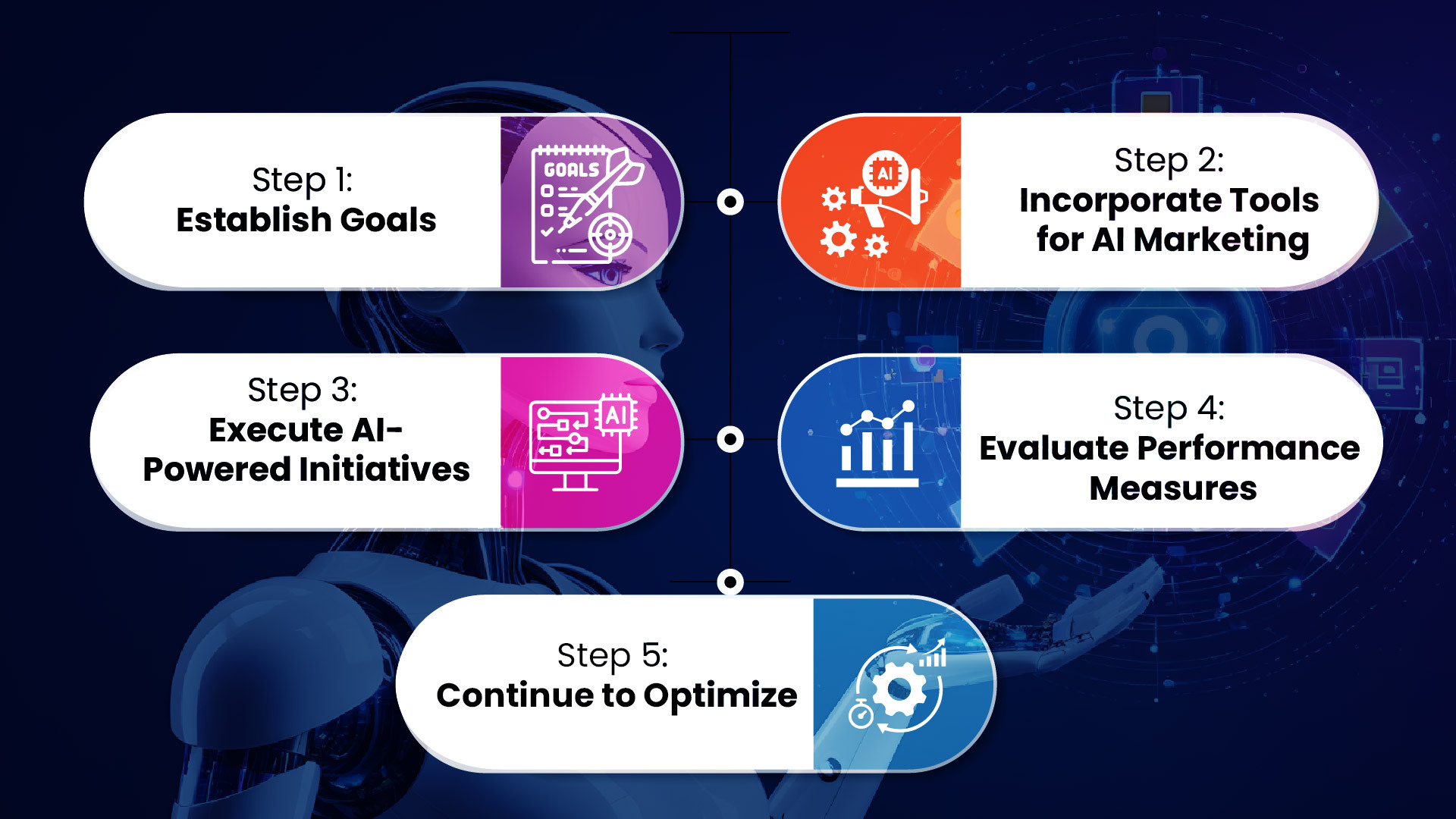
Step 1: Establish Goals
Determine KPIs like sales enablement, customer engagement, and conversion rate optimization.
Step 2: Incorporate Tools for AI Marketing
For content production, predictive analytics, and CRM integration, use AI marketing automation tools.
Step 3: Execute AI-Powered Initiatives
Run customized landing pages, automated email workflows, and AI-powered ad targeting.
Step 4: Evaluate Performance Measures
Monitor client happiness, ROI, CTR, and the accuracy of predicted lead scoring.
Step 5: Continue to Optimize
Over time, machine learning in digital marketing advances, automatically improving segmentation and targeting.
2026 AI Marketing Trends: What Comes Next?
A number of developments are changing digital ecosystems as we get closer to AI marketing trends in 2026:
- Multimodal AI that combines speech, text, and video marketing
- Real-time decision-making using sophisticated predictive analytics
- Generative AI for large-scale automated content production
- Augmented reality experiences powered by AI
- Increased automation in all marketing automation systems
The increasing sophistication of AI in business ecosystems is indicated by emerging ideas such as ASI and AJI talks in advanced AI forums.
Early adopters will rule their respective markets.
Examples of AI Marketing: Practical Impact
Let's look at some real-world AI marketing examples:
B2B Illustration:
A SaaS business combines AI marketing automation with predictive lead scoring. As a result:
- Sales forecasting accuracy has increased by 40%.
- AI-generated leads increased by 25%
- Increased interaction with customers
B2C Example:
An online retailer employs AI for client segmentation and tailored advertising.
- Better conversion rate optimization is the outcome.
- Increased CTR
- A higher return on investment from sponsored campaigns
These illustrations show the real advantages of AI in marketing.
AI's Marketing Benefits for Modern Brands
AI has advantages in marketing that go beyond automation:
- Enhanced return on investment via performance optimization
- Improved insights and data analysis
- Increased client satisfaction
- Generative AI for scalable content production
- Quicker digital transformation
AI improves predictive lead scoring and sales enablement for business-to-business transactions.
It improves AI and hyper-personalization in B2C e-commerce marketing.
Conclusion: Developing an AI Digital Marketing Strategy for the Future
Data, automation, personalization, and predictive analytics are all combined into a single ecosystem by a successful AI digital marketing strategy. The secret is organized execution, whether you are scaling AI in e-commerce marketing or deploying AI marketing for B2B businesses.
Businesses that use AI-driven solutions now will benefit in the future from increased customer engagement, greater conversion rate optimization, stronger sales optimization, and quantifiable ROI.
Success in 2026 and beyond will depend on how cleverly you use AI in digital marketing, not how much you market.
Brands that blend strategy and intelligence will win the future.
- Amit Jadhav
www.amitjadhav.com