
How to Build Trust and Close Deals with a 7-Step Social Selling Strategy
Introduction
Customers buy from people they trust in today's hyper-digital world, not from forceful sales pitches or generic advertisements. For businesses and sales professionals, a 7 step social selling strategy has proven a game-changer. Social selling enables you to establish reputation, meaningfully engage prospects, and convert leads more quickly than traditional selling by fusing human connection with AI-driven insights. Businesses can now automate, improve, and customize each step of the social selling process thanks to the development of sophisticated tools like Amit Jadhav's Digital Growth Accelerator System (DGAS).
For more information, you can read our blog post, “How Social Selling Accelerates Business Growth - The DGAS Advantage”!
This blog explains the 7 step social selling process, demonstrating how to increase client interaction, foster trust, and regularly close more purchases.
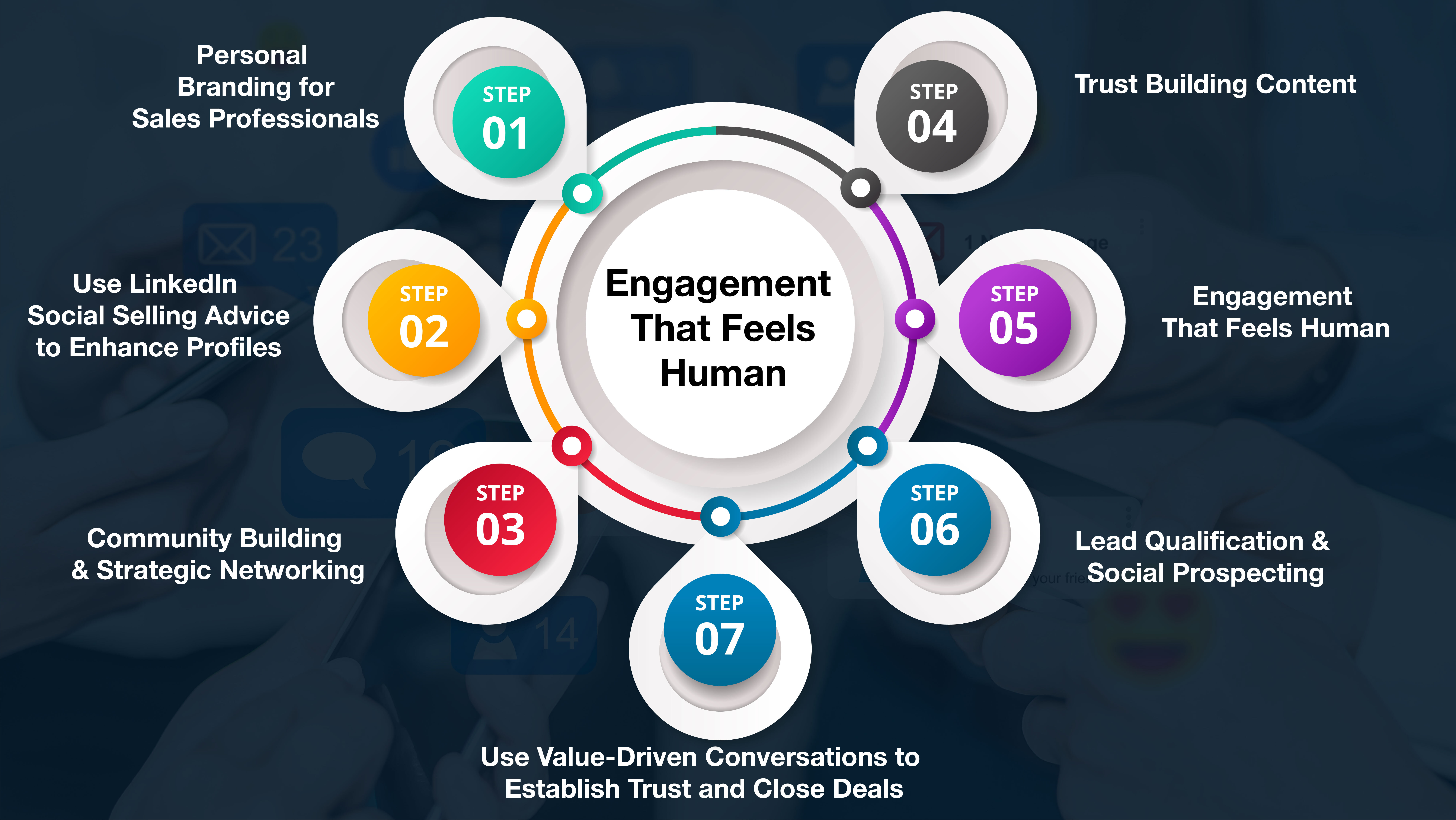
Step 1: Personal Branding for Sales Professionals
You are the first person on your social selling adventure. Customers trust your personal brand before they trust your product.
Having a strong personal brand benefits you:
- Boost decision-makers' visibility
- Show off your authority by producing content.
- Create deep connections on the internet
Post interesting articles, videos, client testimonials, and thought leadership stuff. When combined with AI-driven tools that evaluate performance metrics and optimize your posting strategy, platforms such as LinkedIn are perfect for social selling for business growth.
Predictive analytics, customer data analysis, and behavioral targeting are tools found in systems like DGAS that help you understand what your audience wants so that your brand consistently conveys the proper message.
Step 2: Use LinkedIn Social Selling Advice to Enhance Profiles
Your online storefront is your social media profile.
Your credibility starts here.
A profile that is optimized consists of:
- A concise, value-driven headline
- An expertly taken picture
- An authentic "About" section that tells a tale
- Testimonials, press coverage, or case studies are examples of evidence of expertise.
Your exposure and trust are increased when you use LinkedIn social selling tips. Automation, content creation, and even chatbots for customer engagement guarantee that prospects receive prompt responses, increasing customer happiness and CTR.
Step 3: Community Building & Strategic Networking
While talking about social selling vs traditional selling, social selling demonstrates that modern buyers react better when you cultivate relationships, traditional selling concentrates on pursuing prospects.
Among the components of effective networking are:
- Making connections with the appropriate prospects
- Interacting with business communities
- Taking part in specialized groups
- Participating in conversations and offering insights
You can now find high-intent prospects more quickly thanks to multimodal AI, predictive lead scoring, and natural language processing. DGAS tools allow businesses to use AI by displaying the most engaged prospects, which enables your sales teams to contact them at the ideal moment.
Lead generation becomes more intelligent and focused at this point.
Step 4: Trust-Building Content
The most important factor in building credibility online is content. Your content must inform, uplift, or resolve issues in order to draw in and convert leads.
You may combine:
- Posts with lots of value
- Short videos
- Infographics
- Webinars
- Content produced by AI
- Articles on thought leadership
This makes it easier to demonstrate how to generate leads through social media and helps you show off your skills. By customizing your message to your audience's interests, you can add hyper-personalization.
You can precisely produce highly targeted content, increasing CTR and total ROI, thanks to generative AI, ASI & AJI, and sophisticated data analysis.
Step 5: Engagement That Feels Human
Conversations, not pitches, are what your audience wants.
Meaningful involvement is the main objective of this phase in the 7 step social selling strategy:
- Respond to remarks
- Participate in discussions
- Recognize client accomplishments
- Use surveys or inquiries
- Discuss your thoughts on business news
Even on hectic days, you can stay constantly active using solutions like marketing automation, and virtual assistance. In the meantime, your team may react with the appropriate message at the appropriate moment thanks to sales enablement tools.
Trust increases when involvement is genuine. Additionally, conversion rate optimization is strongly impacted by trust.
Step 6: Lead Qualification & Social Prospecting
Unfiltered consumer conversations can be found in abundance on social media. These conversations can be filtered by sophisticated algorithms using behavioral targeting, voice search optimization, and predictive analytics.
This benefits you:
- Recognize purchasing indications
- Give top priority to quality leads
- Recognize the problems that customers face
- Make your outreach unique
The entire social prospecting process is automated by AI technologies like DGAS, which makes it simpler to comprehend how to convert leads using social media without wasting time on unqualified prospects.
Sales forecasting and advanced performance indicators are used in this step to make sure your pipeline remains robust.
Step 7: Use Value-Driven Conversations to Establish Trust and Close Deals
Transitioning from social to commercial discussions while maintaining authenticity is the last phase of the 7 Step Social Selling Strategy.
To close business with assurance:
- Prior to pitching, provide real value.
- Provide case studies, evidence, and endorsements.
- Utilize AI-powered insights to customize your offer
- Follow up with assurance and clarity
- Display quantifiable ROI
The Digital Growth Accelerator System is crucial in this situation. By utilizing automation, predictive analytics, and sales optimization solutions to guarantee that no lead expires, it streamlines the buyer experience.
When the proper foundation is in place, conversations become customers and trust becomes action.
Why a 7 Step Social Selling Strategy Is More Effective Than Traditional Selling?
Traditional selling is frequently forceful and disruptive. However, social selling is quantifiable, insight-driven, and built on trust.
Its main objectives are:
- Building relationships with customers
- Being present all the time
- Delivering value without selling first and
- Using AI tools to increase efficiency
Sales professionals can make more informed decisions and develop customized buyer experiences at scale by integrating AI, which includes conversational chatbots, predictive lead scoring, and behavioral analytics.
For modern sales teams, this is a true digital transformation.
Concluding Remarks: Technology + Trust = High-Impact Selling
A well-implemented 7 Step Social Selling Strategy changes the way you sell in addition to increasing your visibility. You can develop a strong ecosystem that fosters trust and speeds up growth by utilizing personal branding, focused engagement, robust networking, and AI-driven solutions like the Digital Growth Accelerator System.
Social selling enables you to engage more deeply, convert more quickly, and provide outstanding customer experiences - one conversation at a time - in a world where customers demand relevance, authenticity, and value.
- Amit Jadhav
www.amitjadhav.com