
AI Automation for Enterprises: How Businesses Are Scaling Faster in 2026
Introduction to AI Automation
By 2026, AI automation for enterprises will be a competitive need rather than a futuristic idea. Businesses in a variety of sectors are using AI automation in business to improve decision-making, expedite processes, and encourage rapid expansion. Businesses may now automate complicated processes, enhance consumer engagement, and reach new productivity levels thanks to the quick development of AI-driven technologies.
Businesses who use enterprise AI automation early are gaining a substantial advantage in scalability and operational efficiency, according to industry experts like Amit Jadhav. In 2026, let's examine how AI automation is changing businesses and facilitating quicker growth.
AI Automation for Enterprises: What Is It?
The application of artificial intelligence technologies to automate corporate processes, minimize human participation, and improve decision-making capabilities at scale is known as AI automation for enterprises. AI-powered systems have the ability to learn, adapt, and optimize over time, in contrast to traditional automation.
Important elements consist of:
- Natural language processing (NLP) for chatbots and communication
- Forecasting and decision-making using predictive analytics
- Generative AI for innovation and content production
- Multimodal AI for concurrent text, picture, and video analysis
This combination enables businesses to automate business processes with AI while retaining intelligence and flexibility.
The Significance of AI Automation in Business in 2026
The need for quicker decision-making, more rivalry, and increased customer expectations have all contributed to the surge in demand for AI automation in business.
1. Accelerating the Digital Transformation
Digital transformation techniques revolve around AI. Businesses are incorporating AI into their processes to enhance agility and upgrade outdated systems.
2. Improving Operational Efficiency
Businesses may decrease errors, remove repetitive processes, and optimize resource allocation by utilizing AI for operational efficiency. Better ROI and performance metrics result from this.
3. Data-Driven Decision Making
Businesses may improve results across departments, from sales to customer service, by using AI-powered data analysis to make well-informed decisions in real time.
How Businesses Will Employ AI Automation in 2026
Clarity on the practical effects of AI automation can be gained by understanding how enterprises use AI automation in 2026.
1. Automation of Intelligent Workflow
Businesses are using AI workflow automation tools to improve supply chain management, HR procedures, and invoicing.
2. Chatbots and virtual assistants for customer support
Chatbots and virtual assistance systems driven by AI increase client satisfaction by offering round-the-clock assistance and quicker query resolution.
3. Forecasting and Sales Enablement
Sales enablement is supported by AI-driven systems through:
- Predictive lead scoring
- Sales forecasting
- Sales optimization
Teams benefit from more income and better conversion rate optimization as a result.
4. Hyper-Personalization and Marketing Automation
Businesses can use AI to create hyper-personalized marketing strategies. In order to maximize consumer engagement and CTR (click-through rate), AI systems examine user behavior.
AI Automation's Advantages for Businesses
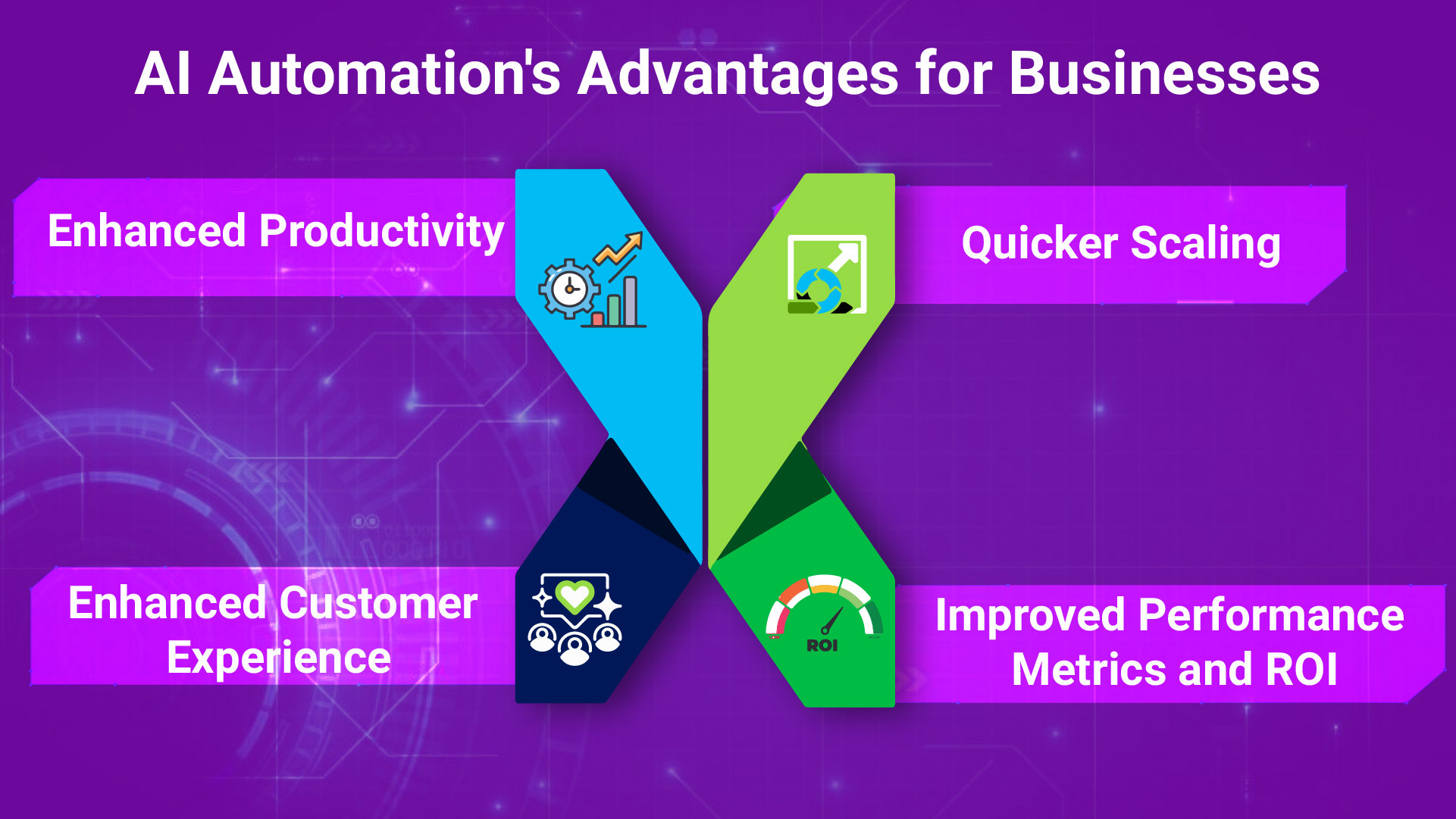
Beyond just saving money, benefits of AI automation for companies has a direct positive impact on expansion and scalability for businesses.
1. Enhanced Productivity
AI increases corporate efficiency by reducing manual labor, freeing up staff to concentrate on key projects.
2. Quicker Scaling
AI for scaling business is a major growth driver since businesses may expand operations without correspondingly raising costs.
3. Enhanced Customer Experience
AI increases customer satisfaction by improving customer engagement through tailored interactions.
4. Improved Performance Metrics and ROI
Efficiency gains from automation lead to quantifiable increases in ROI and key performance metrics.
AI Automation Tools Driving Businesses
Businesses are able to innovate and expand thanks to a variety of AI automation tools:
- CRM solutions driven by AI for client relationship management
- Platforms for marketing automation to optimize campaigns
- Predictive insights with AI analytics tools
- Tools for creating content that use generative AI
These tools are crucial for large-scale business automation using AI.
Examples of AI Automation in Business
AI automation examples in business in the real world in business demonstrate its revolutionary potential:
- Retail businesses utilizing AI for inventory control and demand forecasting
- Manufacturing companies using augmented reality and artificial intelligence for predictive maintenance
- Financial organizations using AI to evaluate risk and detect fraud
- AI-powered e-commerce sites that provide customized product suggestions
These use stories show how AI solutions for enterprises are spurring innovation in a variety of sectors.
Enterprise AI Automation's Difficulties
Despite the substantial advantages, businesses need to overcome a few obstacles:
1. Complexity of Implementation
Companies must have the right infrastructure and implementation experience in order to use AI.
2. Security and Privacy of Data
Strong security precautions are necessary when handling massive amounts of data.
3. Deficits in Skills
To fully utilize AI, organizations must invest in business automation training or hire qualified individuals.
The Function of AI Training and Consulting
Businesses are progressively investing in the following to successfully use AI:
- AI consulting services
- AI corporate training program
- AI workshop for enterprises
These programs assist businesses in comprehending how to successfully use AI into their operations and attain sustained profitability.
To speed up the use of AI and guarantee quantifiable commercial results, experts like Amit Jadhav support structured learning and strategic advising.
DGAS's Contribution to the Success of Enterprise AI Automation
Amit Jadhav's Digital Growth Accelerator System (DGAS) is one of the best frameworks for scalable enterprise AI automation. By integrating digital marketing, sales automation, and AI-driven execution into a single system, DGAS helps organizations match AI initiatives with business growth. It offers businesses ready-to-use automation workflows, structured frameworks, and strategic advice to effectively automate business processes with AI.
Businesses may greatly increase ROI, improve customer journeys, and use cutting-edge features like marketing automation, generative AI, and predictive analytics by utilizing DGAS. This approach serves as a useful guide for companies that want to grow more quickly, making it simpler to apply AI without confusion or trial and error. In 2026, DGAS is becoming a potent enabler for businesses looking to achieve steady, quantifiable growth and expedite digital transformation.
Future Trends in Enterprise AI Automation
Enterprise AI automation will continue to develop in the future due to new trends:
1. Integration of Multimodal AI
For greater insights, businesses will adopt AI systems that can handle several sorts of data at once.
2. Self-governing Decision-Making Systems
AI will become more autonomous in its decision-making, requiring less human involvement.
3. Integration of AI and AR
AI and augmented reality together will transform sectors like retail and manufacturing.
4. Rise of ASI and AJI Concepts
ASI and AJI are examples of advanced AI that will push the limits of automation and intelligence.
Final Thought: Using AI to Scale More Quickly in 2026
AI automation for enterprises is radically altering how they function and expand. AI is the foundation of contemporary business success, from increasing operational effectiveness to boosting consumer experiences and facilitating quick scalability.
Businesses are setting themselves up for long-term growth, innovation, and competitive advantage by investing in AI automation in business. The moment to take action is now, whether it be through AI automation tools, consultancy services, or tried-and-true systems like DGAS.
- Amit Jadhav
www.amitjadhav.com