
Lead Generation Strategies That Actually Work in 2026
Let’s Start
Lead generation in 2026 involves more than just executing sporadic advertising efforts or gathering random contact information. The goal is to create intelligent, AI-powered ecosystems that draw in, screen, develop, and turn prospects into devoted clients. Adopting organized, scalable, ROI-focused frameworks driven by automation, data analysis, and customer-centric engagement is essential for businesses seeking steady growth in their sales pipelines.
This article examines the most successful lead generation strategies that are producing quantifiable outcomes in 2026, drawing on lessons from contemporary digital development frameworks promoted by prominent business instructors like Amit Jadhav.
What Has Changed in Lead Generation in 2026?
These days, the effectiveness of conventional strategies like cold phoning and generic email blasts has diminished. The focus of contemporary digital lead generation is:
- AI-powered targeting
- Extreme customization
- Analytics for prediction
- Engagement across several channels
- Optimization of conversion rates
The emphasis is now on qualified lead generation rather than volume. Instead of focusing only on lead quantity, businesses now use ROI, CTR (click-through rate), performance metrics, and customer satisfaction to gauge performance.
To guarantee consistent results, companies embracing digital transformation are incorporating CRM integration, marketing automation, and predictive lead scoring into their lead generation system.
Data-Informed Lead Generation: The Basis for Achievement
In 2026, data driven lead generation will be the most successful strategy. Businesses use AI to examine consumer demographics, surfing habits, purchasing intent, and behavior.
Important Facilitators:
- Using predictive analytics to find prospects with high conversion rates
- Prioritizing sales-ready leads with predictive lead scoring
- Advanced data analysis to improve the campaign
- Tools for sales forecasting to anticipate revenue
Businesses increasingly use performance metrics to make real-time campaign adjustments rather than relying solely on guesswork. This guarantees that marketing funds are directed toward channels that yield the highest return on investment.
Creating Inbound Leads That Draw in High-Quality Leads
Although their implementation has changed, inbound tactics are still a vital component of lead generation for business.
Effective Inbound Lead Generation Strategies:
- Generative AI-powered content creation
- Video funnels and blogs powered by SEO
- Masterclasses and interactive webinars
- Chatbots and virtual help for immediate client interaction
- Multimodal AI experiences that blend text, audio, and video
Today's content is hyper-personalized in addition to being instructive. Platforms can customize messaging according on user behavior thanks to natural language processing. Companies that successfully use inbound lead generation get enhanced conversion rate optimization and greater CTR.
For B2B lead generation, when establishing trust and educating prospects are essential before completing a sale, inbound marketing is incredibly effective.
Effective Outbound Lead Generation
Even though inbound leads talks, when done well, planned outbound lead generation may still be very effective.
Examples of modern outbound:
- AI-driven cold email personalization
- Campaigns for LinkedIn automation
- Retargeting advertisements
- Marketing based on accounts
- Campaigns for performance-based lead generation
While predictive analytics enhances targeting accuracy, automation guarantees scalability. The outcome? Improved customer acquisition tactics and quicker expansion of the sales funnel.
Outbound is now data-supported precision targeting rather than spam.
Creating a Lead Generation Funnel That Converts Well
In 2026, a well-organized lead generation funnel will be crucial. Even powerful campaigns don't convert without it.
The Funnel Model in Five Stages:
- Awareness: Creating awareness and demand using social media, advertisements, and SEO
- Interest: Interest-driven webinars and content
- Consideration: Examining case studies, testimonials, and ROI estimates
- Goal: Demos and sales-enabling tools
- Conversion: Automated follow-ups and CRM connectivity
Through remarketing campaigns, SMS, and email sequences, marketing automation tools cultivate potential customers. Prospects are guaranteed to receive the appropriate message at the appropriate moment thanks to lead nurturing.
Businesses greatly increase customer happiness and revenue results by concentrating on conversion optimization at every stage of the funnel.
To know more about Amit Jadhav’s lead generation funnel idea, read our blog, “Mastering the Art of Lead Generation: A Journey through EPICART”!
AI-Powered Lead Generation Platform for Expandable Growth
Technology, marketing, and sales procedures are all integrated in a strong lead generation system.
Essential Elements:
- Integrating CRM for centralized data
- Models for automated lead scoring
- Dashboards for sales optimization
- Natural language processing-powered chatbots
- Analytics that predict campaign performance
Real-time tracking of ROI and performance indicators is made possible by AI-driven solutions. Businesses can quickly determine which advertisements generate income and modify their plans accordingly.
Automation is necessary for scalable lead generation. Companies that just use manual follow-ups find it difficult to stay consistent and expand.
Lead Generation via Multiple Channels: Omnipresence Is Superior
Before deciding, consumers engage with many platforms. Multichannel lead generation is therefore essential.
2026's top channels include:
- LinkedIn for generating B2B leads
- YouTube and Instagram to establish authority
- Using Google Ads and Meta Ads to generate leads online
- Sequences for email automation
- Experiences with augmented reality for product demonstrations
Multichannel tactics increase customer engagement and CTR by ensuring consistent brand visibility. Businesses may monitor activity across channels and adjust messaging by integrating it with marketing automation.
Demand Generation vs. Lead Generation Marketing
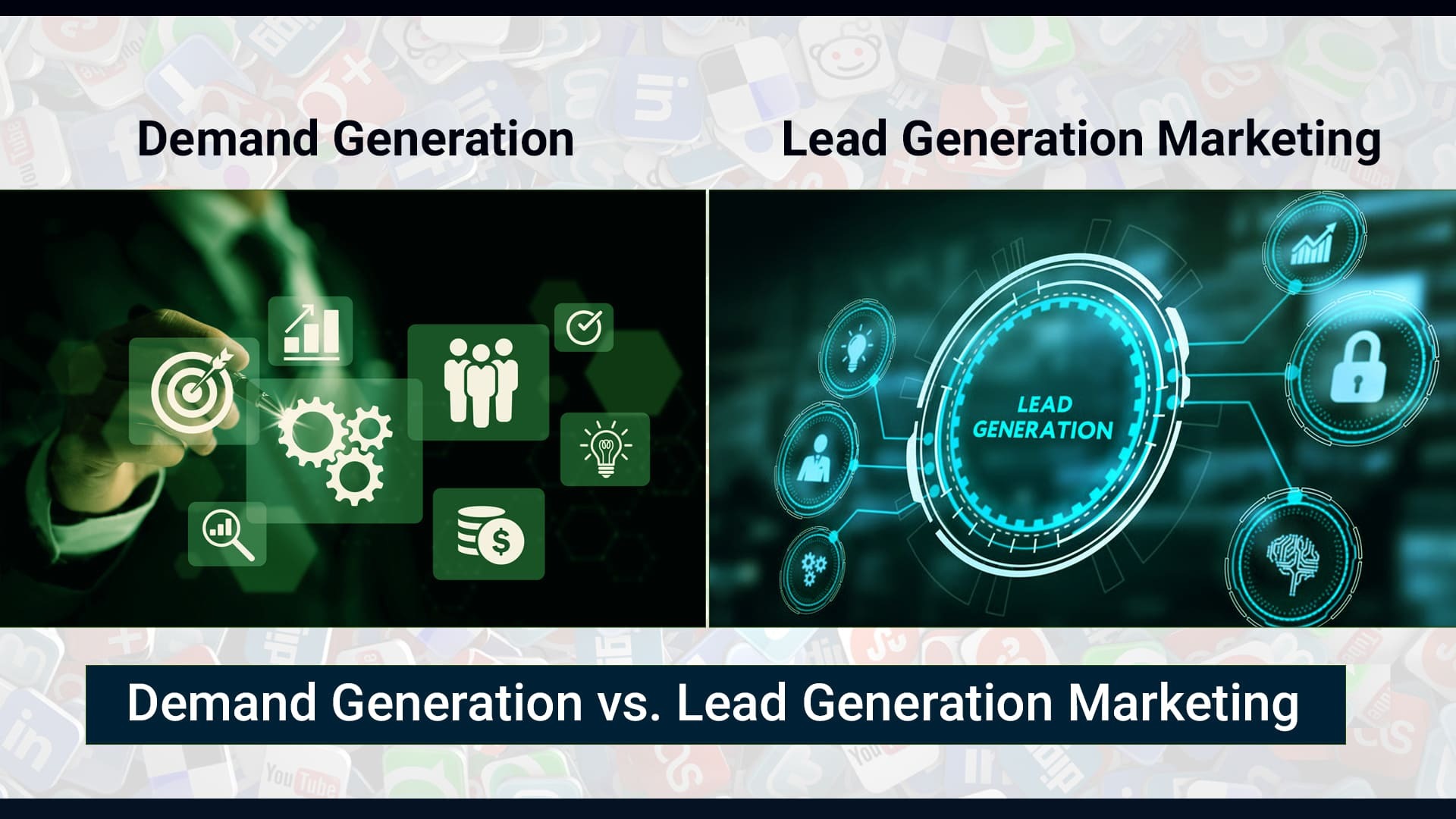
Demand generation and lead generation marketing are often confused by organizations.
- Demand generation increases market interest and awareness.
- That desire is transformed into viable prospects through lead generation.
These days, growth marketing teams combine the two tactics into a single customer acquisition plan. For the expansion of the sales funnel, this alignment guarantees smooth collaboration between the marketing and sales teams.
Sales enablement technologies give teams the data, insights, and material they need to complete deals more quickly.
Performance-Based and ROI-Focused Marketing
Accountability is unavoidable in 2026. Companies look to their lead generation agency partnerships or lead generation services to produce quantifiable results.
A contemporary lead generating agency in India or around the world needs to offer:
- Unambiguous ROI monitoring
- Models of lead generation based on performance
- Clear performance indicators
- Insights into sales forecasting
Businesses are favoring performance-linked contracts more and more, in which agencies receive compensation for qualified conversions rather than just leads.
This change guarantees that the impact on revenue and marketing investment are aligned.
Extreme Personalization: The Competitive Edge
AI-powered hyper-personalization has revolutionized consumer interaction.
Businesses today use behavioral data, CRM integration, and predictive analytics to:
- Adapt landing pages dynamically
- Send customized email sequences
- Suggest customized offers
- Automate chatbot dialogues
Natural language processing guarantees contextual communication, whereas generative AI allows for the large-scale production of dynamic material.
Higher conversion rate optimization and increased customer satisfaction are the outcomes of this.
New Developments Affecting Lead Generation in 2026
The future is being shaped by several cutting-edge technologies:
- Multimodal AI that integrates text, audio, and video communication
- Experiences using augmented reality products
- Theoretical developments in ASI and AJI impacting AI-driven decision systems
- Modern automation that minimizes human involvement
Scalable lead generation has reached new levels of efficiency as advanced technologies and automation accelerate digital transformation initiatives.
Conclusion: Developing a Lead Generation Strategy That Is Future-Ready
The companies that succeed in 2026 are creating interconnected ecosystems rather than pursuing strategies. In a structured lead generation funnel, effective lead generation strategies integrate conversion optimization, AI-driven analytics, outbound precision targeting, and inbound lead generation.
In conclusion, to succeed, one needs:
- Data-driven lead generation
- CRM integration and marketing automation
- Lead prediction scoring
- Tools for enabling sales
- Multi channel lead generation
- ROI-oriented advertising
Businesses that use AI for automation, performance accountability, and business will continuously produce high-quality leads and optimize sales over the long term.
Lead generation is a strategic growth engine in 2026, not just a marketing activity. Companies will rule their industry if they regard it as such.
- Amit Jadhav
www.amitjadhav.com