
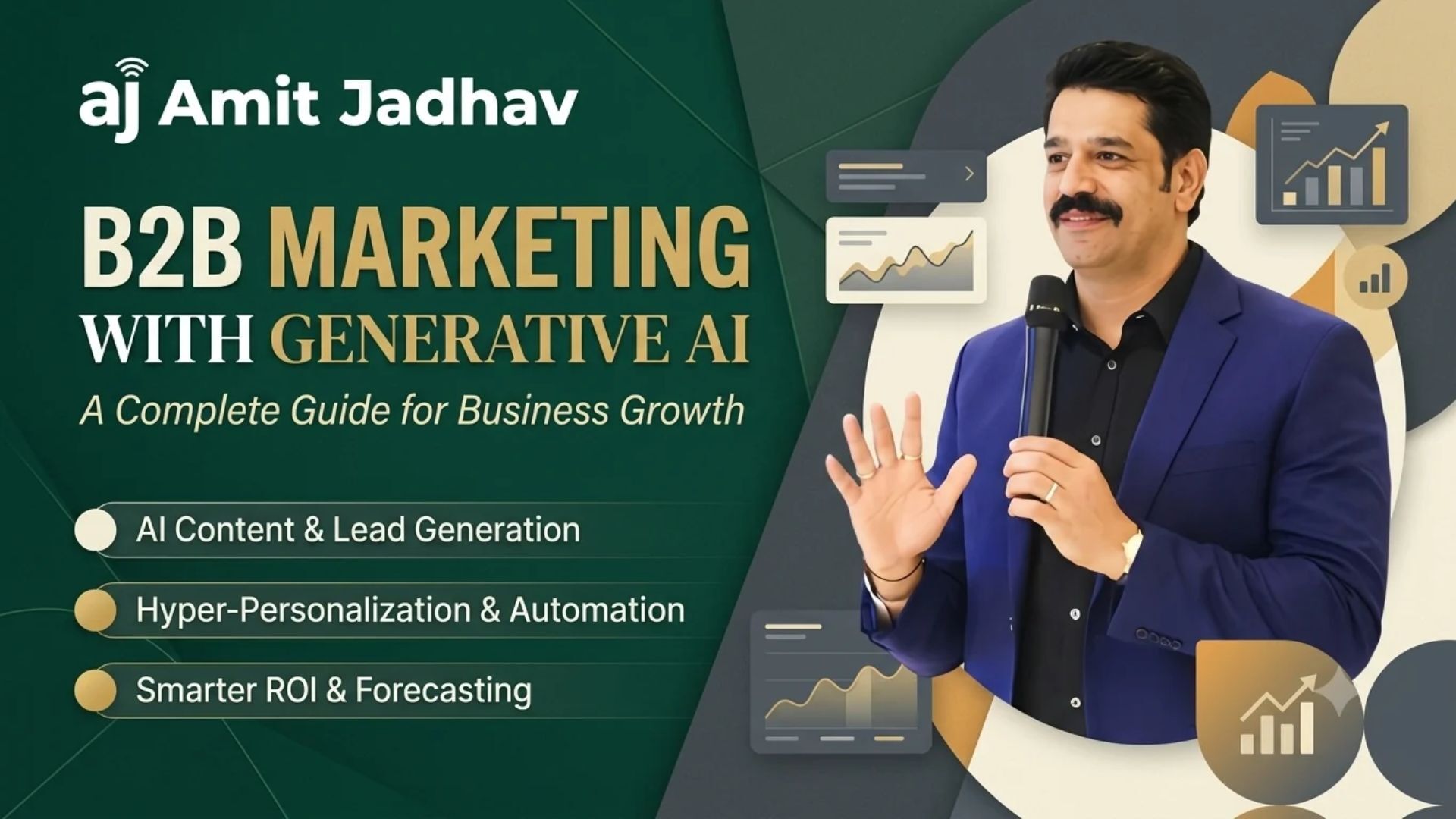
B2B Marketing with Generative AI: A Complete Guide for Business Growth
Introduction to B2B Marketing With Generative AI
What if your marketing team could run personalized campaigns, discover potential customers, track market trends, and boost lead conversions without wasting time on repetitive work? B2B marketing with generative AI is helping businesses achieve this by changing how they reach prospects, connect with decision-makers, and build meaningful customer relationships.
Business-to-business (B2B) marketing focuses on connecting with other businesses, understanding their requirements, and earning their trust before they make buying decisions. Generative AI helps companies simplify marketing tasks, develop engaging content, analyze customer behavior, and make smarter decisions. From generating leads to supporting sales teams, AI is becoming a valuable tool for business growth.
What Is Generative AI in B2B Marketing?
Generative AI is a form of artificial intelligence that can produce content such as text, images, emails, ideas, and marketing material using prompts and existing data. In B2B marketing, it helps businesses better understand their audiences, tailor communication, and improve marketing processes.
Instead of spending hours on manual research, content development, and campaign planning, marketing teams can use AI to simplify routine tasks and concentrate on strategic activities.
For instance, a software company targeting manufacturers can use AI to draft targeted emails, write blogs addressing industry challenges, develop product messaging, and create content for different buyer personas.
AI in B2B marketing is not intended to replace marketers. It helps them improve productivity, work efficiently, and make more informed decisions.
How to Use Generative AI in B2B Marketing
AI can be used across different stages of the marketing process. When incorporated into existing workflows, it can help businesses improve several marketing activities.
1. AI Content Generation for B2B Companies
Producing fresh content regularly is a common challenge for B2B marketing teams. Creating blogs, newsletters, case studies, landing pages, social media posts, and email campaigns takes considerable time and effort.
Generative AI can assist with writing drafts, developing headline ideas, simplifying complex information, and converting existing content into different formats. For example, a blog can be repurposed into LinkedIn posts, email newsletters, promotional content, or FAQs.
However, marketers should always review and edit AI-generated content to maintain accuracy, originality, and brand voice.
2. B2B Lead Generation Using AI
Identifying the right prospects matters more than simply collecting a large number of leads. AI can examine customer data, recognize patterns in previous conversions, and help marketers identify businesses that are more likely to become customers.
Predictive lead scoring helps sales teams prioritize prospects based on their interests, engagement, behavior, and other relevant data. AI-based chatbots can also respond to queries, gather contact information, and direct website visitors toward suitable products or services.
These capabilities make b2b lead generation using AI more focused and effective.
3. Personalized Marketing Campaigns
B2B customers are more likely to respond to relevant communication than generic marketing messages. AI can help personalize emails, advertisements, landing pages, and product recommendations according to customer preferences, industry, and previous interactions.
Hyper-personalization helps businesses deliver targeted messages throughout the buyer journey. Natural language processing (NLP) enables AI to understand customer queries and feedback, while data analysis helps marketers identify which messaging strategies deliver better results.
This can strengthen customer engagement, improve CTR (click-through rate), and boost overall campaign performance.
Benefits of Generative AI for B2B Marketing
There are huge benefits of generative AI for B2B companies and hence, B2B companies are investing in Generative AI marketing. For more information, check out our blog post, “Why B2B Companies Are Investing in Generative AI Marketing?”
Generative AI is transforming how businesses develop, manage, and evaluate marketing campaigns. Some of its major advantages include:
1. Increased Marketing Productivity
AI can simplify routine activities such as drafting emails, creating campaign variations, summarizing research, and organizing marketing data. This enables marketing teams to focus more on strategy, creativity, and building customer relationships.
2. Improved Marketing ROI
AI can track performance metrics such as CTR, engagement, conversion rates, and campaign expenses. This helps marketers evaluate campaign performance and identify areas that need improvement.
By improving targeting and automating workflows, businesses can minimize unnecessary expenses, manage marketing budgets more effectively, and improve marketing ROI through automation.
3. Enhanced Customer Engagement
AI-powered chatbots and virtual assistants can respond to customer questions, provide useful information, and guide prospects through their buying journey. They can also help businesses engage with customers beyond regular working hours.
4. Smarter Data-Driven Decisions
Predictive analytics can help businesses understand customer trends, anticipate campaign outcomes, and improve sales forecasting. By using data instead of relying solely on assumptions, marketing teams can make better-informed decisions.
Generative AI Marketing Strategies for Business Growth
For AI to deliver meaningful marketing results, businesses must use it with a well-defined plan. Using AI tools without aligning them with business objectives may not produce the desired outcomes.
Here are some effective generative ai marketing strategies businesses can follow.
- Know your audience: Use AI to study customer feedback, industry trends, purchasing patterns, and business needs to plan targeted campaigns.
- Plan your content: AI can help generate topic ideas, prepare content outlines, brainstorm campaigns, and adapt content for different platforms.
- Automate campaigns: Use automation tools to schedule emails, nurture leads, personalize communication, and simplify routine marketing tasks.
- Support sales teams: AI can assist with prospect research, follow-up messages, meeting summaries, and customized sales presentations.
- Measure results: Regularly review performance metrics to evaluate campaigns, discover improvement areas, and adjust marketing efforts.
A well-planned approach to b2b marketing with generative AI can help businesses align their marketing efforts with measurable business outcomes.
How to Automate B2B Marketing with AI
Marketing automation reduces the time spent on routine tasks, while AI adds capabilities such as content creation, predictive insights, personalization, and intelligent decision-making.
Businesses can automate several marketing activities using AI, including:
- Email marketing and lead nurturing.
- Social media planning and content creation.
- Lead qualification and predictive scoring.
- Website chatbot responses.
- Marketing reports and data analysis.
- Sales follow-ups and customer communication.
For example, if a potential customer downloads a product brochure, an AI-enabled workflow can automatically send a follow-up email, provide related resources, and alert the sales team when the prospect engages further.
Using b2b marketing automation with AI can simplify lead management, save time, and deliver a more seamless customer experience.
AI Tools for B2B Marketing
Businesses can explore various AI tools to simplify and improve their marketing activities.
| AI Tool | Marketing Application |
|---|---|
| ChatGPT | Content writing, research, campaign brainstorming, email drafting |
| HubSpot | CRM, lead tracking, marketing automation |
| Canva AI | Visual content, marketing designs, presentations |
| Jasper | Marketing content, copywriting, brand messaging |
| Google Analytics | Website insights, visitor behavior, conversion tracking |
The tools businesses choose should match their goals, budget, team size, current systems, and marketing requirements. Selecting tools that solve specific problems is more useful than adopting multiple platforms without a clear purpose.
B2B Marketing Trends 2026 with AI
With digital transformation accelerating across industries, AI is becoming increasingly integrated into business marketing and sales operations.
Some important trends to watch include:
- AI-driven marketing: Using customer data to personalize campaigns, understand audiences, and discover new opportunities.
- Multimodal AI: Combining text, images, audio, and video to create more interactive marketing experiences.
- AI-driven sales optimization: Using predictive analytics to improve lead prioritization, sales forecasting, and conversion rates.
- Marketing automation: Automating campaign management, customer interactions, and routine marketing workflows.
- Augmented reality: Offering interactive product demonstrations, equipment visualization, and immersive experiences for potential customers.
These trends are expected to further strengthen AI's role in B2B marketing.
How Businesses Can Get Started with Generative AI
Businesses can adopt AI gradually instead of changing their entire marketing process at once. Starting with a few tasks where AI can make a measurable difference is a practical approach.
Identify repetitive activities, choose suitable AI tools, set clear goals, and test them on smaller campaigns. Evaluate the results by tracking lead quality, engagement, conversions, productivity, and ROI.
Content creation, automated lead follow-ups, and campaign analysis are useful starting points. Once teams become comfortable using AI, they can expand its application to other marketing activities.
Businesses planning to adopt b2b marketing with generative AI can also seek AI training, consulting, or implementation guidance to build an effective AI-driven marketing strategy.
Conclusion
Generative AI is reshaping B2B marketing by helping businesses improve lead generation, customer engagement, content creation, and sales optimization. It offers opportunities to simplify marketing workflows, analyze customer data, automate campaigns, and improve lead quality.
However, achieving meaningful results requires a combination of the right tools, strategic planning, human expertise, and regular performance evaluation. Businesses that balance AI capabilities with creativity, customer insights, and marketing knowledge can improve efficiency and create stronger growth opportunities.
At amitjadhav.com, professionals and businesses can explore AI learning opportunities to discover practical ways to apply AI across marketing, sales, and business operations.
- Amit Jadhav
www.amitjadhav.com